Published on: 2026-03-31
Updated on: 2026-03-31
The S&P 500 can rally toward a clean round number, stall, and reverse with no obvious news trigger. No earnings shock. No Fed surprise. No sudden macro miss.
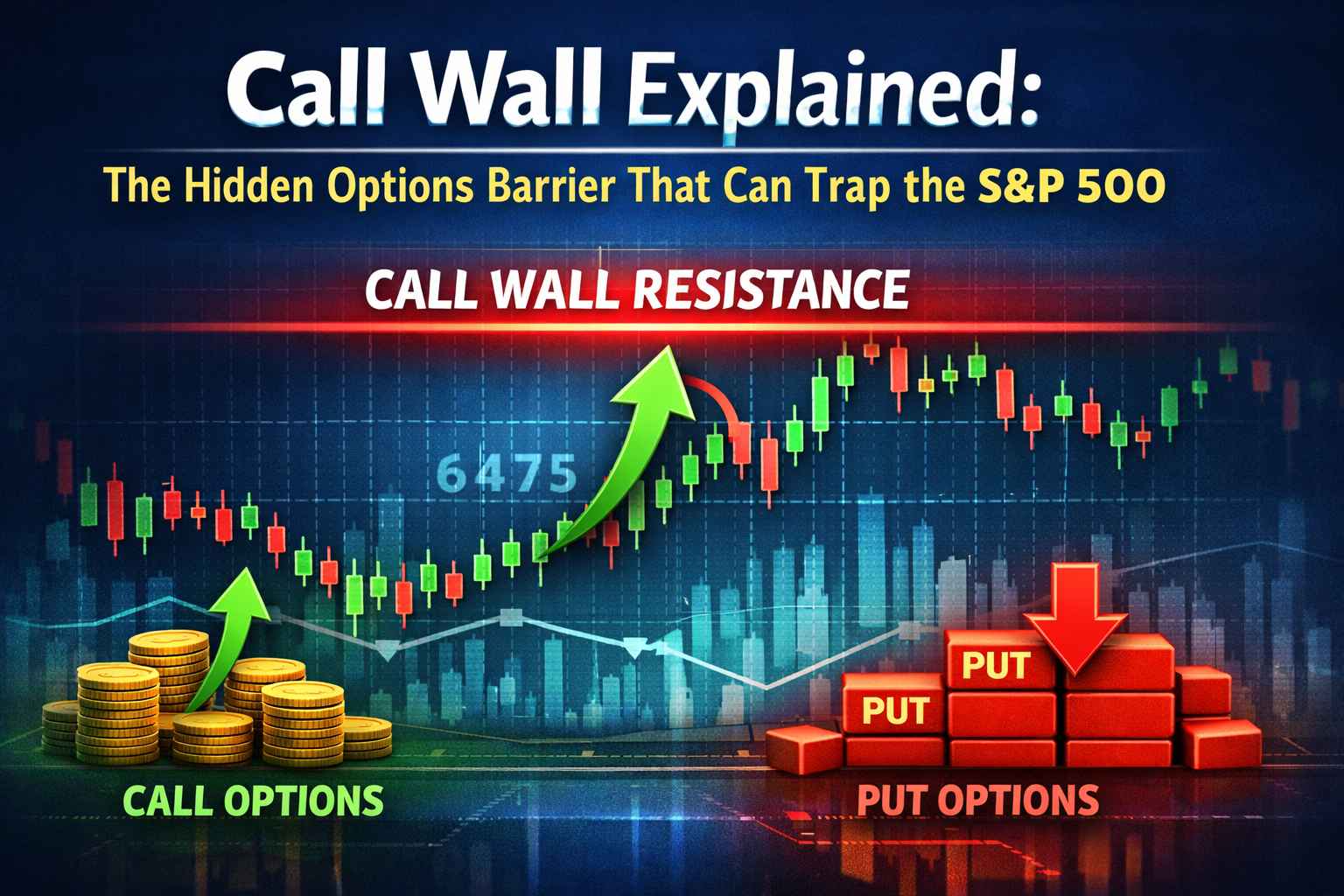
Often, the answer is not on the headline tape at all. It sits in the options market, where concentrated positioning can create an invisible ceiling known as a call wall.
The term is trader slang rather than an official exchange label, but it has become a widely used way to describe how options flows can shape price action near key strikes.
For anyone trading U.S. indexes, understanding the call wall matters, as SPX sits at the centre of the most liquid equity index options market. That makes options positioning a real part of market structure, even if it is only one piece of the puzzle.
A call wall is a strike where call open interest or call gamma is unusually concentrated. Open interest refers to the number of outstanding contracts that remain open, not to contracts traded during the day.
When that concentration becomes large enough, traders start watching the strike as a potential ceiling. The idea is simple: if the market rises toward a heavily populated call strike, dealer hedging can start to matter more.
That is why a call wall is often described as an options wall. It is not a traditional chart resistance based only on past prices. It is a derivatives-driven level shaped by current positioning.
Analyst describes the call wall as the strike with the largest net call gamma and uses it as a resistance reference when the spot is below it.
The basic setup starts when investors buy call options and market makers take the other side. Dealers then hedge that exposure dynamically as prices move.
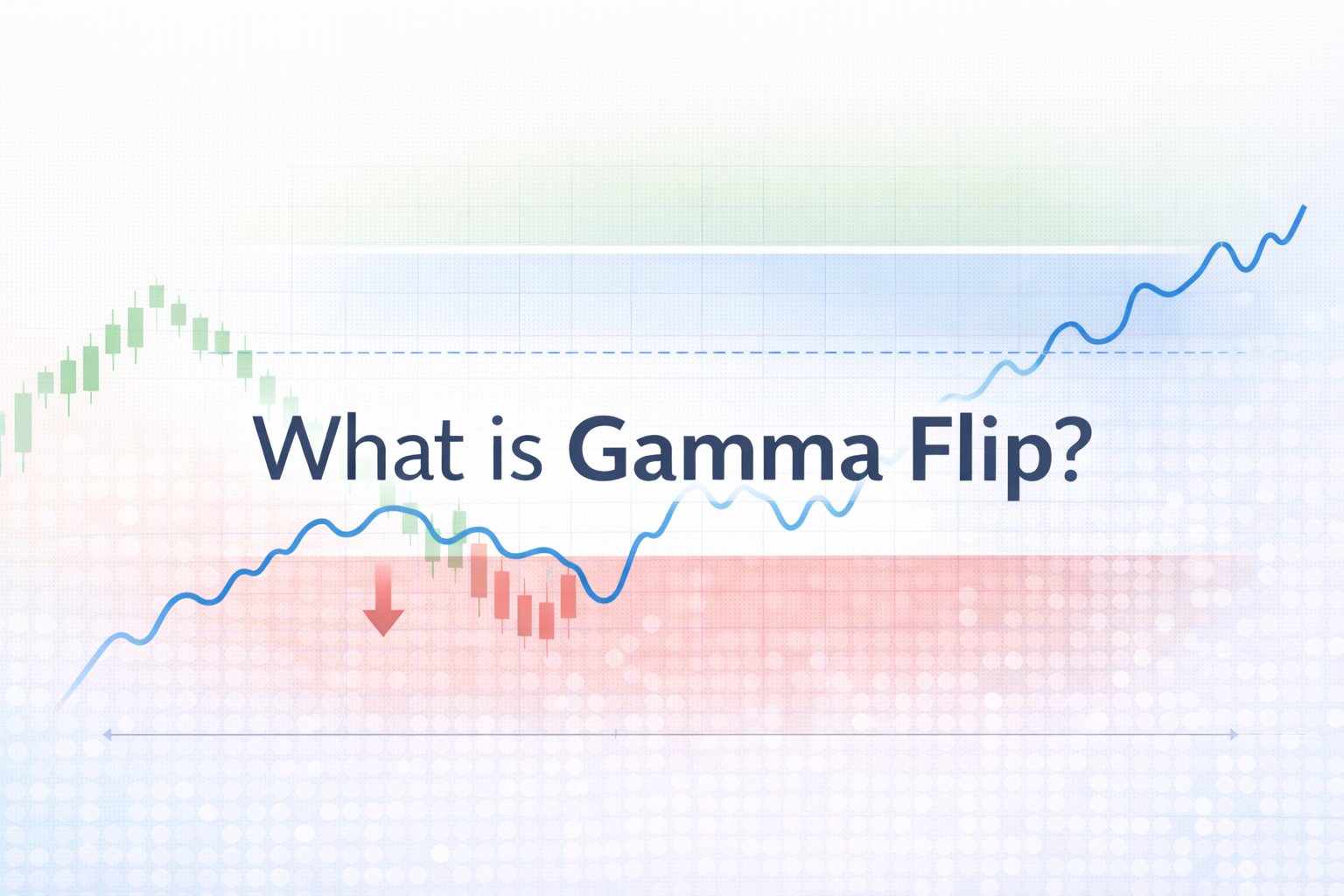
The important point is that the market effect is not always the same. It depends on the dealer’s broader gamma exposure, not just on one trade. In a positive-gamma environment, hedging can dampen moves by encouraging dealers to sell strength and buy weakness.
In a negative-gamma environment, hedging can amplify moves by encouraging buying into rallies and selling into declines.
That distinction matters because many simplified explainers treat dealer behavior as automatic. Real markets are more conditional than that.
So why does a call wall still matter? Because near a heavily watched strike, especially one close to spot and close to expiry, hedging flows can still create a visible resistance effect. The result is often a market that slows down, chops sideways, or repeatedly fails near the same level.
A put wall is the mirror image of a call wall. It is a strike with concentrated put positioning that can behave like support when hedging flows lean the other way.
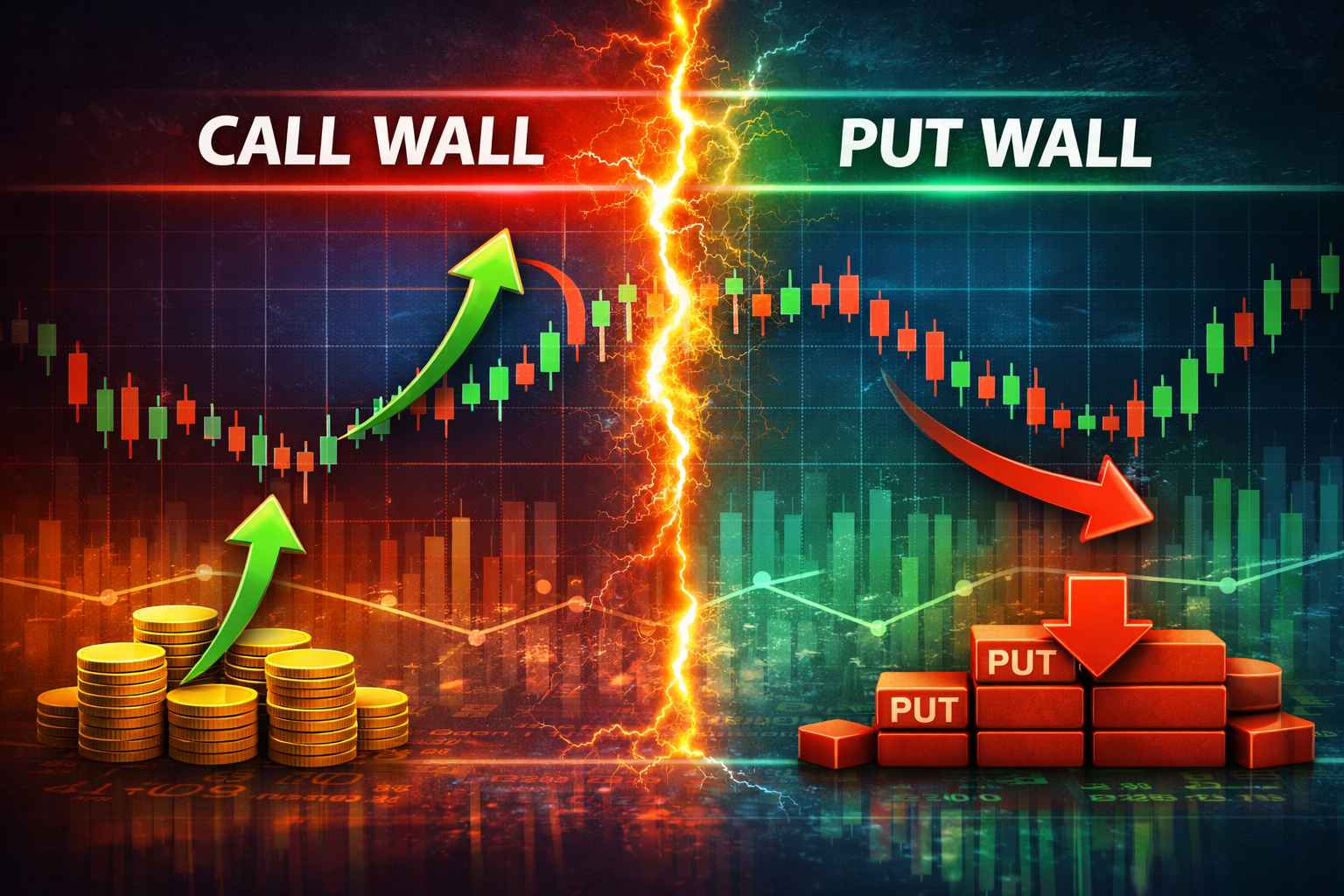
Together, the two can create a range.
| Level | What It Is | Typical Dealer Behaviour* | Market Effect |
|---|---|---|---|
| Call Wall | Heavy call positioning above price | In positive gamma, dealers often sell into rallies near the strike | Can act as resistance |
| Put Wall | Heavy put positioning below price | In positive gamma, dealers often buy into dips near the strike | Can act as support |
*Dealer behaviour depends on the broader gamma regime and is not fixed in every session.
When price trades between a well-defined call wall and put wall, traders often describe the market as being “pinned” inside an options-defined corridor.
The pin effect refers to the tendency of the price to gravitate toward a heavily populated strike as expiration approaches. This happens because near-the-money options become more sensitive to small price moves late in their life, which can intensify hedging flows around key strikes.
That said, pinning is a tendency, not a rule. It is more common when positioning is concentrated, volumes are balanced, and there is no major catalyst forcing the price away from the strike.
It is also important to be precise about expiration language. Triple witching is a quarterly event, not a monthly one.
The SEC describes it as the third Friday of March, June, September, and December, when index options, index futures, and options on index futures expire concurrently.
You cannot identify a call wall from a price chart alone. You need options data. The most common tools are:
Open interest by strike: Look for unusually large concentrations versus nearby strikes.
Gamma exposure charts: Many data platforms map dealer gamma concentration by strike.
Distance from spot: A strike just above the current price matters far more than one sitting well out of reach.
Time to expiry: The nearer the expiration, the more sensitive those strikes can become.
In practice, traders usually care less about a single absolute number than about the cluster of strikes shaping the current trading range.
A call wall is not an unbreakable barrier.
If the price clears it with enough force, the resistance effect can weaken quickly. Analyst noted that once the price rises above the call wall, the level can shift from resistance to more of an anchor or magnet. In other words, the level does not disappear; its behaviour can change.
This is why traders watch breakouts carefully. A failed breakout can lead to another rejection. A clean break with follow-through can change the whole structure of the session.
The best way to think about a call wall is not as a prediction engine, but as a risk map. It tells you where options positioning may matter most.
Call wall analysis has become more popular because SPX options trading is now so deep and so visible. Cboe describes SPX as the cornerstone of the most liquid equity index options market, and 0DTE options have become a major share of SPX volume.
But this is also where many articles go too far. A large 0DTE volume does not automatically mean a massive market impact every day. Cboe’s own research says net market-maker gamma hedging from SPX 0DTE flow is often de minimis relative to daily SPX liquidity.
That means options matter, but their effect varies by session, by positioning, and by the broader flow backdrop.
That is the mature way to use the concept. A call wall is not magic. It is one of the clearest ways to translate options positioning into a practical trading framework.
For traders looking to access global indexes with a regulated broker, EBC Financial Group operates under recognised regulatory frameworks including the FCA, ASIC, and CIMA. Trading leveraged products still carries risk, and losses can exceed deposits depending on the product and jurisdiction.
No. It is better described as potential resistance. Price can stall below it, break through it, or even trade back toward it after clearing the level.
No. Max pain is a separate options concept based on where the options would expire worthless, yielding the greatest value. A call wall is about concentrated call positioning and hedging sensitivity.
No. It can matter in single stocks, too, especially heavily optioned names. But SPX gets the most attention because its options market is exceptionally liquid.
Yes. It can move as positions are opened, closed, rolled, or expire. That is why traders monitor it as a live level rather than a permanent line.
A call wall is one of the most useful concepts in modern options-driven market structure because it helps explain why the S&P 500 can stall near certain strikes even when the news flow looks supportive.
The key is to use it correctly. A call wall is a probability-weighted resistance zone, not a guaranteed ceiling. Dealer hedging can shape price action, but its effect depends on the broader gamma regime, the distance from spot, and the timing of expiration.
Used that way, the call wall is not jargon. It is a practical way to read the hidden structure sitting behind the tape.
Disclaimer: This material is for general information purposes only and is not intended as (and should not be considered to be) financial, investment or other advice on which reliance should be placed. No opinion given in the material constitutes a recommendation by EBC or the author that any particular investment, security, transaction or investment strategy is suitable for any specific person.