Published on: 2026-04-07
Updated on: 2026-04-07
In options trading, understanding how positions respond to price movements is crucial for effective risk management and strategic decision-making. One advanced yet important concept in this area is the gamma flip, which marks the point at which an option’s sensitivity to its underlying asset changes significantly.
A gamma flip occurs when an option’s gamma changes sign, from positive to negative or vice versa.
Positive gamma benefits option holders by increasing delta in their favour, while negative gamma increases risk for option sellers.
Gamma flips often occur near specific strike prices or expiration dates and can amplify short-term market volatility.
Traders and market makers adjust hedges around gamma flips, which can influence underlying asset prices.
Understanding gamma flips helps investors anticipate price swings and manage options positions more effectively.
To fully comprehend a gamma flip, it is essential to understand gamma itself. Gamma (Γ) measures how much the delta of an option changes as the price of the underlying asset moves.
Delta (Δ) measures the change in an option’s price for every $1 move in the underlying asset. For example, a delta of 0.5 means the option price moves $0.50 for every $1 move in the stock.
Gamma measures the rate of change of delta, describing how quickly an option’s price sensitivity accelerates as the stock moves.
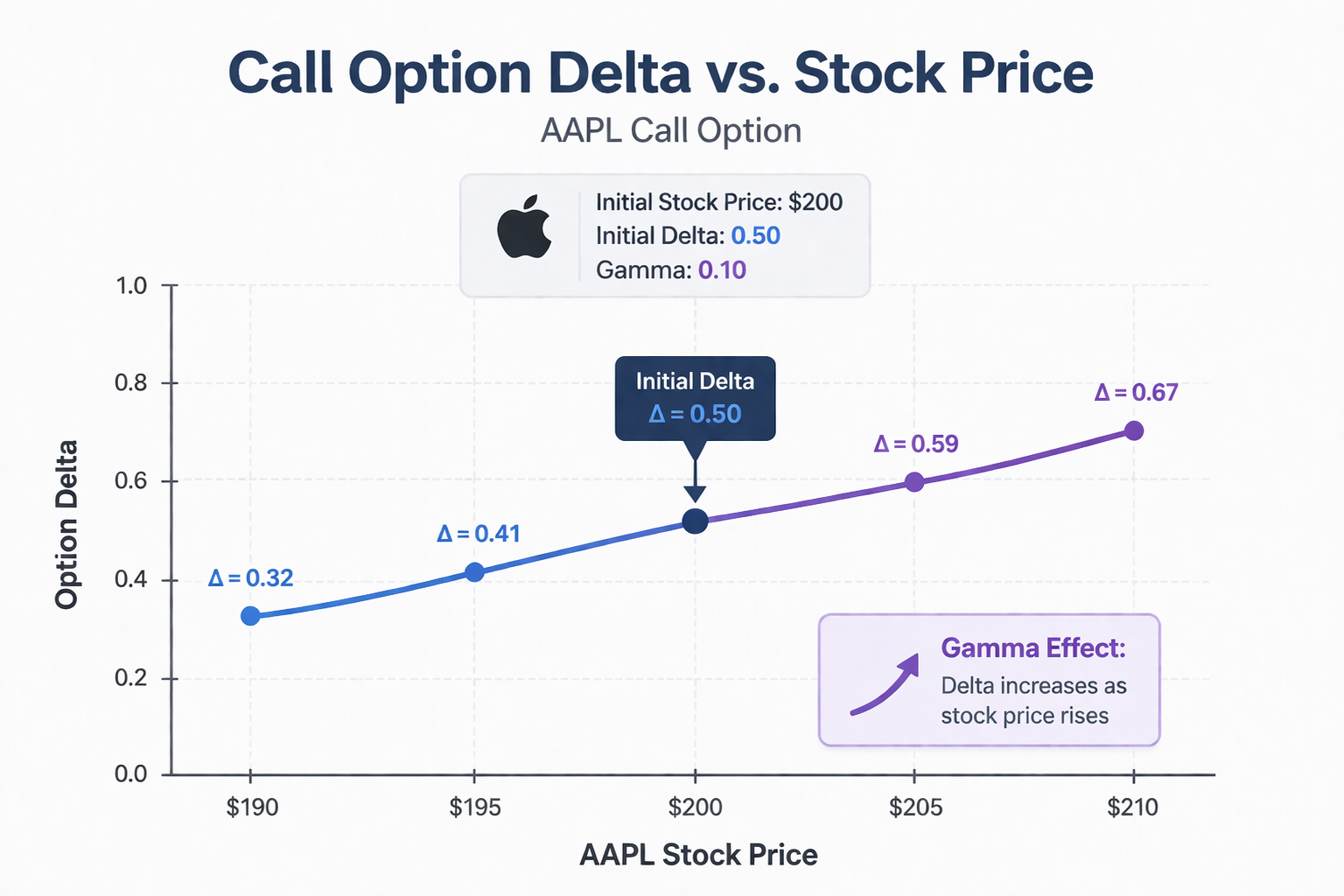
For example, consider a call option on Apple Inc. (AAPL) with a delta of 0.5 and a gamma of 0.1. If AAPL rises by $1, delta increases from 0.5 to 0.6. This change directly affects how sensitive the option becomes to subsequent stock price movements, underscoring the importance of gamma in dynamic market conditions.
A gamma flip occurs precisely at the point where gamma switches from positive to negative or vice versa. This sign change has significant implications for hedging strategies and short-term market behaviour.
A gamma flip is the critical point at which an option’s gamma changes sign. It often occurs near key strike prices or near option expiration.
Before the flip: A trader may have positive gamma, meaning movements in the underlying asset adjust delta in their favour.
After the flip: Gamma becomes negative, and delta now moves against the position, increasing risk and the need for hedging adjustments.
For example, in early 2026, options analytics for the Invesco QQQ Trust (QQQ) showed that dealer gamma exposure and zero‑gamma or “gamma flip” levels could act as structural thresholds influencing price behaviour.
When QQQ traded above these zero‑gamma thresholds, dealer hedging tended to stabilize moves (buying dips and selling rallies). Conversely, when the price traded below zero‑gamma levels, negative gamma exposure coincided with more amplified short‑term volatility in the underlying ETF
Gamma flips are not just theoretical; they have real consequences for market participants:
Hedging Activity: Market makers and institutional traders adjust positions around gamma flips to maintain delta neutrality. These adjustments can create buying or selling pressure in the underlying asset.
Volatility Spikes: Sudden adjustments at gamma flip points can amplify price movements, producing rapid, short-term swings that can affect both options and stocks.
Strategic Positioning: Investors can anticipate potential stress points, plan entries and exits, and avoid being caught off guard by unexpected price moves.
Understanding these dynamics helps traders and investors navigate complex options markets while mitigating unexpected losses.
Consider SPDR S&P 500 ETF (SPY) trading at $450 in April 2026:
A large number of call options are held at the $455 strike price.
As SPY approaches $455, the gamma of these options begins to flip from positive to negative.
Market makers hedge by buying SPY to maintain delta neutrality, thereby creating upward price pressure.
Once SPY surpasses $455, gamma becomes negative, and hedging activity may reverse, leading to rapid short-term price fluctuations.
This example illustrates how gamma flips directly influence underlying market dynamics and why investors closely monitor such points.
Risk Management: Adjusting positions to mitigate sudden exposure when gamma flips occur.
Volatility Trading: Anticipating price swings driven by hedging activity at critical strike prices.
Strategic Positioning: Buying or selling options near likely gamma flip points to capture potential market movements.
Gamma flips provide insight into potential price stress points, allowing traders to make informed decisions about hedging and position sizing.
Gamma flips generally occur near significant strike prices or close to options expiration. While exact timing cannot be known in advance, investors can monitor open interest, market depth, and options volume to anticipate likely flip points and prepare their trading or hedging strategies accordingly.
Market makers, option sellers, and traders with large positions near critical strikes are most directly affected. Retail investors may observe increased market volatility, but the primary impact is on those adjusting delta-heavy positions to maintain hedging neutrality during the flip.
Yes. Gamma flips can increase short-term market risk by amplifying price movements through hedging activity. Rapid adjustments by traders or institutions to remain delta-neutral can cause sudden swings in the underlying asset, temporarily affecting both options pricing and stock volatility.
No. Gamma flips apply to any asset with traded options, including ETFs, indices, commodities, and even cryptocurrencies. Any market with actively traded options can experience gamma flips, making this concept broadly relevant across various asset classes and trading environments.
Beginner investors should understand that gamma flips indicate potential short-term volatility. By monitoring strike prices, expiration dates, and options activity, they can plan entry and exit strategies, adjust risk exposure, and better manage positions in options or the underlying securities.
A gamma flip marks the point where an option’s gamma changes sign, fundamentally altering how delta responds to movements in the underlying asset. Positive gamma benefits option holders, while negative gamma increases risk for sellers. By monitoring key strike prices and expiration dates, investors can anticipate market fluctuations, manage risk, and make more informed options-trading decisions.
Disclaimer: This material is for general information purposes only and is not intended as (and should not be considered to be) financial, investment or other advice on which reliance should be placed. No opinion given in the material constitutes a recommendation by EBC or the author that any particular investment, security, transaction or investment strategy is suitable for any specific person.