Published on: 2026-03-31
Updated on: 2026-03-31
In 2012, a single trading strategy at JPMorgan Chase generated losses exceeding $6 billion despite being designed to reduce risk. The episode, later known as the London Whale, quickly became one of the most prominent examples of how complex strategies and weak oversight can spiral out of control.

At the centre of the incident was Bruno Iksil, a trader whose unusually large positions in credit derivatives earned him the nickname “the Whale.” While the scale of the losses was extraordinary, the underlying issues, poor position sizing, misunderstood risk, and liquidity constraints, are highly relevant to traders at all levels.
Excessive position sizing can destabilise even well-capitalised institutions.
Hedging strategies can turn into speculative bets if not properly managed.
Liquidity risk is often underestimated until it becomes critical.
Complex derivatives require a deep understanding before trading.
Risk controls are only effective if consistently enforced.
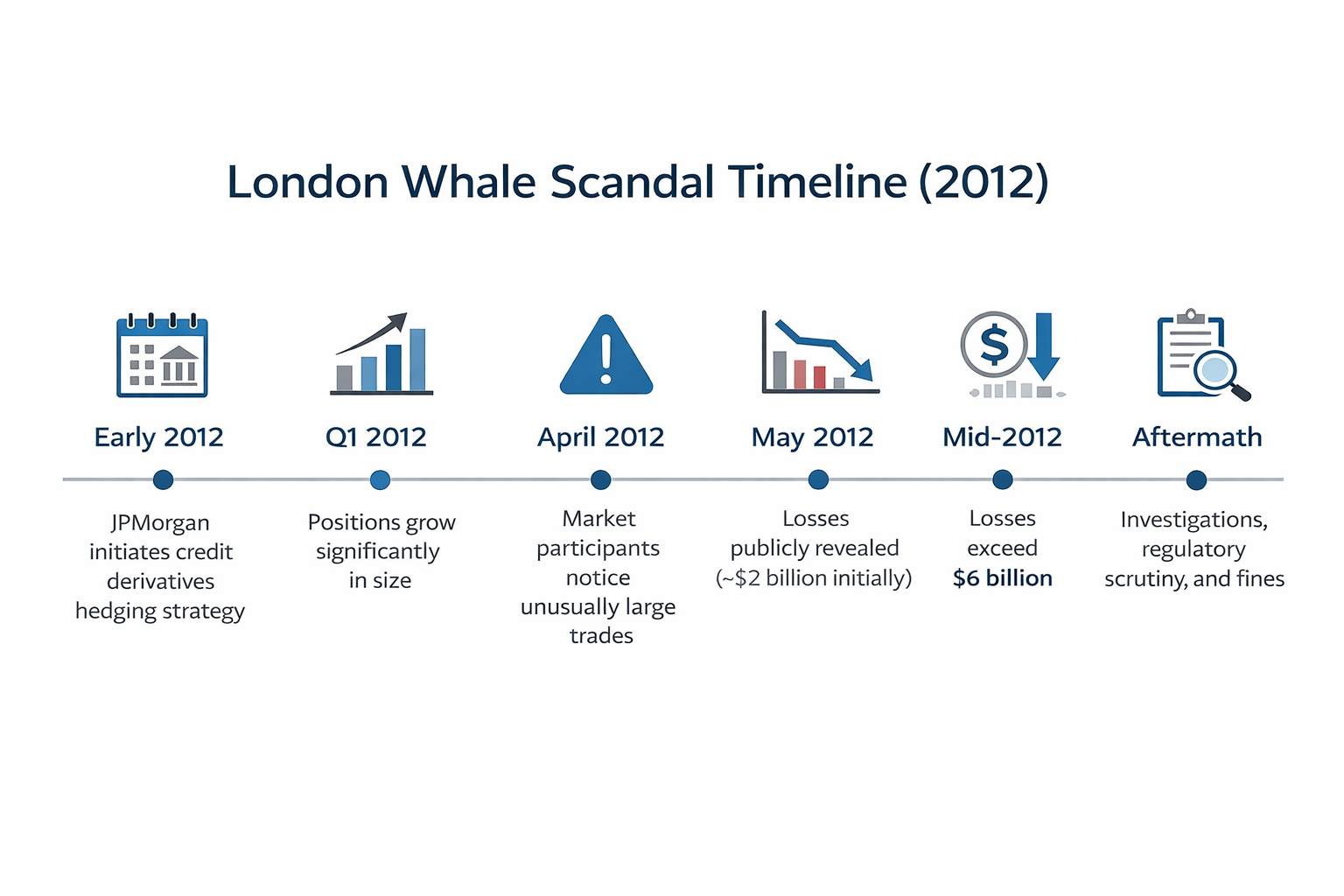
The term “London Whale” refers to Bruno Iksil, a trader working in JPMorgan’s London-based Chief Investment Office (CIO). He became known for placing exceptionally large trades in credit derivatives markets, particularly credit default swaps (CDS).
These positions were initially intended to hedge the bank’s overall credit exposure. However, the trades grew so large that they began to distort the market itself. By mid-2012, the strategy resulted in losses exceeding $6 billion, drawing global attention from regulators, investors, and the media.
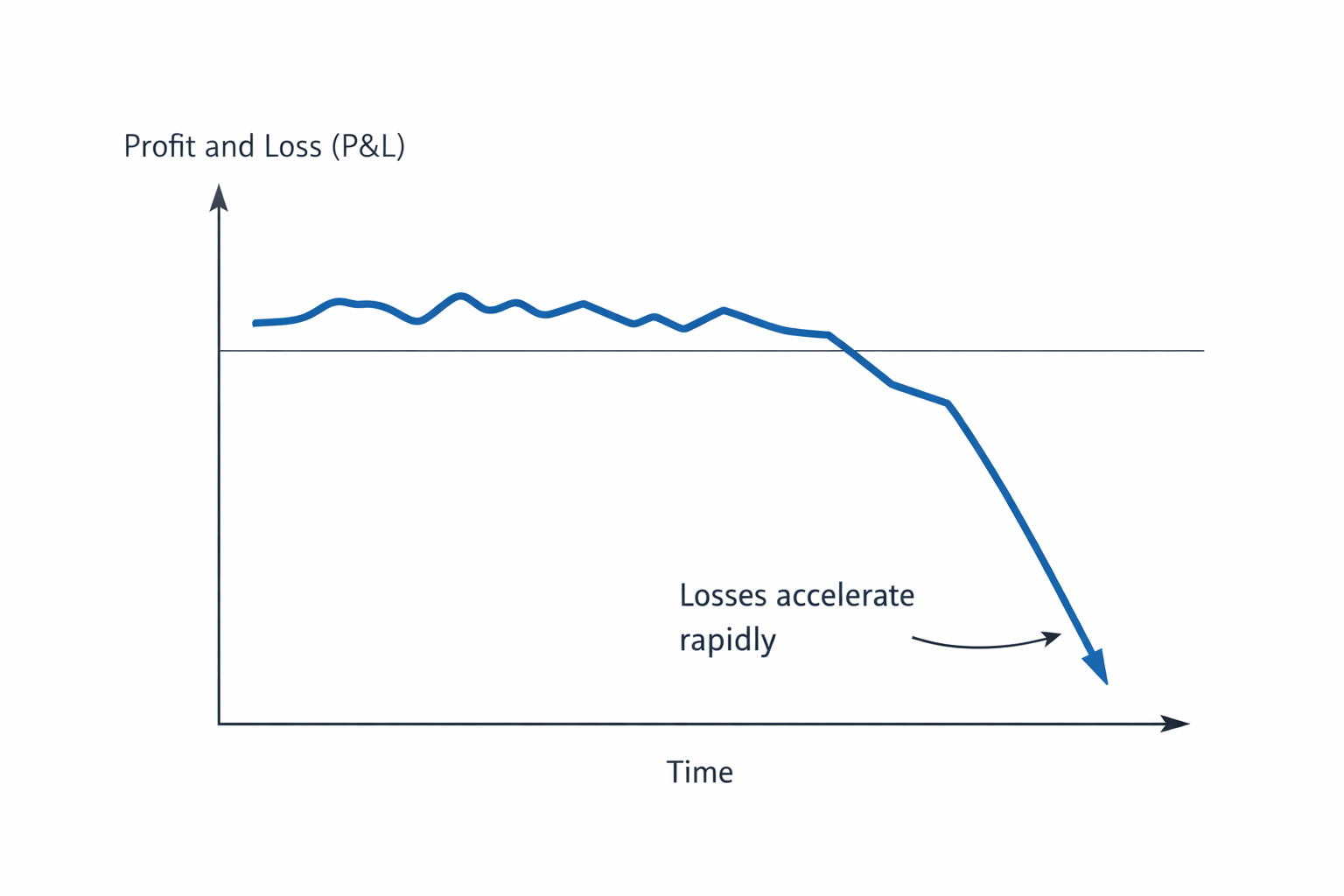
The London Whale losses did not result from a single mistake, but from a series of compounding failures. Understanding these breakdowns provides valuable insight into how trading risks can escalate.
What began as a hedging strategy gradually evolved into an outsized exposure. As positions increased, they became difficult to adjust without influencing market prices.
For traders, this highlights a critical principle: a position that is too large is no longer flexible. Even a fundamentally sound strategy can fail if it cannot be executed or exited efficiently.
The trades were concentrated in credit derivatives markets that appeared liquid under normal conditions. However, as positions grew, liquidity became insufficient to absorb them.
When the bank attempted to unwind its trades:
Bid-ask spreads widened
Counterparties became limited
Prices moved sharply against the position.
This illustrates how liquidity risk often emerges only when it is needed most.
Although the strategy was intended to hedge credit risk, its size and structure led it to behave more like a directional bet.
A well-constructed hedge should reduce overall exposure. In this case, however:
The hedge introduced new risks.
Portfolio correlations became unreliable.
Losses increased as market conditions shifted.
This serves as a reminder that not all hedges provide true protection, particularly in stressed markets.
Internal risk management systems failed to contain the growing exposure. Reports later indicated that:
Risk limits were adjusted rather than enforced.
Valuation methods lacked consistency.
Warning signals were not escalated in time.
Risk frameworks are only effective when applied consistently. Without discipline, even the most sophisticated systems can fail.
The London Whale case is not just about a large bank; it reflects mistakes that individual traders can also make on a smaller scale.
Even a strong strategy can fail if position sizes are too large. Traders should ensure that:
No single trade dominates their portfolio.
Losses remain manageable under adverse conditions.
Many traders assume that holding opposite positions automatically reduces risk. However:
Correlations can change
Instruments may not behave as expected.
Always evaluate whether your hedge truly offsets your exposure.
Markets may appear liquid under normal conditions, but this can change quickly:
Large trades can move prices.
Exiting positions may not be possible at expected levels.
This is especially relevant in derivatives and less liquid instruments.
Credit derivatives such as CDS are inherently complex. Without a clear understanding:
Pricing errors can occur.
Risks may be hidden or underestimated.
Retail traders should be cautious when trading leveraged or structured products.
Quantitative models are useful tools, but they rely on assumptions:
Historical data may not reflect future conditions.
Extreme events can invalidate models.
Traders should combine models with judgment and scenario analysis.
Although the incident occurred in 2012, its lessons remain highly relevant in today’s trading environment.
In 2026, traders will have greater access to:
Leveraged products such as CFDs and options
Global markets with varying liquidity conditions
Algorithmic tools and automated strategies
At the same time, market shocks, whether from interest rate changes, geopolitical tensions, or credit events, can still expose weaknesses in risk management.
The London Whale serves as a reminder that scale does not eliminate risk. Whether managing billions or a personal trading account, the principles remain the same.
Before entering any trade, consider the following:
Is my position size appropriate relative to my capital?
Can I exit this trade easily if market conditions change?
Do I fully understand the instrument I am trading?
Is this trade truly reducing risk, or adding to it?
What is my worst-case scenario?
The London Whale was the nickname given to Bruno Iksil, a trader at JPMorgan Chase. He became known for placing extremely large trades in credit derivatives, which ultimately led to significant losses for the bank.
JPMorgan reported losses exceeding $6 billion from the trades. The final figure included trading losses, legal costs, and regulatory fines related to the incident.
The trades primarily involved credit default swaps (CDS), which are financial derivatives used to hedge or speculate on credit risk. These instruments can be complex and sensitive to market conditions.
Losses escalated due to oversized positions, poor liquidity, ineffective hedging, and weaknesses in risk management. The inability to exit trades efficiently also contributed significantly to the scale of losses.
Yes, although on a smaller scale. Retail traders using leverage or trading complex instruments can face similar issues, including overexposure, liquidity constraints, and a misunderstanding of risk.
The London Whale was not merely a failure of strategy but a failure of control. What began as a risk-reducing initiative gradually evolved into a concentrated exposure that the market could not absorb. Whether trading institutional portfolios or personal accounts, the principle remains the same: effective risk management is not optional. It is the foundation of long-term market sustainability.
Disclaimer: This material is for general information purposes only and is not intended as (and should not be considered to be) financial, investment or other advice on which reliance should be placed. No opinion given in the material constitutes a recommendation by EBC or the author that any particular investment, security, transaction or investment strategy is suitable for any specific person.