Published on: 2025-04-29
Updated on: 2026-01-29
Options trading can seem complicated at first, but mastering strategies like the butterfly spread can help traders manage risk while targeting profits in stable markets. Butterfly spreads are designed to capitalise on stocks expected to have little volatility, making them ideal for traders looking for limited-risk, limited-reward scenarios.
It is a multi-leg options strategy typically used after you understand basic call and put options. It offers defined risk and defined reward, but it requires accurate strike selection and careful execution.
Therefore, understanding how butterfly spreads work and when to use and manage them is crucial for beginners to build a solid foundation in options trading.
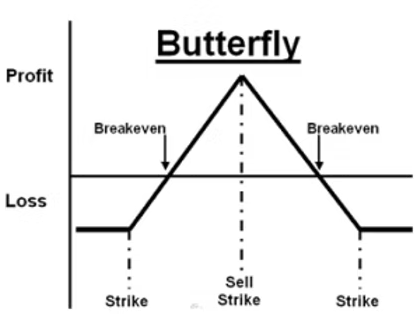
A butterfly spread is a neutral options strategy combining bull and bear spreads. It is created using three different strike prices, all within the same expiration date, and can be set up with either call or put options. It is designed to perform best when the underlying finishes near the middle strike at expiration, with losses limited to the net cost of the position.
It is constructed by simultaneously buying and selling multiple options contracts with different strike prices but the same expiration date.
The "wings" of the butterfly represent the outer strikes, while the "body" represents the middle strike. A classic butterfly spread involves three different strike prices, and it's often structured with either calls or puts, although call butterflies are more common among beginners.
This strategy limits both potential profit and potential loss, making it particularly attractive to beginners who prefer defined outcomes.
As mentioned, a basic butterfly spread with calls involves:
Buying one in-the-money call (lower strike price)
Selling two at-the-money calls (middle strike price)
Buying one out-of-the-money call (higher strike price)
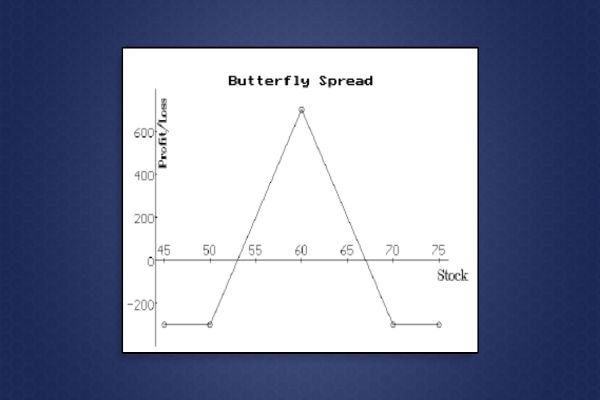
The distance between each strike price is usually the same, creating the symmetrical "butterfly" shape on a profit and loss chart.
It is the traditional butterfly setup where you buy the wings and sell the body. It is suitable when volatility is expected to be low and the stock price is expected to move minimally.
In the short butterfly, you sell the wings and buy two middle strikes. This strategy profits if there is a significant movement from the middle strike price. However, it carries a higher risk and is less popular among beginners.
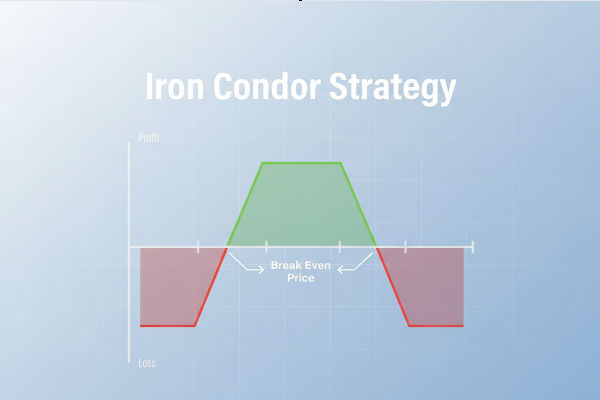
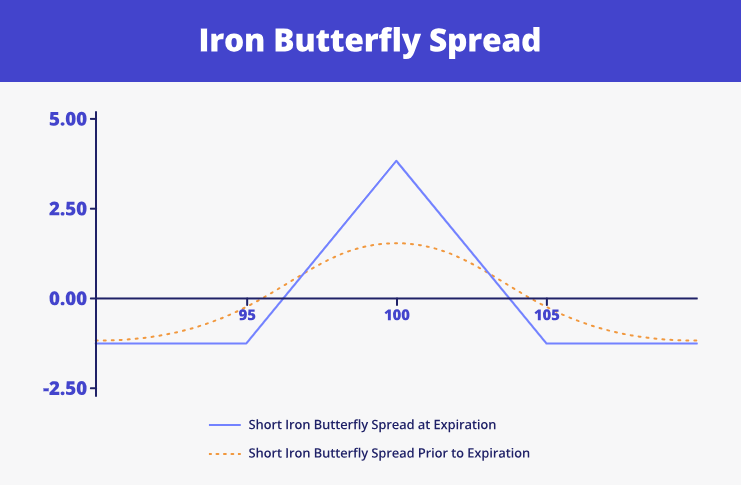
An iron butterfly uses both calls and puts. It involves selling an at-the-money call and put while buying an out-of-the-money call and put. The iron butterfly is also neutral but can be structured as a net credit strategy, which changes how profit and risk are expressed.
To set up a standard butterfly spread, you need to:
Buy one option at a lower strike price (higher premium)
Sell two options at a middle strike price (collect premiums)
Buy one option at a higher strike price (lower premium)
All options must have the same expiration date.
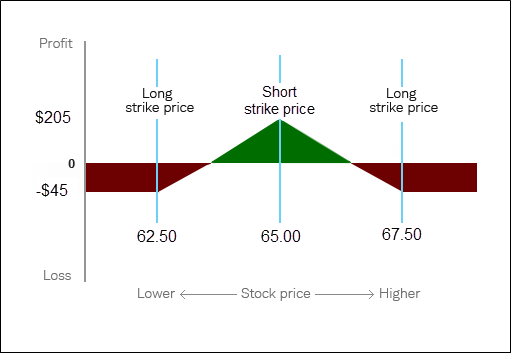
The cost to enter a standard long butterfly spread is called the net debit. This net debit is also the maximum possible loss (before fees). The maximum profit occurs if the underlying closes at the middle strike price at expiration.
For a standard long butterfly with equal strike widths, there are two breakeven prices at expiration:
Lower breakeven = lower strike + net debit
Upper breakeven = upper strike − net debit
Your actual break-even points can shift once commissions, fees, and asymmetric strike spacing are included.
Butterfly spreads work best when:
The trader expects minimal movement in the underlying asset.
Implied volatility will fall.
The trader seeks a defined risk-reward structure.
Some traders consider butterflies around scheduled events because implied volatility can drop after the event. However, event-driven gaps can push price outside the breakeven range, so position sizing and exit rules matter.
Butterfly spreads may also be considered when implied volatility is elevated and expected to decline, but pricing, spreads, and fees can materially change the breakevens.
Suppose stock XYZ is trading at $100, and you expect it to remain relatively stable over the next month.
You could set up a butterfly spread like this:
Buy 1 $95 call for $7
Sell 2 $100 calls for $4 each ($8 total)
Buy 1 $105 call for $2
The total cost (net debit) = $7 + $2 - $8 = $1
Thus, the maximum loss is $100 (since 1 contract controls 100 shares). The strike width is $5, and the net debit is $1, so the maximum gain is ($5 − $1) × 100 = $400 if the stock closes at $100 at expiration.
The breakevens (ignoring fees) are $96 ($95 + $1) and $104 ($105 − $1), so the position needs the stock to finish within that range to be profitable at expiration.
To maximise the potential of butterfly spreads, beginners should follow a few best practices:
Before committing real money, start with Paper Trading and practise setting up butterfly spreads on a virtual trading platform. This helps build familiarity with the strategy and order execution without risking capital.
Butterfly spreads work best when the underlying is not expected to move much. Look for stocks or ETFs with relatively low implied volatility, or underlyings that have been trading in tight ranges.
Butterfly spreads involve multiple legs, which can increase commissions, exchange fees, and total transaction costs. Compare the per-contract costs and the impact of fees on your breakevens before placing a multi-leg trade.
Liquidity is critical for entering and exiting butterfly spreads at favourable prices. Reduce slippage by using well-traded options with tight bid-ask spreads.
Butterfly spreads are particularly sensitive to gamma and theta. Understanding how delta, gamma, theta, and vega affect your position can help you make better decisions, especially as expiration approaches.
Choose narrower strike intervals (like $5 apart rather than $10) to limit risk. As you gain experience, you can experiment with wider spreads.
The butterfly spread has several advantages, especially for traders looking to define risk while expressing a view on where a stock might settle at expiration.
Defined Risk: The maximum risk is limited to the initial premium paid, making it an attractive strategy for beginners who want to control downside exposure.
Defined Reward: You know your maximum profit potential from the start.
Low Capital Requirement: Since risk and reward are capped, the margin and capital requirements are much lower than those of options positions.
Best for Low Volatility: Butterfly spreads may benefit when the underlying stays near the middle strike and implied volatility declines after you enter the trade.
Flexibility: The strategy can be adapted to different strike price widths, depending on the amount you want to risk or the amount you want to reward.
Despite its advantages, the butterfly spread is not foolproof. It has several risks and limitations that traders must be aware of.
Time Decay Sensitivity: The strategy benefits from time decay mainly when you are closer to expiration, and the price is near the middle strike. Earlier in the trade, a move away from the middle strike can reduce the spread value.
Assignment Risk: If your butterfly includes short options, early assignment can occur in some markets (especially around dividends). This can create an unwanted stock position before expiration and may require active management.
Volatility Risks: Unexpected volatility spikes can widen trading ranges and push the stock price out of the profitable zone.
Precise Target Required: The closer the final price is to the middle strike, the higher the profit. Significant moves away from this price lead to losses.
Complexity for Beginners: Although the risk is limited, correctly setting up the butterfly spread requires an understanding of options pricing and execution nuances.
In conclusion, the butterfly spread is an options strategy designed for defined risk and defined reward when you expect the price to stay near a target level at expiration. It requires careful planning, an understanding of volatility, and precise execution.
Beginners who take the time to master butterfly spreads can add a powerful tool to their trading arsenal. Practising in a simulated environment, starting with highly Liquid Assets, and maintaining disciplined risk management are all keys to success.
Disclaimer: This material is for general information purposes only and is not intended as (and should not be considered to be) financial, investment or other advice on which reliance should be placed. No opinion given in the material constitutes a recommendation by EBC or the author that any particular investment, security, transaction or investment strategy is suitable for any specific person.