Published on: 2026-03-16
Updated on: 2026-03-16
Ulta Beauty (NASDAQ: ULTA) reported a strong fourth quarter on March 12, 2026. Net sales increased by 11.8% to reach $3.9 billion, and comparable sales rose by 5.8%. Management expressed optimism about Space NK's performance; however, they also noted that it is still too early to assess the full value Ulta can derive from the acquisition.
However, ULTA stock fell sharply after fiscal 2026 guidance came in below investor expectations on key comparable sales and earnings lines. On March 13, 2026, ULTA closed at $535.72, a 14.24% decline in a single session, marking its worst day in nearly 2 years.

The key point is simple. This was not a demand-collapse story. It was a guidance and margin story. For investors asking whether this is a buying opportunity or a warning sign, the answer is more nuanced than the selloff suggests.
Ulta's business continues to grow and remains highly profitable. However, the recent selloff shows how much optimism was already priced into the stock before the earnings report.
Hard catalyst: For fiscal year 2026, guidance anticipates comparable sales growth of 2.5% to 3.5% and diluted EPS of $28.05 to $28.55, both of which fall short of analyst consensus.
Hard catalyst: Fourth-quarter net sales rose 11.8% to $3.9 billion, and comparable sales increased 5.8%, but diluted EPS of $8.01 was down from $8.46 a year earlier.
Hard catalyst: SG&A increased by 23.0% in the quarter, and the operating margin decreased to 12.2% from 14.8%, which led investors to focus on cost pressures.
Soft catalyst: Ulta warned about more selective consumer spending and rising geopolitical uncertainty, which made the cautious outlook feel more credible.
Soft catalyst: The stock entered earnings after a strong rally, making it vulnerable to a sharp decline if guidance fell short of expectations.
ULTA stock is down because the company's 2026 guidance was softer than investors had hoped after a strong run in the shares. The reported quarter was strong in sales and comparable growth, but the outlook indicated slower momentum in the areas that mattered most to the market.
Ulta's volatility is not random. It is the result of strong backward-looking numbers colliding with a more cautious forward-looking message. That is often the exact setup that produces a sharp "good quarter, bad stock reaction" move.
| Metric | Q4 FY2025 | Q4 FY2024 | What It Says |
|---|---|---|---|
| Net sales | $3.90B | $3.49B | Strong holiday demand and continued growth |
| Comparable sales | +5.8% | +1.5% | Better store and digital momentum |
| Gross margin | 38.1% | 38.2% | Slight pressure on merchandise mix and costs |
| SG&A as % of sales | 25.7% | 23.4% | Investments and advertising weighed on margins |
| Operating margin | 12.2% | 14.8% | Profitability narrowed |
| Diluted EPS | $8.01 | $8.46 | Earnings fell from a year earlier |
Ulta's quarter was not weak on the surface. The business continued to achieve strong sales growth, healthy comparable sales, and another year of solid revenue expansion. The problem was that profit flow-through was not as strong as investors hoped, and next year's outlook did not fully reward the quarter's momentum.
For the full year, Ulta reported $12.39 billion in net sales, up 9.7%, with comparable sales up 5.4% and diluted EPS of $25.64. During fiscal 2025, the company repurchased 2.0 million shares for a total of $890.5 million.
At the end of the year, it held $424.2 million in cash and cash equivalents, along with $70.0 million in short-term investments. Additionally, the company had $1.8 billion remaining in its buyback program by year-end.
One detail that the market may have underestimated is that Ulta's plan for 2026 still anticipates operating income growth of 6% to 9%, with the operating margin expected to remain flat or increase by up to 20 basis points. That does not erase the guidance miss, but it does show management is not guiding for a broken margin story.
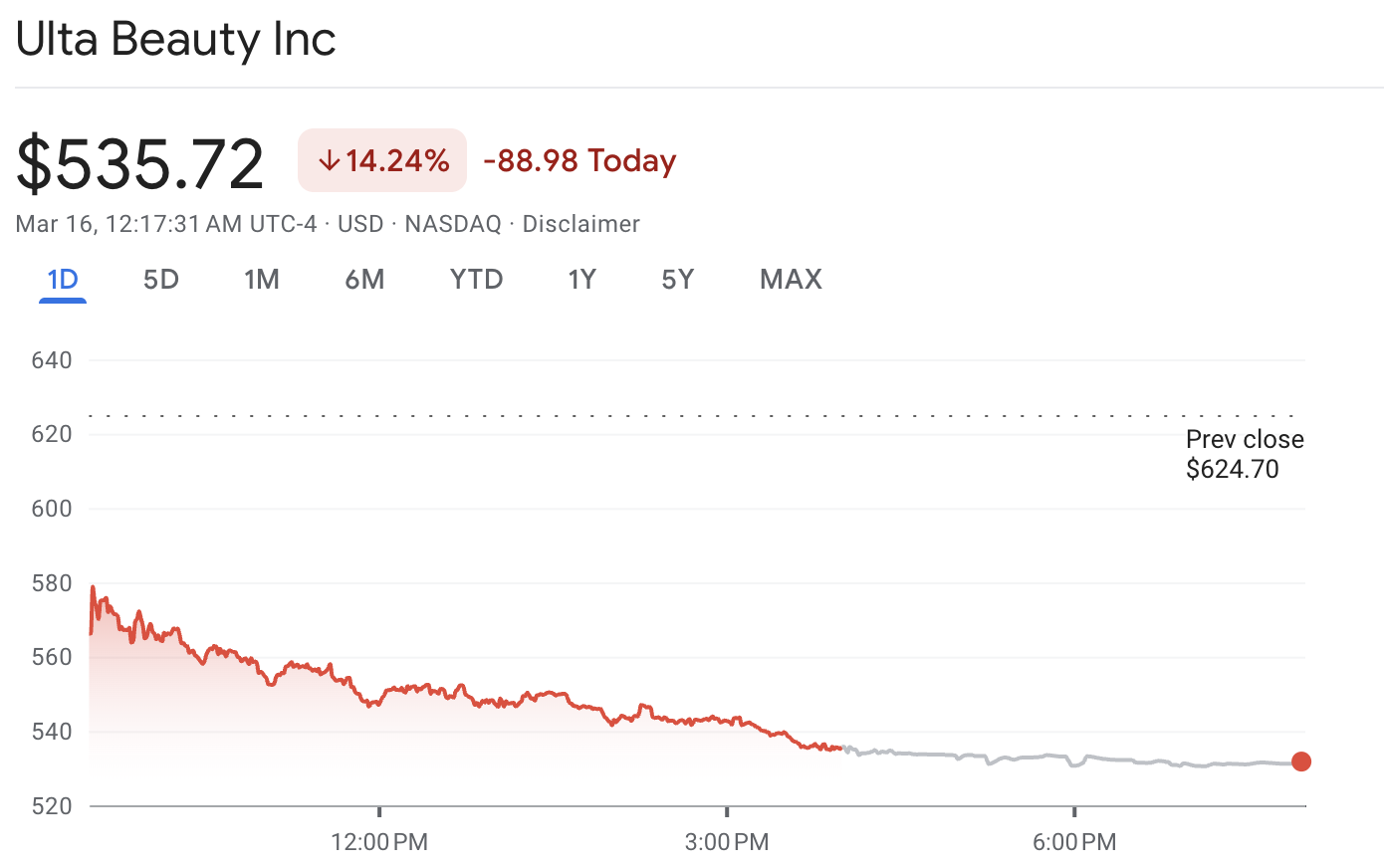
This is the main reason for the drop. Ulta's fiscal 2026 outlook called for 6% to 7% net sales growth, comparable sales growth of 2.5% to 3.5%, and diluted EPS of $28.05 to $28.55.
Despite evident growth, it fell short of market expectations after a significant stock rally pre-earnings. The miss versus consensus on comparable sales growth and EPS mattered more than the backward-looking strength in the quarter.
Ulta's fourth-quarter sales grew nicely, but the operating margin fell from 14.8% to 12.2%. Gross margin slipped by 10 basis points, and SG&A rose much faster than sales.
The company stated that the increase in corporate overhead was linked to strategic enterprise investments, higher advertising expenses, and greater incentive compensation.
This is important because investors can tolerate slower growth if profit margins remain stable, or accept lower margins if growth is rapidly increasing. However, Ulta didn't provide either of these straightforward outcomes this time. The business continues to grow, but concerns about its margin profile have emerged.
Ulta did not say demand had broken. Management noted that consumer behavior remained strong, but emphasized a heightened focus on value and affordability, along with greater discernment in spending decisions.
The company also expressed growing concern about rising global conflicts that could impact economic conditions. That made the cautious outlook sound more credible to investors.
This drop also needs context. Ulta had experienced a strong rally leading up to its earnings announcement, reaching a record high just a month prior. However, following the earnings report, the stock saw a significant decline, erasing its year-to-date gains and making it the worst performer in the S&P 500 that Friday.
High expectations can lead to a sharp drop in stock prices, even after a solid quarterly performance, if the forward guidance falls short of investor expectations.
| Reasons to Buy ULTA | Reasons to Stay Careful |
|---|---|
| Sales are still growing at a healthy pace | Guidance disappointed relative to expectations |
| Comparable sales remain positive | Operating margin narrowed materially |
| Buybacks continue to support shareholder returns | Advertising and strategic investment costs are rising |
| Fiscal 2026 still implies growth in sales, operating income, and EPS | Management is signaling a more value-focused consumer |
For long-term investors, this starts to look more like a reset than a breakdown. Ulta continues to generate strong cash flow, repurchase stock, and gain market share, while still guiding for growth rather than contraction.
As of the end of fiscal 2025, the company had $424.2 million in cash and cash equivalents, $70.0 million in short-term investments, and $1.8 billion remaining under its repurchase authorization.
However, short-term traders should still respect the damage. After the selloff, ULTA dropped below key moving-average levels on popular technical indicators, and several technical services reported an RSI in the low 20s. That can support a relief bounce, but it does not confirm that a durable bottom is already in place.
Our read is straightforward. Fundamentally, the stock looks more attractive than it did a month ago. Technically, it still looks broken. Long-term investors may see value emerging, but short-term traders may prefer to wait for signs that support is actually holding.
The stock fell because investors focused on fiscal 2026 guidance rather than the reported quarter.
Ulta appears more affordable following earnings, particularly when comparing sales and book value to its own five-year averages.
The biggest risk is that softer guidance turns out to be the start of slower growth with weaker profit flow-through, especially if customers stay value-focused and costs remain elevated.
In conclusion, ULTA's stock decline appears to be a realignment of expectations rather than a judgment that the business is failing. The market is adjusting for slower near-term growth, a more value-focused consumer, and a tighter tolerance for margin pressure after a powerful rally in the stock market.
That is painful in the short term, but it is not the same as a broken long-term thesis.
The bull case still exists, but it now depends on Ulta proving that strong sales can translate into firmer margin performance over the next few quarters.
Disclaimer: This material is for general information purposes only and is not intended as (and should not be considered to be) financial, investment or other advice on which reliance should be placed. No opinion given in the material constitutes a recommendation by EBC or the author that any particular investment, security, transaction or investment strategy is suitable for any specific person.