Published on: 2026-04-29
Updated on: 2026-04-29
Amazon reports Q1 2026 results after the U.S. market close on Wednesday, April 29, with its earnings call scheduled for 2:30 p.m. PT / 5:30 p.m. ET.
The report lands on a crowded Big Tech earnings day: Alphabet’s call starts earlier at 1:30 p.m. PT, while Microsoft, Meta, and Amazon all have calls scheduled for 2:30 p.m. PT. That overlap matters because investors will be comparing AWS commentary against Azure, Google Cloud, and Meta’s AI spending plans in real time.
AWS growth is partly priced into AMZN after the stock’s roughly 29% rally over the last 30 days. For the move to continue, Amazon likely needs AWS growth above consensus, operating income near the high end of guidance, and specific commentary showing that AI capex is producing measurable demand and credible future returns. Business Insider reported that Amazon stock rose 29% over the prior 30 days and traded around $260 before the report.
This article is for educational market analysis only and is not investment advice or a recommendation to buy, sell, or hold AMZN stock.
AWS is the main number. Wall Street is looking for roughly $36.8B–$36.9B in AWS revenue, or about 25%–26% year-over-year growth.
Amazon’s own Q1 guidance is wide. The company guided Q1 net sales of $173.5B–$178.5B and operating income of $16.5B–$21.5B. (1)
The stock already reflects AI optimism. Recent headlines about Meta’s use of AWS Graviton cores and Anthropic’s expanded AWS commitment support the bull case, but both deals were announced after Q1 ended, so investors should not expect them to materially affect Q1 reported revenue. (2)
Options traders expect a large move. Investopedia reported that traders expected AMZN stock to move by about 7% by the end of the week, based on options pricing. (3)
Guidance may matter more than Q1 results. Amazon has told investors to expect about $200B in 2026 capex across AI, chips, robotics, and low-earth-orbit satellites.
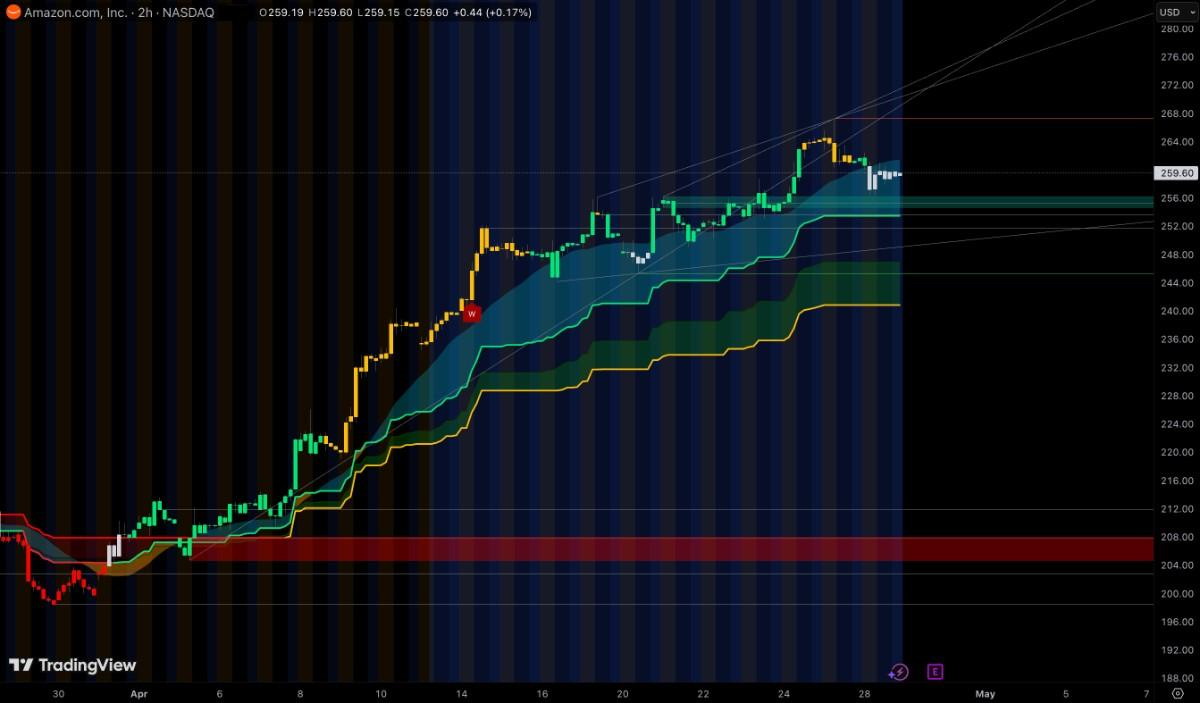
Amazon’s recent rally has been driven by a mix of AI infrastructure optimism, stronger sentiment toward mega-cap technology stocks, and fresh AWS-related deal headlines.
The most important recent headline is Meta’s agreement to bring tens of millions of AWS Graviton cores into its compute portfolio for agentic AI workloads. Meta said Graviton5 cores are designed for workloads that need more CPU capacity as agentic AI systems reason, plan, and execute tasks. (4)
Amazon also expanded its relationship with Anthropic. Anthropic said it is committing more than $100B over 10 years to AWS technologies and securing up to 5 gigawatts of Amazon custom-chip capacity. Separately, Amazon is investing $5B immediately and may invest up to $20B more, according to AP’s summary of the deal.
Those deals strengthen the long-term AWS AI story. But they do not automatically solve the Q1 earnings question. Meta’s deal was announced on April 24, and the Anthropic expansion followed Q1's end.
For this report, the market is not asking whether Amazon has AI headlines. It is asking whether AWS revenue, margins, and guidance already show that AI demand is flowing through the income statement.

Amazon guided Q1 revenue to $173.5B–$178.5B, representing 11%–15% year-over-year growth. It guided operating income to $16.5B–$21.5B, compared with $18.4B in Q1 2025. The guidance also included about $1B of higher year-over-year Amazon Leo costs, plus investment in quick commerce and sharper international pricing.
Consensus sits near the high end of the revenue range. Business Insider reports Wall Street expectations of about $177.23B in revenue and $1.62 in EPS, while IBD cites about $177.3B in revenue and $1.63 in adjusted EPS. (5)
For AWS, consensus is roughly $36.8B–$36.9B in revenue, or about 25%–26% growth. That would be a modest acceleration from Q4 2025, when AWS revenue grew 24% to $35.6B, its fastest growth rate in 13 quarters.
AWS is the clearest test of the AI thesis. Amazon said AWS grew 24% in Q4 2025, and Wall Street now expects another step higher in Q1.
A practical framework:
| AWS Q1 growth | Likely market read |
|---|---|
| Below roughly 23% | Re-acceleration thesis weakens |
| Around 25%–26% | In line with consensus, but maybe not enough after the rally |
| Above roughly 28% | Stronger evidence that AWS is participating more visibly in AI cloud demand |
| 30%+ | Clear bull-case outcome, especially if margins hold |
These thresholds are an analytical framework, not company guidance.
Peer comparisons will matter, but they are imperfect. Microsoft reported 39% growth in Azure and other cloud services in its January quarter, while AWS reported 24% growth in Q4 2025. Investors will compare those numbers, but AWS, Azure, and Google Cloud are not disclosed on the same basis.
Amazon’s Q1 operating income guidance range is wide: $16.5B to $21.5B. A result near the top of that range would help answer the concern that Amazon can spend aggressively on AI infrastructure without immediately crushing margins. A result near the low end would make the $200B capex plan a bigger focus.
Microsoft provides the clearest recent comparison. Microsoft’s January quarter showed strong headline growth, including 17% revenue growth and 39% Azure growth, but investors still focused heavily on AI spending, capex, free cash flow, and whether demand justified the infrastructure buildout.
Amazon faces a similar question: not “is AI demand real?” but “is Amazon earning an adequate return on the money it is spending to capture that demand?”
Q2 guidance may matter more than Q1 results. Amazon has already told investors to expect about $200B in 2026 capex, tied to AI, chips, robotics, and low-earth-orbit satellites.
Investors will be listening for something measurable:
updated AWS AI revenue run-rate
supply-constraint commentary
backlog or customer-commitment details
evidence that AWS margins can hold despite higher infrastructure spending
signs that demand is broad-based rather than concentrated in a few large AI partners
After the stock’s rally, generic comments about “strong AI demand” are unlikely to be enough. The market needs numbers, capacity details, backlog commentary, or evidence that AWS margins can hold despite higher infrastructure spending.
Yes, but they are secondary to AWS in this setup.
Amazon advertising remains an important profit driver. Amazon said advertising grew 22% in Q4 2025, while AWS grew 24%. A strong Q1 advertising print would help because advertising is generally higher-margin than retail and less directly tied to the AI capex debate than AWS.
Retail margins also matter because tariffs and inventory timing remain risks. Andy Jassy said consumers were beginning to see higher prices as some sellers passed on tariff costs, while others absorbed some of the pressure. He also said Amazon and many third-party sellers had stocked up ahead of tariffs, but much of that supply had run out. (6)
That makes North America retail margin commentary important, especially if Amazon is absorbing costs to protect price perception.
AWS grows above consensus, operating income lands near the high end of guidance, and Q2 guidance shows confidence.
This would support the idea that Amazon’s AI spending is turning into measurable AWS growth. The stock could still be volatile because much of the good news is already priced in, but this is the cleanest path to a positive reaction.
Revenue and EPS beat, but AWS growth is only in line, and Q2 operating income guidance is cautious.
This is the most complicated outcome. Bulls could point to continued growth, while bears would argue that Amazon’s capex burden and retail cost pressure are limiting earnings leverage. In this scenario, the conference call matters more than the press release.
AWS growth falls meaningfully below expectations, operating income lands near the low end of guidance, or Q2 guidance disappoints.
This is the highest-risk setup because the stock has already rallied sharply. If the AI cloud acceleration thesis weakens, investors may reassess how much of Amazon’s valuation should be tied to future AWS growth versus current margin pressure.
AWS growth has not yet been fully proven, but a meaningful amount of optimism is already priced into AMZN after its roughly 29% rally over the last 30 days. A standard revenue or EPS beat may not be enough.
For the stock to justify the move, Amazon likely needs three things: AWS growth above consensus, operating income near the upper end of guidance, and specific management commentary showing that AI capex is producing broad-based customer demand and credible future returns.
The key question is not whether Amazon can produce AI headlines. It already has. The question is whether the numbers show those headlines turning into revenue, margins, and guidance.
(2) https://www.anthropic.com/news/anthropic-amazon-compute
(3) https://www.investopedia.com/amazon-stock-expected-to-move-after-earnings-q1-2026-update-11955138
(4) https://about.fb.com/news/2026/04/meta-partners-with-aws-on-graviton-chips-to-power-agentic-ai/
(5) https://www.businessinsider.com/amazon-q1-earnings-preview-aws-amzn-stock-ai-capex-2026-4