Published on: 2026-04-29
Meta Platforms is scheduled to announce its first-quarter 2026 earnings after the US market close on Wednesday, 29 April 2026, with its conference call set for 5:30 p.m. ET.
This Meta earnings comes at a defining moment for the company, as investors assess whether one of the world’s most powerful advertising platforms can turn aggressive AI investment into durable revenue growth.
The market is no longer rewarding artificial intelligence spending on ambition alone. For Meta, the test is more specific: whether AI-driven improvements in ad targeting, engagement and automation can justify a capital expenditure cycle that now sits among the largest in global technology.
Meta guided for first-quarter revenue of $53.5 billion to $56.5 billion, with foreign exchange expected to add an approximately 4% tailwind to year-over-year growth. The guidance follows a strong fourth quarter, when revenue rose 24% to $59.89 billion, while full-year 2025 revenue increased 22% to $200.97 billion.
Analysts expect Q1 revenue of about $55.51 billion and earnings per share of $6.65, placing consensus near the upper half of Meta’s own guidance range. That leaves little room for a merely in-line result, especially after renewed strength in AI-linked mega-cap technology shares.
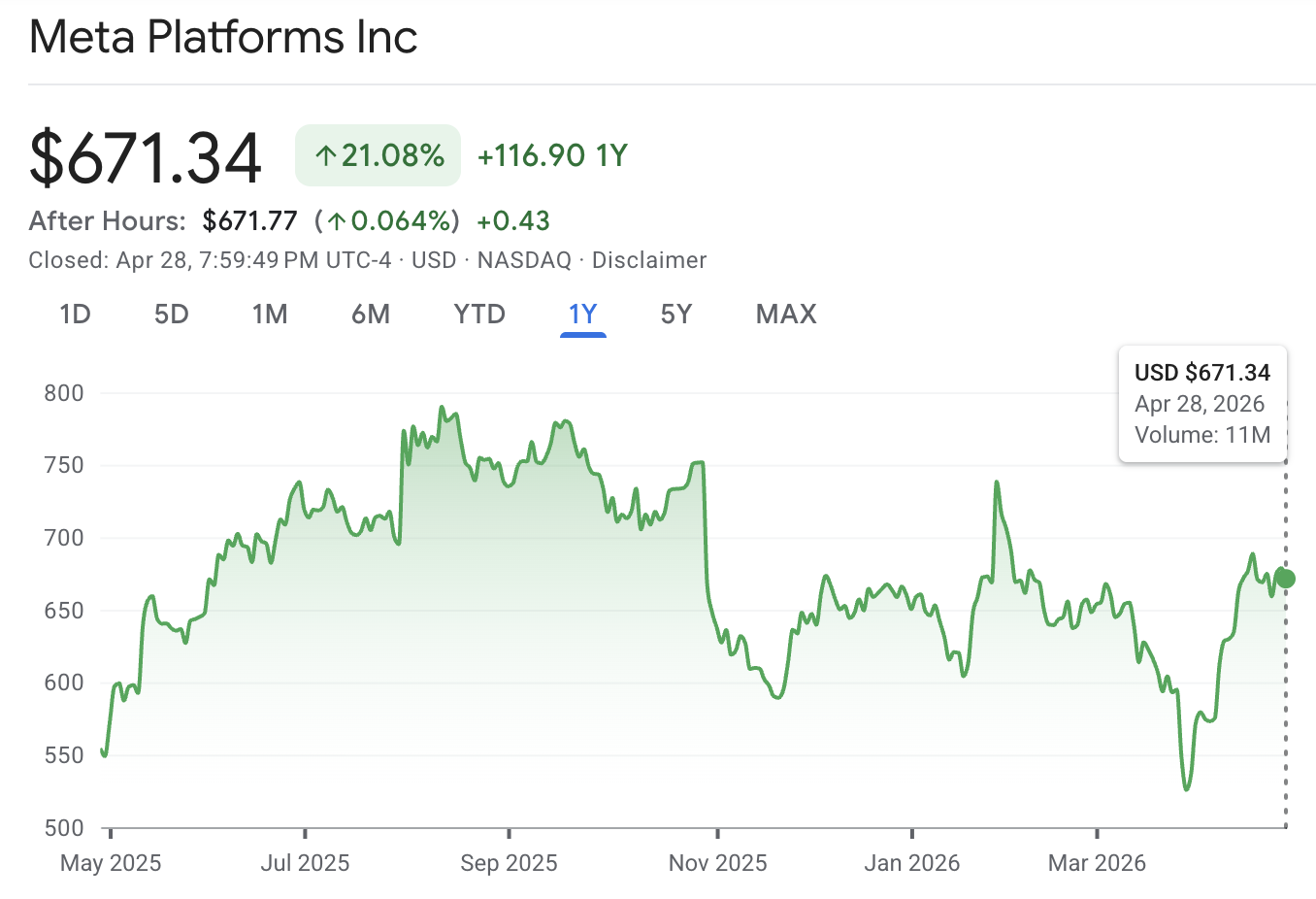
META recently traded at $671.34, with an intraday range of $665.75 to $683.07 and a market value of about $1.73 trillion. At that scale, the earnings release is not only a company event. It is a sentiment test for the Nasdaq 100, the S&P 500 and the wider AI trade.
| Metric | Figure | Why It Matters |
|---|---|---|
| Q1 revenue guidance | $53.5B to $56.5B | A high-end print would reinforce ad demand |
| Analyst revenue estimate | $55.51B | Consensus already expects strong execution |
| Analyst EPS estimate | $6.65 | Profit quality matters more than a headline beat |
| 2026 capex guidance | $115B to $135B | Core test of AI spending discipline |
| 2026 expense guidance | $162B to $169B | Any increase could pressure margins |
| Latest META quote | $671.34 | Elevated valuation raises reaction risk |
Meta’s advertising business remains highly profitable, but the company’s AI buildout has changed how investors read its earnings. Management expects 2026 capital expenditures of $115 billion to $135 billion, including principal payments on finance leases. The increase is tied to Meta Superintelligence Labs and investment in the company’s core business.
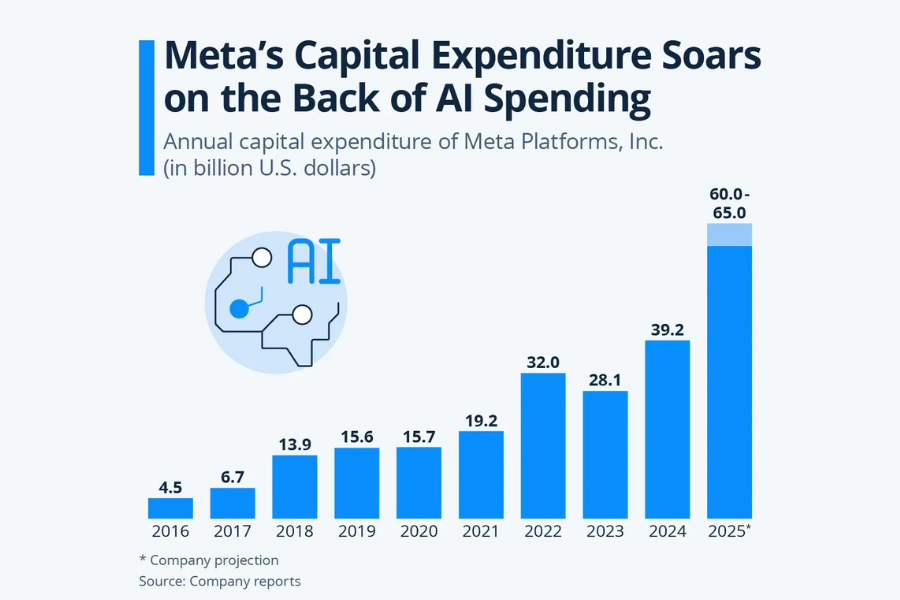
That makes capex commentary as important as EPS. Investors want evidence that spending on data centres, chips, cloud capacity and technical talent is improving ad performance. Without that connection, AI investment risks being viewed as margin dilution rather than a growth engine.
Meta also expects 2026 total expenses of $162 billion to $169 billion. Infrastructure is the main driver, including third-party cloud spending, higher depreciation and operating costs. Employee compensation is the second-largest contributor, led by technical hiring in priority areas, particularly AI.
That is why the market will listen closely to management’s tone. A stable expense and capex outlook would support the case that Meta is still controlling the pace of its AI buildout. Any upward revision could shift attention from revenue growth to free cash flow pressure.
Meta enters the report with a strong operating base. In the fourth quarter, Family daily active people reached 3.58 billion, up 7% year over year. Ad impressions across the Family of Apps rose 18%, while average price per ad increased 6%. These figures point to continued strength in both engagement and monetisation.
That resilience matters because the advertising business is funding the AI cycle. If Q1 shows firm ad pricing and healthy impression growth, investors may remain comfortable with elevated infrastructure spending. A clean report would suggest that AI is strengthening Meta’s revenue engine, not simply expanding its cost base.
Reality Labs remains a pressure point, but not the centre of this earnings preview. Meta expects Reality Labs operating losses in 2026 to remain similar to 2025 levels, while expense growth at the segment level is expected to be driven mainly by Family of Apps. That keeps pressure on the core advertising business to generate enough operating income to absorb both AI investment and long-term metaverse spending.
A newer concern for investors is whether Meta can monetise AI beyond its core advertising loop. Muse Spark’s April launch sharpened that debate because Meta AI already has more than 1 billion monthly active users, while the standalone Meta AI app jumped from No. 57 to No. 5 on the US App Store after launch. Sensor Tower estimated about 46,000 US iOS downloads on 8 April 2026, up 87% day over day.

The financial question is whether that usage can become revenue. Meta has a commercial bridge through messaging, where people already have more than 1 billion active threads with business accounts every day. Its Business AI tests have generated millions of conversations in early markets, while click-to-WhatsApp ads grew revenue 60% year over year in Q3 2025.
That gives investors a clearer benchmark. Muse Spark does not need to produce immediate standalone revenue, but it must show progress in product discovery, shopping assistance and business messaging. Without that, Meta AI risks being seen as a high-engagement product still waiting for a visible monetisation model.
A bullish reaction would likely require more than a revenue beat. Investors will look for stable capex guidance, firm second-quarter revenue commentary and clearer evidence that AI tools are improving advertiser returns. JPMorgan analysts have said steady capex guidance would likely be a bullish catalyst, while several major banks remain focused on AI-driven ad monetisation.
The risk is a “good but not good enough” report. Mega-cap technology expectations are high, and investors increasingly want proof that AI leaders can deliver faster growth with visible margin discipline.
Options markets reflect that tension. Recent pricing implies META could swing by as much as 6.5% by the end of the week, with traders preparing for a meaningful post-earnings move.
Meta enters Q1 earnings with powerful advertising momentum, a vast user base and one of the strongest operating engines in global technology. Yet the market’s focus has shifted from growth alone to capital efficiency.
The cleanest outcome would pair revenue near the top of guidance with stable spending expectations and credible AI monetisation commentary. Anything weaker may leave META exposed to volatility, not because the business is fragile, but because expectations are already high.