Published on: 2026-04-10
AMZN surged after Amazon revealed new details that made its AI investment case look more measurable and less abstract.
The latest disclosures suggest AWS and Amazon’s silicon strategy may be scaling faster than the market had assumed.
Amazon’s infrastructure push is expanding beyond narrative, with fresh investment signalling how aggressively it is building to meet AI demand.
Investors now need to judge whether stronger AI momentum can outweigh the pressure from elevated capital spending.
AMZN surged 5.6% on April 9 to close at $233.65 after CEO Andy Jassy’s annual shareholder letter gave investors fresh evidence that Amazon’s AI strategy is moving from heavy spending to measurable scale.
The stock rally followed disclosures that AWS’s AI business is running at more than $15 billion annually and that Amazon’s broader chips business has topped a $20 billion run rate.
Those figures gave the market a clearer basis for Amazon’s capital-intensive AI expansion. With management also pointing to roughly $200 billion in planned 2026 capital spending, investors appeared to conclude that Amazon is building not only capacity but also a larger profit engine within AWS.
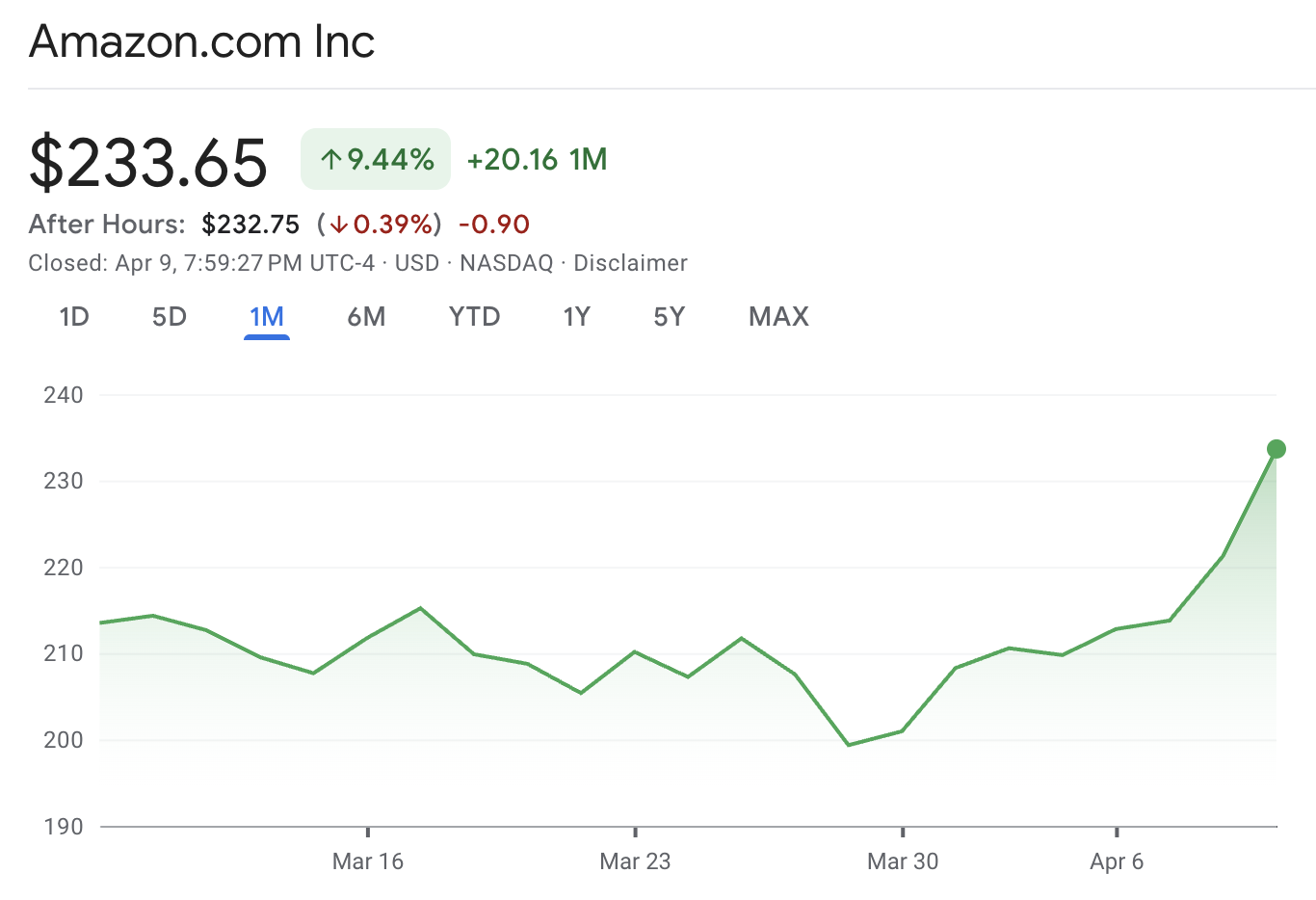 These market metrics confirm that the move was significant, but they also show the stock is already trading at a premium that assumes execution remains strong.
| Metric | Value |
|---|---|
| Closing price | $233.65 |
| Intraday high | $233.97 |
| Market cap | $2.34T |
| Trailing P/E | 30.62x |
| EPS | $7.08 |
| Intraday volume | 65.96M shares |
Andy Jassy said AWS’s AI revenue run rate is now over $15 billion in Q1 2026. He also said Amazon’s chips business is running at over $20 billion annually, with triple-digit year-over-year growth. Together, those figures gave the market a sharper view of how quickly Amazon is turning AI demand into real revenue.
He added that two large AWS customers had asked whether they could buy all of Amazon’s Graviton instance capacity for 2026, a sign of how tight demand remains.
Amazon cannot accommodate that because it needs to preserve supply for other customers, but the remark underscored how heavily cloud clients are leaning into Amazon’s in-house infrastructure.
Amazon expects to invest about $200 billion in capital expenditures in 2026, with much of that tied to AI infrastructure. He argued that these investments are not speculative and said Amazon already has customer commitments for a substantial portion of the AWS capacity it expects to monetize in 2027 and 2028.
The most striking disclosure in the letter was the scale of Amazon’s silicon business. Jassy said Amazon’s annual revenue run rate for chips, including Graviton, Trainium, and Nitro, is now above $20 billion.
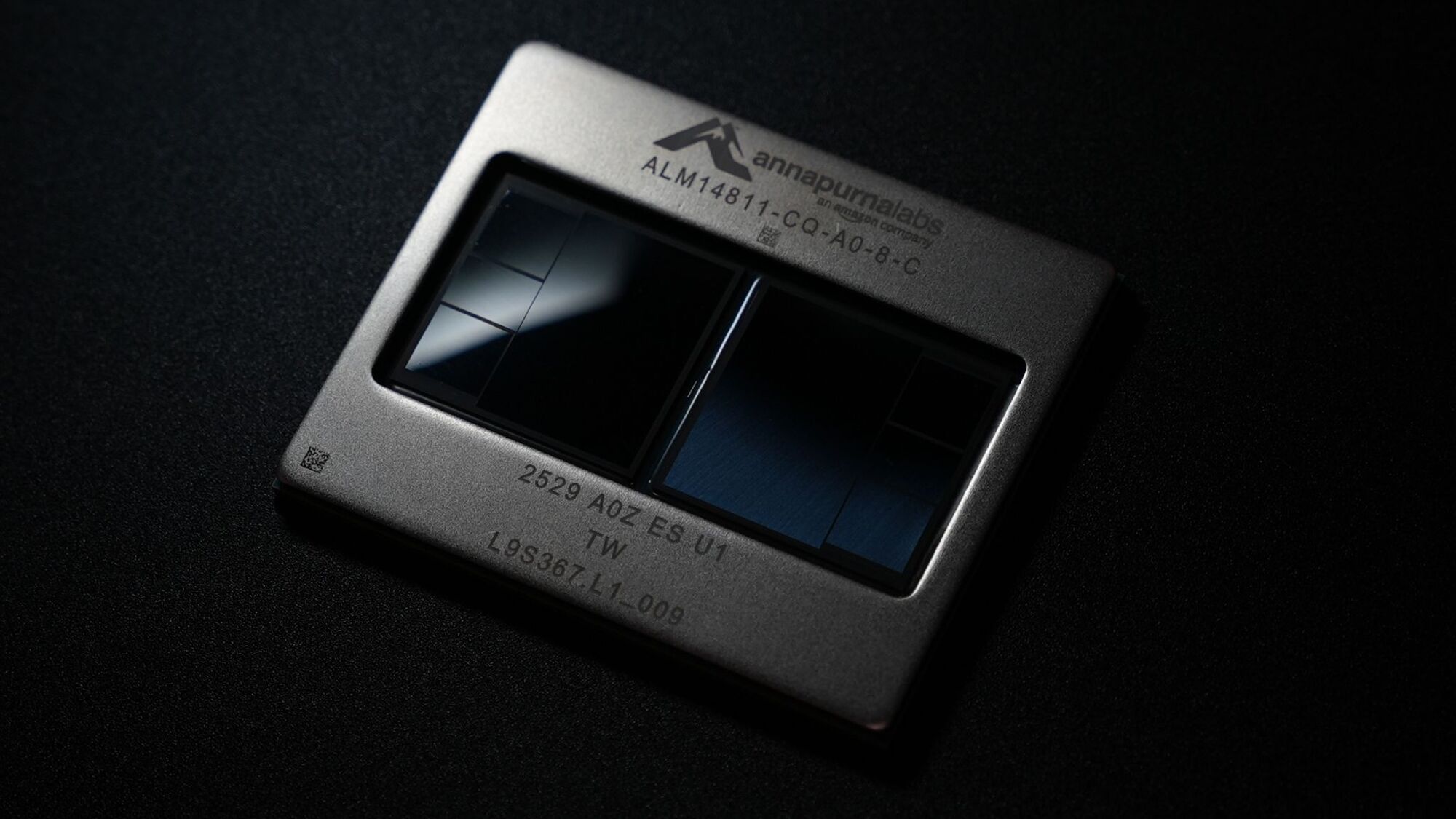
He also said that if the business were run as a stand-alone operation and sold this year’s output to AWS and external customers, the run rate would be about $50 billion.
That matters because Amazon is no longer just buying AI infrastructure from outside suppliers. It is building a broader technology stack inside AWS that can help lower costs, improve performance, and deepen customer lock-in over time.
Trainium demand reinforces that case. Jassy said Trainium2 has largely sold out, Trainium3 is nearly fully subscribed, and a significant portion of Trainium4 has already been reserved, even though it is still about 18 months from broad availability. Amazon also said Bedrock, its main inference service, runs most of its inference on Trainium.
| Metric | Detail |
|---|---|
| Chips business run rate | Over $20B annually |
| Growth | Triple-digit YoY |
| Included products | Graviton, Trainium, Nitro |
| Stand-alone run rate | About $50B |
| Trainium2 | Largely sold out |
| Trainium3 | Nearly fully subscribed |
Amazon also said Trainium could save the company tens of billions of dollars in annual capex at scale and deliver several hundred basis points of operating margin advantage for inference workloads.
That is one reason the market reacted so strongly. Investors were not just hearing about demand. They were hearing about future economics.
Jassy said AWS could be growing even faster if not for capacity constraints. In Q4 2025, AWS posted 24% year-over-year growth and reached a $142 billion revenue run rate, but Amazon said demand still exceeds available capacity.

Amazon Bedrock is also scaling quickly. Jassy said Bedrock nearly doubled month over month in March and processed more tokens in Q1 2026 than in all prior years combined. That suggests enterprise AI demand is broadening beyond experimentation and moving deeper into production workloads.
The broader AWS business remains strong as well. Amazon reported that AWS revenue rose 20% to $128.7 billion in full-year 2025, while AWS operating income reached $45.6 billion. Those numbers matter because they show Amazon is funding its AI buildout from a very large and still profitable cloud franchise.
The shareholder letter landed alongside a major infrastructure announcement in Mississippi. Amazon said its total planned investment in the state has reached $25 billion, with 2,000 jobs expected across its data center operations. That includes an additional $11 billion in Madison County and $1 billion in Hinds County.
Amazon also said it is funding $300 million in grid improvements and investing in carbon-free energy as part of the expansion. That gives the AI buildout a more visible physical footprint and supports the case that the spending is already moving from plan to execution.
The market liked the growth story, but the cost story has not disappeared. Amazon said trailing twelve-month free cash flow fell to $11.2 billion from $38.2 billion, driven primarily by a $50.7 billion increase in purchases of property and equipment tied mainly to AI investments.
That is the main risk to the bullish case. If AWS growth, chip adoption, and AI monetization keep accelerating, investors may continue to tolerate the cash flow pressure. If revenue conversion slows, that same capex bill could start to weigh more heavily on the stock.
AMZN rose after Andy Jassy’s shareholder letter gave investors hard numbers on AWS AI revenue, Amazon’s chips business, and 2026 capex. The market responded to scale, not just narrative.
It is Amazon’s broader chips business, not AI chip revenue alone. The figure includes Graviton, Trainium, and Nitroand is running at more than $20 billion annually.
Not exactly. Amazon said Trainium2 has largely sold out and Trainium3 is nearly fully subscribed. That is a strong demand, but it is not the same as saying all supply is gone.
It can be, but only if revenue keeps catching up with spending. Amazon’s AI monetization is becoming clearer, but free cash flow is under pressure because capex is rising fast.
Do not publish a specific date unless Amazon confirms it. I could not verify an official next earnings date from Amazon’s current IR results hub.
The AMZN stock surge looks justified by fundamentals more than hype. Amazon gave investors what they had been waiting for: concrete numbers showing that AWS AI revenue is already large, that its chips business has reached meaningful scale, and that demand for Trainium is strong enough to support a much bigger long-term story.
The next phase now depends on execution. If Amazon converts this spending cycle into faster AWS growth, lower inference costs, and stronger cash generation, the move can hold through 2026. If free cash flow stays under pressure for too long, the stock’s new premium will face a tougher test.
Disclaimer: This material is for general information purposes only and is not intended as (and should not be considered to be) financial, investment or other advice on which reliance should be placed. No opinion given in the material constitutes a recommendation by EBC or the author that any particular investment, security, transaction or investment strategy is suitable for any specific person.