Published on: 2026-04-23
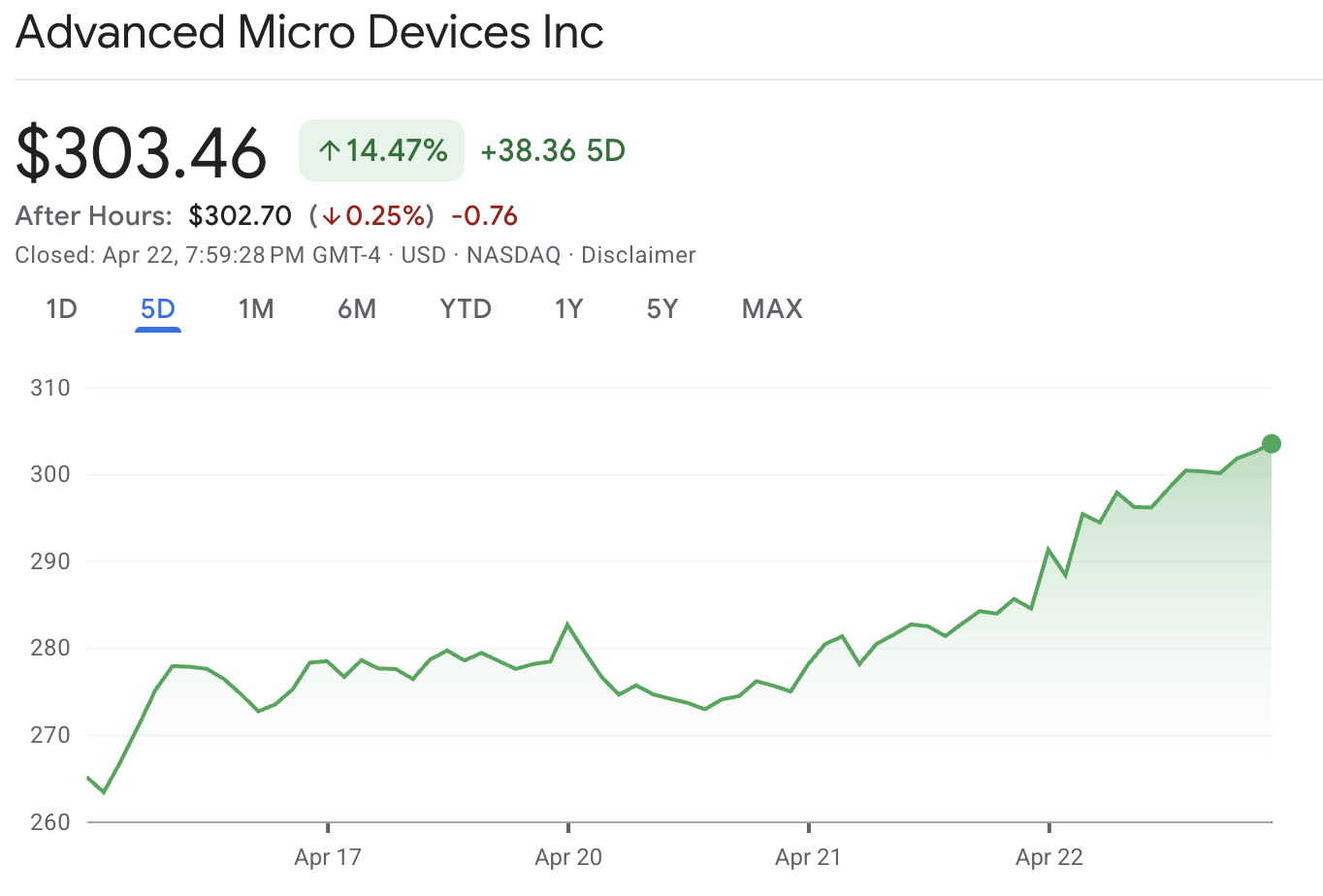
AMD stock has entered a new price zone, with the April 22 close at $303.46 pushing the shares above the $300 mark and setting a fresh all-time closing high. The move came after AMD had already reached a previous record close of $278.26 on April 16, turning a strong April advance into a more consequential re-rating ahead of the company’s next earnings report on May 5, 2026.
 The rally is being supported by stronger fundamentals than AMD had in many earlier runs. The company finished 2025 with record revenue of $34.6 billion, while the Data Center segment delivered $5.4 billion in fourth-quarter revenue and $16.6 billion for the full year.
That combination has shifted the conversation away from whether AMD belongs in the AI infrastructure trade and toward whether its new valuation can be sustained through another earnings cycle.
AMD closed at $303.46 on April 22, 2026, up 6.67% on the day, after setting a previous record close of $278.26 on April 16.
Data Center is AMD’s largest growth driver, with Q4 2025 revenue of $5.4 billion and full-year revenue of $16.6 billion, both record levels.
Q1 2026 guidance calls for about $9.8 billion in revenue, plus or minus $300 million, with non-GAAP gross margin near 55% and about $100 million of Instinct MI308 sales to China included in that outlook.
AMD’s Meta agreement covers up to 6 gigawatts of Instinct GPUs, with shipments supporting the first gigawatt expected to begin in 2H 2026 using a custom MI450-based platform.
The next major catalyst is May 5 earnings, when investors will be looking for proof that AI server demand, margins, and deployment timing can support the stock’s move into a higher trading range.
A move through $300 carries more weight when it is backed by improving earnings quality, a stronger product mix, and clearer visibility into hyperscale demand. AMD now has all three. The company is no longer trading on a broad semiconductor rebound alone, and the latest breakout reflects a market that is assigning more value to its server CPUs, AI accelerators, and system-level partnerships.

The stock has also benefited from fresh analyst support ahead of earnings. A higher price target from Stifel helped reinforce the idea that Wall Street is revising its valuation framework as AMD deepens its role in AI infrastructure.
Even so, the rally has lifted expectations quickly, which means the next earnings release now carries more weight than the one that sparked the move.
AMD’s latest financial results showed how much the business has changed. Fourth-quarter 2025 revenue reached $10.3 billion, while non-GAAP operating income climbed to a record $2.9 billion. The Data Center segment stood out, driven by EPYC processor demand and the ongoing ramp of Instinct GPU shipments, with quarterly revenue up 39% year over year.
That shift has altered the market’s view of AMD’s earnings base. In 2025, the company generated $4.3 billion in GAAP net income, while non-GAAP diluted earnings per share reached a record $4.17. Investors are paying up for a business that is becoming more exposed to higher-value data center and AI workloads, which generally carry stronger strategic value than legacy PC cycles.
AMD’s recent hyperscaler agreements have added scale to the bullish case. Its October 2025 agreement with OpenAI covers 6 gigawatts of GPUs, with the first 1 gigawatt deployment of MI450 Series products slated for 2H 2026.
In February 2026, AMD expanded its partnership with Meta through another 6 gigawatt framework tied to 2H 2026 shipments and broader coordination across GPUs, CPUs, systems, and software.
Those agreements do not remove competitive pressure from Nvidia, although they do make it harder to dismiss AMD as a secondary participant in AI buildouts. The company now has clearer exposure to multi-year AI infrastructure spending, and investors are beginning to value that pipeline more aggressively.
| Metric | Latest reading |
|---|---|
| AMD close, April 22, 2026 | $303.46 |
| Daily move | +6.67% |
| Previous record close | $278.26 |
| 2025 revenue | $34.6 billion |
| Q4 2025 revenue | $10.3 billion |
| Q4 2025 Data Center revenue | $5.4 billion |
| Full-year 2025 Data Center revenue | $16.6 billion |
| Q1 2026 revenue guidance | $9.8 billion ± $300 million |
| Q1 China MI308 contribution in guide | About $100 million |
| Q1 2026 non-GAAP gross margin guide | 55% |
| Next earnings date | May 5, 2026 |
AMD’s guidance for the March quarter points to roughly 32% year-over-year revenue growth, although it also implies a 5% sequential decline from the seasonally stronger December quarter. That pattern is not unusual, but the market will want more than a clean headline beat.
Investors will be watching whether Data Center growth remains strong enough to justify the stock’s sharp rerating and whether management adds more detail on deployment timing, customer traction, and margin progression.
The most important question is whether AMD can translate strategic AI wins into a revenue profile that continues to expand at scale. The company has already shown that its Data Center business can carry more of the growth burden, though a stock above $300 leaves less room for operational slippage or cautious guidance.
Expectations are elevated after the stock’s rapid advance and record close.
Q1 guidance still points to a sequential revenue decline, even with strong year-over-year growth.
AMD’s Meta agreement includes a performance-based warrant for up to 160 million shares, with vesting tied to shipment milestones, escalating AMD stock-price thresholds, and other technical and commercial conditions.
Competition in AI accelerators remains intense, which means AMD still needs to prove that its recent partnerships will translate into durable share gains and not simply stronger visibility.
As of the April 22, 2026 close, AMD stock was at an all-time high, finishing at $303.46. That move placed the shares above the previous record close of $278.26 set on April 16 and established a clear breakout above the $300 level.
The main drivers are record AMD data center revenue, stronger visibility into AI infrastructure demand, and large-scale agreements with Meta and OpenAI that support a broader long-term growth narrative around GPUs, server platforms, and rack-scale systems.
Revenue relative to the $9.8 billion guide, gross margin against the 55% non-GAAP target, and management commentary on Data Center momentum, AI deployments, and the pace of customer demand in the second half of 2026 will likely carry the most weight.
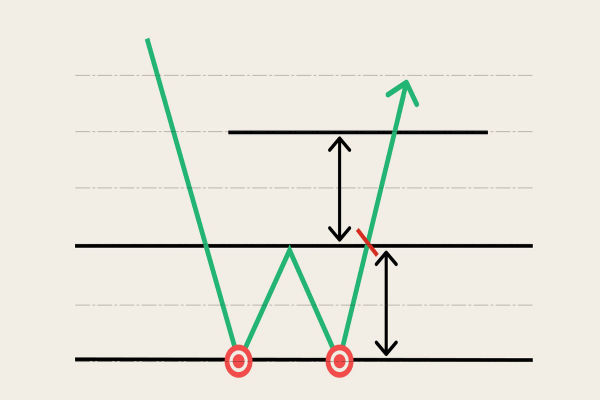
The breakout above $300 is clear, although a true support flip usually requires time and successful retests. At this stage, the cleaner conclusion is that AMD has broken into a higher trading range, with earnings likely to determine whether that level can hold.
AMD’s breakout above $300 reflects a market that is assigning greater value to proven Data Center growth and a more credible position in the global AI server buildout. Record revenue, stronger earnings quality, and expanding hyperscaler partnerships have given the rally substance, while the May 5, 2026 earnings release now stands as the next test of whether this higher valuation range can be maintained.