Published on: 2026-04-22
Updated on: 2026-04-22
Tesla does not need this quarter to prove that AI, autonomy, and robotics are large opportunities. The market has already priced in that possibility. Investors have already granted Tesla the right to tell a future-facing story. What they want now is evidence that rising AI spending is making that future more believable, not simply more expensive.
That is why this Tesla earnings report must prioritize credibility over optics. Much of the quarter is already visible. What is not visible is whether Elon Musk can defend a broader AI buildout while the core auto business still looks too thin to finance it comfortably on its own.
Tesla's Q1 report matters less for the headline EPS number than for whether management can justify a more capital-intensive AI strategy.
Revenue is expected at $21.417 billion, and non-GAAP EPS at $0.33, but gross margin, capex, and free cash flow are the numbers carrying the real weight.
With deliveries already reported at 358,023, investors are not waiting to discover the quarter. They are waiting to judge management's explanation.
The options market is pricing roughly a 4.98 percent move into the April 24 weekly expiry, suggesting volatility is expected and that familiar talking points will not be enough.
Tesla's official consensus already shows where the pressure sits. Revenue and EPS will shape the headlines. Margin quality, segment mix, capital intensity, and cash generation will decide whether the release supports or weakens Tesla's valuation case.
| Q1 2026 metric | Tesla company-compiled consensus |
|---|---|
| Automotive revenue | $15.311 billion |
| Energy generation and storage revenue | $2.906 billion |
| Services and other revenue | $3.199 billion |
| Total revenue | $21.417 billion |
| Non-GAAP EPS | $0.33 |
| Gross margin | 17.5% |
| Operating margin | 2.5% |
| Capex | $4.109 billion |
| Free cash flow | -$1.575 billion |
| Deliveries already reported | 358,023 |
| Energy storage deployments | 8.8 GWh |
These figures expose the real conflict in the quarter. Tesla is not being judged as a mature manufacturer with stable economics. Investors are being asked to fund a larger initiative focused on autonomy, robotics, and AI infrastructure, despite the company's modest profitability and negative cash generation.
A narrow EPS beat does not fix that. A revenue beat does not fix it either. For Tesla, the quality of the quarter matters more than the headline.
The valuation problem is simple. Investors are still paying for the assumption that tomorrow's Tesla will earn better economics than today's Tesla. That assumption seems generous, given the quarter's 2.5 percent operating margin and negative free cash flow.
A stock carrying that kind of future premium does not get rescued by another broad statement about AI. It gets rescued only when management gives investors something they can model with less guesswork: clearer rollout timing, sharper capital discipline, and a shorter path from spending to revenue.
A premium multiple does not re-rate because management repeats the size of the opportunity. It re-rates when disclosure gets concrete enough for investors to tighten their assumptions. For Tesla, that means rollout detail that can be checked, spending tied to milestones rather than slogans, and a clearer bridge from capex to revenue-bearing activity.
If Musk gives the market that bridge, the valuation holds. If he does not, this quarter will reinforce a harsher view: Tesla is still asking investors to pay today for businesses that remain too vague to underwrite with confidence.
A 17.5 percent gross margin already implies the automotive business is not generating abundant profit. An operating margin of 2.5 percent makes the point more sharply. The negative free cash flow of $1.575 billion makes it a financing question.
Tesla is asking the market to continue supporting a broader vision, even while its current business faces challenges. This is acceptable only if management can demonstrate that spending is disciplined, well-timed, and effectively reduces execution risks.
This is also why the tone of the call is significant. Tesla does not need to prove that autonomy, robotics, and AI are large opportunities. The market already grants that possibility. What it needs to prove is narrower and harder: that the company is moving from concept to operating evidence.
Investors do not need poetry from Musk on this call. They need timetable compression, clearer milestones, and a credible explanation for why the bill is rising before the payoff becomes visible. In a quarter where the underlying auto economics remain soft, that is a much harder sell than the usual vision pitch.
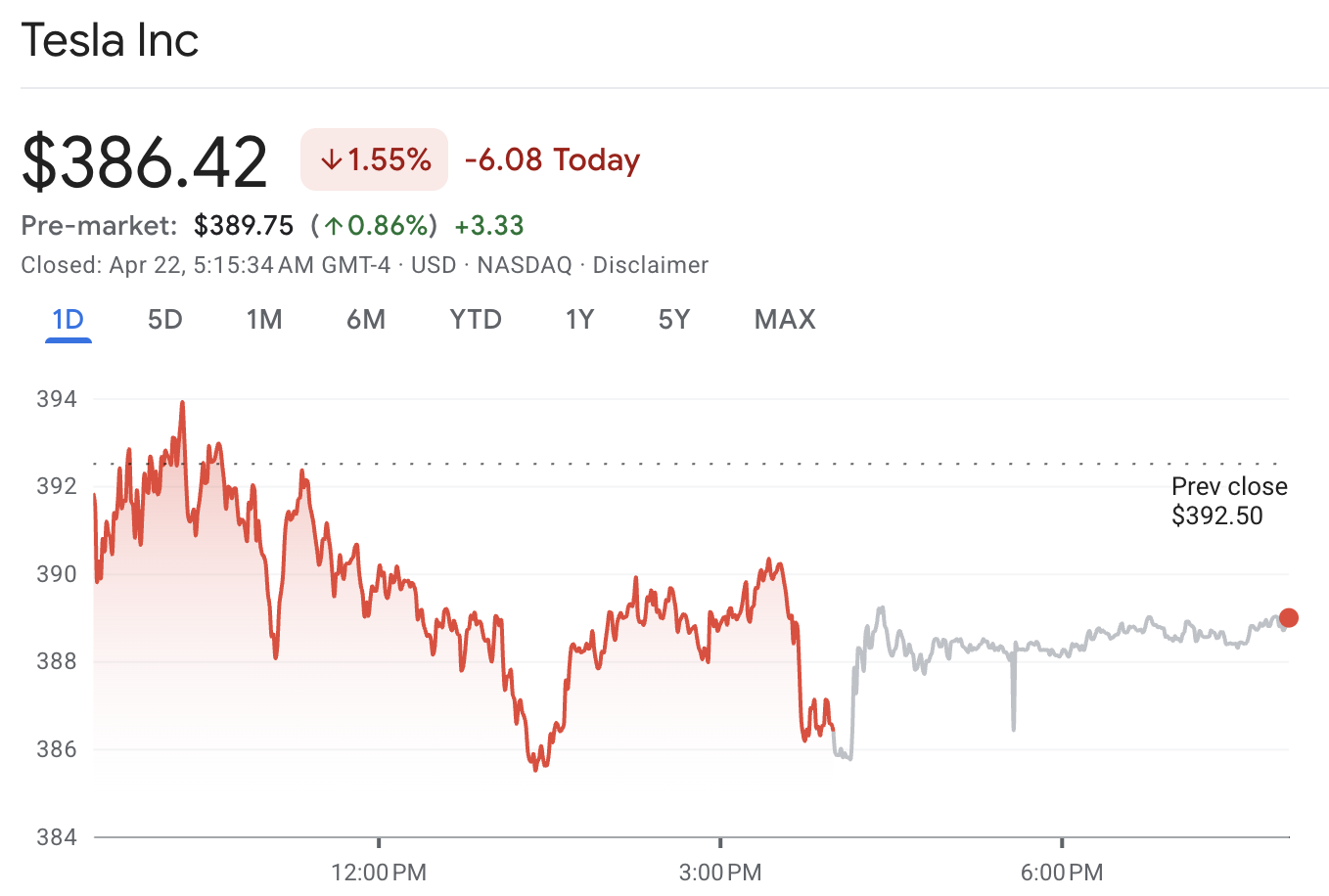
The options market is telling investors something important. Into the April 24 weekly expiry, expected-move data implies a 4.98 percent swing from Tesla's April 21 close of $386.42, or a range of roughly $367.17 to $405.67.
That is large enough to signal real event risk, but not large enough to suggest traders expect a clean re-rating. The market is braced for movement. It is not yet clear that this report will settle the debate.
That raises the standard for management. Tesla does not need to surprise on revenue or EPS to move. It needs to be credible. A routine beat can support the stock for a session, but it will not reset the thesis.
What resets the thesis is evidence that higher spending is producing better visibility: clearer robotaxi operating detail, a firmer spending roadmap, and signs that Tesla is converting ambitious projects into commercial pathways investors can actually underwrite. Without that, volatility may show up in the stock, but not in the story investors tell themselves about it.
Management needs to prove four things, and each carries consequences.
Robotaxi expansion must look operational, not aspirational.
A clear timetable should accompany AI spending.
The base business must still carry weight.
Cash burn cannot be treated as background noise.
That is the framework that matters after the release. Tesla does not need a perfect quarter. It needs a defensible one. More importantly, it needs a call that turns spending into evidence rather than asking investors for another extension of belief.
A stock this expensive can absorb a soft quarter. It cannot absorb too many soft quarters that still demand the same leap of faith.
| If Tesla delivers this | Market will likely read it as |
|---|---|
| Margin near or above 17.5 percent and less-negative free cash flow | The base business is holding up well enough to support the next spending phase |
| Higher capex tied to specific milestones and timing | AI spending is strategic, not open-ended |
| Clearer operating detail around new initiatives | Execution risk is narrowing |
| Soft margin, heavy cash burn and vague AI language | Valuation is outrunning proof |
That is the post-earnings scorecard. Tesla does not have to make every future business fully credible overnight. It does have to make the future feel closer, more measurable, and less dependent on faith alone.
If it fails at that, investors will start treating the company's AI spending not as an early investment in a superior platform, but as the growing cost of a story that still has not become specific enough.
Tesla will release Q1 2026 financial results after the market closes on Wednesday, April 22, with management's webcast scheduled for 4:30 p.m. Central Time.
Tesla's company-compiled consensus calls for Q1 revenue of $21.417 billion and non-GAAP EPS of $0.33, with gross margin expected at 17.5 percent and free cash flow at negative $1.575 billion.
Expected-move data implies a roughly 4.98 percent swing into the April 24 weekly expiry, or about $367.17 to $405.67 based on Tesla's April 21 close of $386.42.
What Tesla must prove now is more demanding than AI, autonomy, and robotics: that rising AI spending is making the future easier to model, not merely easier to imagine.
At this valuation, investors do not need more ambition. They need evidence that the company is moving from promise to economics.
If Musk delivers that, Tesla keeps its premium. If Musk fails to do so, the stock will face a steeper penalty each quarter the story stays bigger than the numbers.