Published on: 2025-12-23
Updated on: 2025-12-23
AI Chips News Today is being driven by two forces that markets cannot ignore: policy and scarcity. A change in U.S. rules has reopened a route for certain high end AI accelerators to be sold to China, but the deal comes with conditions and political scrutiny.
At the same time, the global supply chain is still short of the parts that turn chips into working AI servers.
This is why the “AI boom” remains a supply story. The limiting factor is not interest from data centres. The limiting factor is how many complete accelerator systems can be assembled and delivered on time, with enough high bandwidth memory, enough advanced packaging capacity, and a clear path through export licensing.
For a financial audience, AI chips now sit at the centre of earnings momentum, capital spending, and market risk. A single change in export controls can swing expected sales. A single statement on HBM supply can shift pricing power across the whole semiconductor cycle.
The U.S. has signalled that exports of certain advanced AI chips to China can resume under a framework that includes a 25% fee and licensing reviews, which turns supply risk into policy risk.
Planned H200 deliveries to China are being discussed with a clear target window: mid February 2026, using existing inventory first. Initial volumes have been described as 5,000 to 10,000 modules, equal to roughly 40,000 to 80,000 chips.
HBM supply is the main bottleneck for AI accelerators. One major memory supplier states that it has already completed price and volume agreements for its full 2026 HBM output and expects tight supply to continue beyond 2026.
The same supplier estimates the HBM market could grow from about $35 billion in 2025 to around $100 billion by 2028, which suggests multi year demand that outpaces quick capacity expansion.
Foundries are keeping capital spending high to meet AI demand, with a meaningful share directed to advanced packaging, testing, and related areas where constraints have been visible.
An industry association expects global chip equipment sales to rise from about $133 billion in 2025 to $145 billion in 2026 and $156 billion in 2027, which supports the idea of a longer investment cycle.
China is also building its own AI chip industry at speed, backed by domestic funding, policy support, and strong appetite in public markets for local GPU related listings.
The most important development in AI Chips News Today is a policy shift that reopens a pathway for advanced AI chip sales to China.
The new approach is framed as a controlled channel rather than a full opening, with an added fee and licensing review. For markets, that matters because it changes expectations from “no sales” to “possible sales with conditions.”
 Investors tend to price export access as a simple yes or no. In practice, it becomes a moving target because approvals can depend on technical limits, end users, and how rules are interpreted over time.
That uncertainty is a risk premium that can show up in chip stocks, supplier guidance, and order timing.
It also affects allocation. When AI accelerator supply is scarce, producers decide where to ship based on margin, reliability of approval, and the cost of compliance. If policy risk rises, supply may be steered toward regions where delivery is simpler.
Policy headlines matter most when they turn into real shipments. Current market talk points to a target of mid February 2026 for the first wave of H200 deliveries into China. That timeline matters because it anchors what could otherwise be open ended debate.
The initial plan is linked to existing inventory, which suggests early deliveries may not require immediate new production runs. Reports have described 5,000 to 10,000 modules in the first push, which implies a meaningful number of chips once those modules are counted at the system level.
For earnings, inventory shipments can pull revenue forward. That can lift one quarter and soften another, even when underlying data centre demand is still rising. Traders should be ready for volatility around shipment timing, not just overall demand.
A key point in AI Chips News Today is that export policy is now under close political review in the United States. Lawmakers are asking for visibility into licensing decisions and the logic used to approve or reject sales. That level of scrutiny increases the chance of delays or additional conditions.
This matters because licensing is not only about the chip itself. It can include the buyer, the intended use, the delivery path, and the level of monitoring required. Each extra step adds time and raises the cost of doing business.
For markets, this is classic headline risk with real cash flow impact. Even a small delay can shift delivery schedules for large AI server orders, which then affects data centre build plans and supplier revenue recognition.
On the China side, there is another layer of risk. Recent reporting suggests Chinese officials may consider conditions for accepting imports of high end accelerators, including ideas such as tying imported purchases to a commitment to buy domestic AI chips as well.
If such rules appear, imported chips may not regain the same role they had in earlier years.
This kind of policy is designed to speed up local adoption. Even if domestic GPUs are not yet at the same level for the most demanding training tasks, they can still be used for many inference workloads, enterprise deployments, and narrower AI tasks.
For investors, the message is that China demand may return in a different shape. Imported accelerators may serve specific high end projects, while domestic chips take a larger share of the broader market.
China’s domestic push is not limited to suggestions. Separate reports indicate guidance that state funded data centre projects should use domestically made AI chips.
In some versions of this guidance, projects that are still early in construction may be asked to remove foreign chips or cancel planned purchases.
If enforced widely, this changes the addressable market for foreign suppliers. State linked projects are often large, long running, and less price sensitive. Losing those orders can shift sales toward private sector buyers and overseas markets.
It also strengthens the business case for China’s local chipmakers. When policy directs demand, funding follows, and the ecosystem builds faster through real deployments and developer support.
If you want one supply chain signal that explains the AI chip cycle, it is high bandwidth memory. HBM is the stacked memory used in AI accelerators to feed data fast enough for training and high throughput inference. Without enough HBM, a GPU cannot be shipped as a complete, ready system.
One major memory maker has stated that it has already completed price and volume agreements for its full calendar 2026 HBM supply. It also expects tight conditions to last beyond 2026. That is a strong message: next year’s supply is already spoken for.
This supports firm pricing and long lead times. It also pushes large cloud providers to sign longer contracts and plan capacity earlier, which then reinforces the cycle of high capital spending in AI infrastructure.
HBM is not only tight in 2026. The same memory supplier projects that the HBM market could rise from about $35 billion in 2025 to around $100 billion by 2028. That kind of jump tells you that HBM is becoming a core part of the semiconductor market, not a niche product.
Even with new factories, memory supply cannot expand instantly. It takes time to build capacity, qualify processes, and lift yields. This is especially true for the newest HBM generations, where product quality must be consistent at scale.
For markets, this means the “AI chip shortage” can persist even if GPU wafer supply improves. The limiting factor may remain memory availability and the ability to assemble complete modules.
Suppliers are racing to the next memory generation. SK hynix has announced that it completed HBM4 development and is preparing for mass production, while also signalling a shipment start in the second half of 2025. Samsung has also indicated progress, with HBM3E in mass production and HBM4 samples in customer hands.
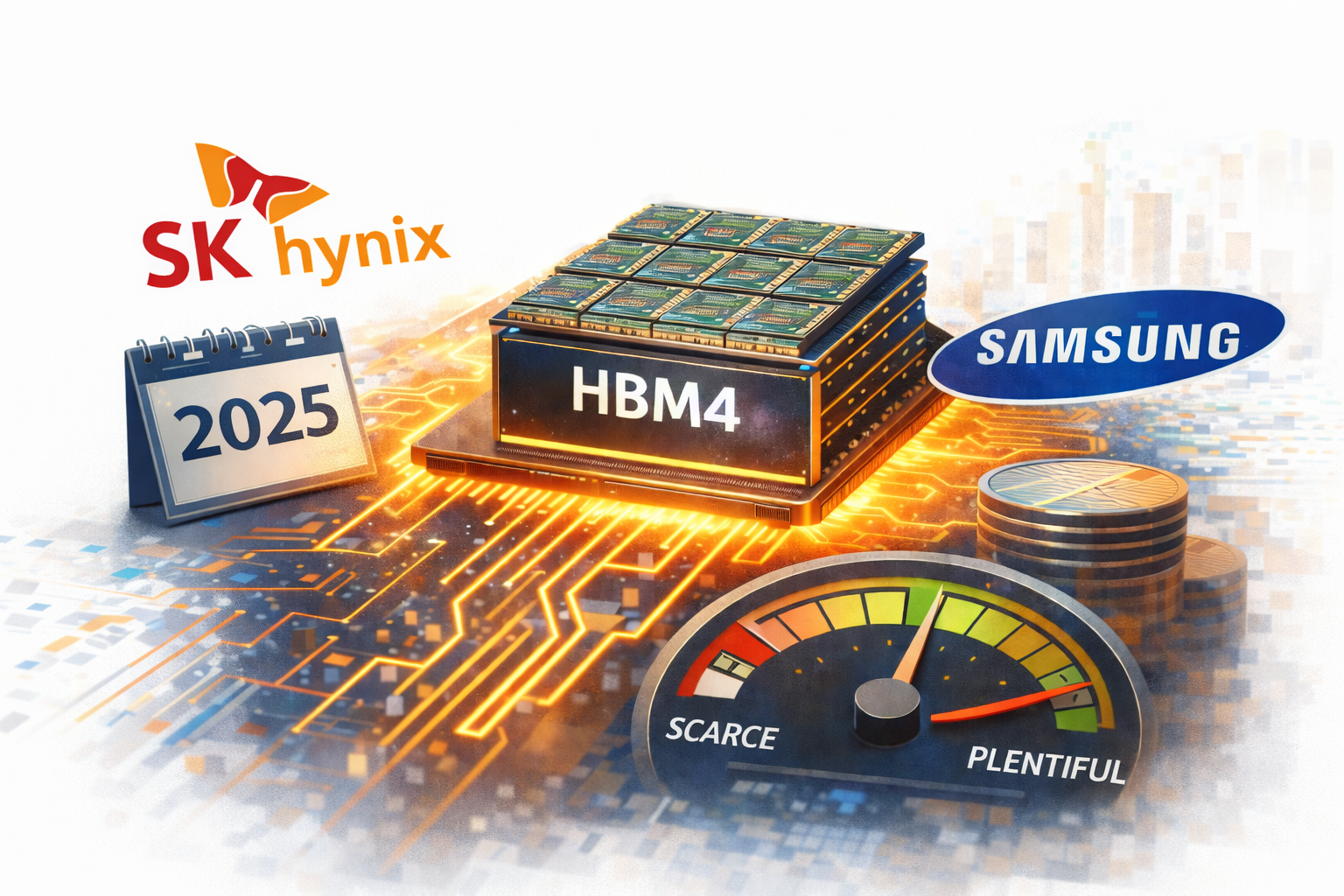
These are important steps because performance per chip matters. Higher memory bandwidth supports larger models, faster training, and more efficient inference. Better performance can reduce the number of chips needed for a given task.
However, new generations do not remove scarcity overnight. Early output is usually limited, and customers must qualify the new memory in real systems. Availability improves over time, but tight supply can remain during the transition.
Even when you have the GPU and the HBM, you still need advanced packaging to bind them into a working unit. Advanced packaging is where many AI accelerator systems face delays, because it requires specialised equipment, high precision assembly, and careful thermal design.
Foundries have highlighted this area in their spending plans. The leading contract chip manufacturer has guided that its 2025 capital spending will remain high, with a meaningful share directed to advanced packaging, testing, and related work. That is a clear signal that packaging is now a strategic capacity.
For investors, packaging is a key part of “real supply.” A wafer shipped from a fab is not the same as an accelerator module delivered to a data centre. Packaging capacity is what turns silicon into revenue.
The AI chip cycle is not a short demand spike. Foundries are treating it as a longer shift in computing, which is why capital spending remains elevated. The leading foundry has set its 2025 investment range at $40 billion to $42 billion and has linked demand to AI related growth.
High investment supports more leading edge capacity and more packaging throughput. It also supports the ecosystem around advanced nodes, where AI accelerators typically sit due to their size and performance needs.
This matters for financial markets because it changes the rhythm of the semiconductor cycle. When demand is driven by long-life infrastructure buildouts, the downturns can be less sharp, but the stakes are higher when policy or supply constraints hit.
An industry association expects global semiconductor equipment sales to rise from about $133 billion in 2025 to $145 billion in 2026 and $156 billion in 2027. That forecast aligns with the idea that AI related demand is pushing the industry into a longer investment phase.
Equipment spending is one of the best early signals for future capacity. When chipmakers order tools for advanced logic, memory upgrades, and packaging, it usually means they see durable demand, not just a short term rush.
For investors, this supports a view that AI chips are driving a broader manufacturing cycle. It also ties into trade flows, industrial output, and earnings across suppliers that sit upstream of the chipmakers.
China’s domestic chip push is also visible in public markets. Recent listings of GPU focused or AI chip related firms have seen very large first day gains, showing strong local appetite for “homegrown compute” themes.
This matters because strong capital access speeds up development. It funds more design work, more testing, and more software support, which are all needed to build a competitive AI accelerator platform. It also helps firms survive early years when margins are thin and product cycles are costly.
For the global industry, this raises competitive pressure over time. Export controls and buy local policies may reduce foreign share in China, while domestic players aim to improve quickly with state support and market funding.
The first takeaway is that policy now sits alongside supply as a major price driver. Export approvals can shift expected revenue, while political scrutiny can slow or reshape that revenue. Investors should treat export controls as an ongoing risk factor, not a one time event.
The second takeaway is that scarcity is concentrated in a few places. High bandwidth memory, advanced packaging, and system level delivery remain tight. This supports pricing power, but it also raises the risk of delays for buyers trying to scale AI data centres quickly.
The third takeaway is that China’s market is changing, not simply reopening. Even if high end imports return, domestic chip policies and state project rules can steer demand toward local suppliers. That changes the long term sales mix for global AI chip companies.
Start with licensing updates and shipment confirmation. The market will react most to clear signs that deliveries are proceeding on schedule, and to any details on conditions tied to end users, volumes, or monitoring requirements.
Next, watch HBM allocation language in company statements. If suppliers continue to say that 2026 output is fully committed, it implies that demand growth will mostly show up in pricing and longer contracts, not in a sudden jump in unit volumes.
Finally, track packaging and equipment indicators. Capacity expansion is underway, but the pace matters. If packaging output improves faster than expected, it could ease delivery delays and support a larger wave of AI server installations in 2026.
AI Chips News Today is telling a clear story: the world is still short of AI computers, and the shortage is shaped by policy and by hard physical limits in the supply chain. Export rules may be shifting, but approvals remain uncertain and politically sensitive.
At the same time, HBM supply is largely booked, and packaging capacity remains a key constraint.
For a financial audience, the market impact is direct. These constraints influence revenue timing, margins, and valuation risk across the AI semiconductor space.
The next phase will depend less on new chip names and more on the ability to secure memory, packaging, and stable access across borders.
Disclaimer: This material is for general information purposes only and is not intended as (and should not be considered to be) financial, investment or other advice on which reliance should be placed. No opinion given in the material constitutes a recommendation by EBC or the author that any particular investment, security, transaction or investment strategy is suitable for any specific person.