Published on: 2026-02-06
Updated on: 2026-02-06
Estée Lauder (NYSE: EL) delivered a quarter that looked "good enough" on the surface. Sales rose, adjusted profit beat expectations, and management lifted its full-year adjusted earnings outlook.

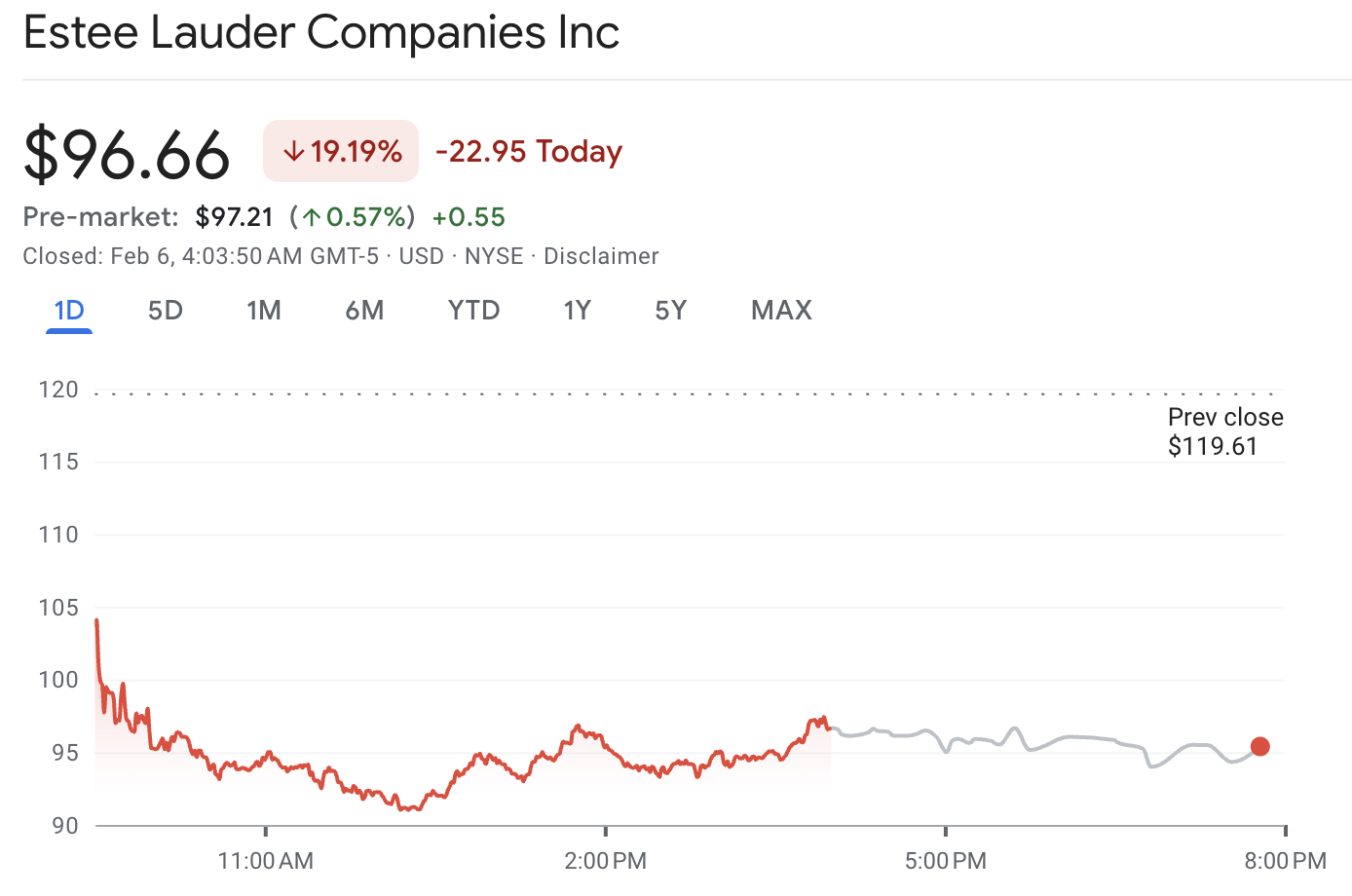
Yet EL stock still fell hard. On February 5, EL stock dropped roughly 19% on the day, making it one of the most significant single-session declines in the stock's history.
The selloff can be explained in three words: Tariffs, costs, and a high bar.
Profitability is projected to decline by about $100 million due to tariffs, mainly in the second half of fiscal 2026, despite planned mitigation efforts.
Restructuring and transformation costs are still high, keeping GAAP earnings well below adjusted earnings and reminding investors that the turnaround is not "free."
Expectations were already high after a major rally from the April 2025 lows, so the guidance tone did not clear the bar the market had set.
| Metric (Fiscal Q2, ended Dec 31, 2025) | Reported | Prior year |
|---|---|---|
| Net sales | $4,229M | $4,004M |
| GAAP diluted EPS | $0.44 | ($1.64) |
| Adjusted diluted EPS | $0.89 | $0.62 |
| Adjusted operating margin | 14.4% | 11.5% |
Estée Lauder's fiscal 2026 second quarter (ended December 31, 2025) showed real improvement versus the prior year.
Net sales increased 6% to about $4.2 billion, and organic net sales rose 4%.
Adjusted diluted EPS was $0.89, up from $0.62 a year ago.
GAAP diluted EPS was $0.44, which matters because it reflects the real cost of restructuring and other items.
Adjusted operating margin expanded to 14.4% from 11.5%, helped by cost actions under the Profit Recovery and Growth Plan (PRGP)
The recovery was not limited to one product line.
By category (year over year):
Skin care: +6%
Fragrance: +6%
Hair care: +5%
Makeup: -1%
By region (reported net sales, year over year):
The Americas: $1.218B (+1%)
Europe, Middle East & Africa: $1.575B (+9%)
Asia/Pacific: $1.424B (+7%)
So why did the stock crater? Because the market's debate was not about the quarter that just ended. It was about what the next two quarters might look like as tariff headwinds intensify and consumer-facing investment ramps up.
Even before earnings day, EL had become a "high expectations" stock again.
| Time frame | Reference close | Reference close | Change |
|---|---|---|---|
| Past week (Jan 30 to Feb 5) | $115.28 | $96.66 | -16.2% |
| Past month (Jan 5 to Feb 5) | $108.16 | $96.66 | -10.6% |
EL stock closed at $96.66 after the earnings-day selloff, down about 19% on the session.
EL stock had been trading between $115 and $120 before the report, making the drop feel even more severe.
EL stock had rallied about 139% from a 14-year low in April 2025, which helps explain why investors demanded a robust forward outlook.

Management confirmed that tariff-related challenges are projected to reduce fiscal 2026 profitability by approximately $100 million, primarily affecting the second half of the year.
That number matters for two reasons:
1) It Hits When Investors Want Momentum to Accelerate
The second half is when the bulls want to see the turnaround "show up" in margins. Instead, the company is telling investors that a fresh headwind is arriving at the same time.
2) It Adds Uncertainty to an Already Complex Cost Story
Estée Lauder said it is using trade programs, supply chain moves, and regional manufacturing shifts, including work tied to its facility in Japan, to offset more than half of the expected tariff impact.
That is constructive, but investors still have to price the unknowns: policy shifts, timing, and how much can be offset without hurting demand.
1. Restructuring Costs (GAAP Pressure)
The market's patience with "one-time" charges grows thin when a stock is priced as if the turnaround is already complete.
Restructuring expenses related to a program launched in February 2025 are significant and ongoing, clearly affecting the GAAP profit, which appears much weaker than the adjusted profit.
2. Reinvestment Costs (Near-Term Margin Pressure)
Management also indicated plans for "greater investments in consumer-facing initiatives" in the second half, typically signaling increased marketing, launches, channel support, and retail execution.
The press release explicitly described PRGP savings as funding increased consumer-facing investments and pointed to the timing of those investments as a reason margins could soften in the near term.
Why traders cared: Investors can accept either heavy restructuring or heavy reinvestment. They become anxious when they see both events occurring simultaneously, especially when tariffs are involved.
This is where understanding market psychology becomes essential.
The company did raise guidance, including:
Organic net sales growth of 1% to 3% (full year)
Adjusted operating margin of 9.8% to 10.2% (full year)
Adjusted EPS (constant currency) of $2.03 to $2.23
But two parts of the outlook worried investors:
Q3 margin is expected to contract by about 50 basis points, due to the timing of consumer-facing investments and tariff headwinds.
Management also signalled "greater consumer-facing investments" into the second half, which can be the right long-term choice, but it tends to cap near-term margin upside.
Simply put, investors had been betting on much higher profits after the rally into earnings, so even "better than expected" results were not enough.
| Indicator / Level | Latest read | What it suggests |
|---|---|---|
| Last close | $96.66 | New base-building likely needed after a gap-down. |
| RSI (14) | 28.079 | Oversold conditions, but oversold can persist in trend breaks. |
| MA50 (simple) | 113.66 | Price is far below MA50, which often acts as overhead resistance. |
| MA200 (simple) | 112.41 | Long-term trend damage unless price recovers meaningfully. |
| Day low / high | $90.81 / $120.98 | Intraday extremes define the immediate risk range. |
From a technical analysis perspective, EL is now in a sharp short-term downtrend after a gap-like selloff.
The drop broke the prior price zone around $115 to $120, which had acted as a recent ceiling and support area.
When a stock falls this quickly, short covering and bargain buying can emerge, but volatility usually remains elevated for several sessions.
| Level | Why it matters |
|---|---|
| ~$90 to $91 | Earnings-day low area (first major support) |
| ~$96 to $97 | Current post-drop area (decision zone) |
| ~$104 to $106 | Earnings-day open and intraday high band (near resistance) |
| ~$115 to $120 | Pre-earnings range (major resistance) |
For Bulls:
A base above the $90 to $91 area, followed by a steady reclaim of the $104 to $106 zone.
Signs that the stock can hold gains on higher-volume days, not just bounce on light trading.
For Bears:
A drop below $90 indicates that the market is still adjusting to the risks of turnaround.
Failed rebounds into the $104 to $106 band.
EL beat on adjusted EPS, but investors focused on margin risks ahead.
Yes. The earnings report acted as a catalyst. However, the decline was primarily driven by guidance and risk factors, including anticipated tariff challenges and costs associated with the ongoing restructuring program.
The company anticipates that tariff-related challenges will lower its fiscal 2026 profits by about $100 million, primarily in the second half, after accounting for planned mitigation strategies through late January 2026.
Estée Lauder guided for organic net sales growth of 1% to 3%, adjusted operating margin of 9.8% to 10.2%, and adjusted EPS of $2.05 to $2.25. GAAP EPS guidance is $0.98 to $1.22.
Right after a 20% earnings move, volatility is usually high. That does not mean it is untradeable, but it does mean position sizing and risk controls matter more than usual.
In conclusion, EL stock fell after earnings because three forces hit at once. Tariffs added a clear profit headwind, restructuring costs kept GAAP earnings under pressure, and expectations were already high after a powerful rally into the report.
For traders, the next phase is about evidence. Monitor whether margins can improve following the short-term investment and tariff impacts, and whether the stock can hold support near the lows from earnings day.
Disclaimer: This material is for general information purposes only and is not intended as (and should not be considered to be) financial, investment or other advice on which reliance should be placed. No opinion given in the material constitutes a recommendation by EBC or the author that any particular investment, security, transaction or investment strategy is suitable for any specific person.