Published on: 2026-06-17
Updated on: 2026-06-17
The question "why is Microsoft stock down" has been showing up more often lately among investors trying to make sense of the recent weakness in one of the market’s biggest tech names. Shares of Microsoft had been one of the strongest performers in the broader tech rally, but that momentum has clearly cooled.
Right now, Microsoft is trading noticeably below its recent highs, moving in the mid-$400s to low-$500s range depending on the session, and it has been stuck in a downward stretch since around June 1, closing today at around $393. It’s not a dramatic crash, but it does feel like the kind of slow, steady decline that makes traders pause and reassess what’s going on.
So let’s break it down in a more realistic way: Why is Microsoft stock down, and what’s actually driving the move?
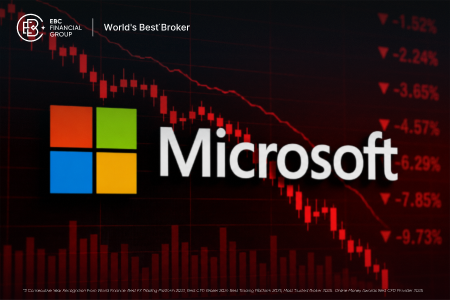
If you zoom into the chart, the story becomes pretty clear. Around the start of June, Microsoft stopped behaving like the strong momentum stock it had been earlier in the year. Instead of pushing higher, the stock started drifting lower with a series of red sessions and weaker rebounds. Nothing explosive—but enough to signal that buyers were stepping back. This is really the first piece of why is Microsoft stock down: momentum simply changed.
A few things stand out in this phase:
Buyers are no longer defending every dip like before
Breakout levels that used to hold are now being retested and failing
The stock is moving more with the broader tech pullback than against it
It feels less like panic selling and more like hesitation—investors taking a breath after a strong run.
A big reason behind why is Microsoft stock down is simply how far and how fast it ran up before. Microsoft became one of the main "AI winners" in the market narrative thanks to its partnership with OpenAI and its integration of AI tools like Copilot across its ecosystem. That excitement pushed the stock higher for months.
But here’s the issue: once expectations get too high, even good news stops being enough. Now investors are asking a more uncomfortable question: Is all of that already priced in?
That shift in thinking is important. Because when a stock moves from "growth story" to "perfect execution required," volatility usually increases.
Another layer behind why is Microsoft stock down is valuation sensitivity. After its strong rally, Microsoft was no longer "cheap" in the eyes of the market. And in environments where interest rates are still a concern, expensive growth stocks tend to feel the pressure first. It’s not that Microsoft suddenly became overvalued in a dramatic sense. It’s more subtle than that.
Investors are basically reassessing:
Is earnings growth strong enough to justify the current price?
Can cloud and AI revenue keep accelerating at the same pace?
Or is growth normalizing after a strong cycle?
When those questions start floating around, stocks like MSFT often pause or drift lower even without bad news.
It’s important to be clear: the AI story isn’t gone. Not at all. Microsoft is still at the center of it. But what has changed is the emotion around it. Earlier in the year, AI felt like a one-way trade. Now it feels more balanced. Investors are starting to ask for proof rather than projections. And that shift helps explain why is Microsoft stock down even though nothing "broken" has happened inside the company.
The market is simply moving from excitement to scrutiny.
Microsoft Azure is still growing, and it’s still a key pillar of the company’s long-term value. But here’s the tricky part: strong growth is no longer enough to push the stock higher on its own. That’s another subtle reason behind why is Microsoft stock down. The reaction now depends on whether results beat expectations—not just meet them.
Some of the current thinking in the market:
Azure growth is solid but more "expected" now
Competition in cloud computing is intensifying
AI-related infrastructure spending is expensive and watched closely
So even good numbers don’t always translate into buying pressure anymore.
Microsoft isn’t moving in isolation. The whole mega-cap tech space has been under pressure at times, especially when investors rotate out of growth stocks. Rising yields and shifting expectations around central bank policy have also made investors more cautious. When rates are a concern, long-duration assets like high-growth tech often lose some appeal. So part of why is Microsoft stock down is simply this: it’s being pulled by the tide of the broader market.
Even strong companies get caught in that wave.
There’s also a very human factor here: people took profits. After a strong run earlier in the year, it’s normal for big institutional investors to lock in gains. That selling doesn’t necessarily mean they’ve changed their long-term view—it just means they’re managing risk.
This creates a ripple effect:
Selling pressure increases
Short-term traders follow the move
Volatility becomes more noticeable
It’s one of the simplest explanations for why is Microsoft stock down: after going up a lot, some people simply cash out.
If you step back, the story isn’t just about Microsoft itself. It’s about how the market is behaving right now.
We’re in a phase where:
Good news doesn’t automatically lift stocks
Expectations are extremely high in tech
Investors are more sensitive to macro signals
Momentum is less reliable than it was a few months ago
So if we ask why is Microsoft stock down, is really a mix of psychology, positioning, and expectations—not a single headline or earnings miss.
At the end of the day, the current weakness in Microsoft feels more like a reset in expectations than a structural problem with the company. Microsoft is still deeply embedded in cloud computing and artificial intelligence, and nothing about that long-term position has changed. But the stock itself has clearly entered a more cautious phase since early June. The Microsoft stock price is adjusting to reality after a strong narrative-driven rally, and that’s usually where things get choppier.
So when people ask why is Microsoft stock down, the honest answer is: it’s not one thing. It’s a combination of cooling momentum, high expectations, profit-taking, and a market that’s simply asking for more proof before pushing it higher again.