Published on: 2026-04-20
Updated on: 2026-04-20
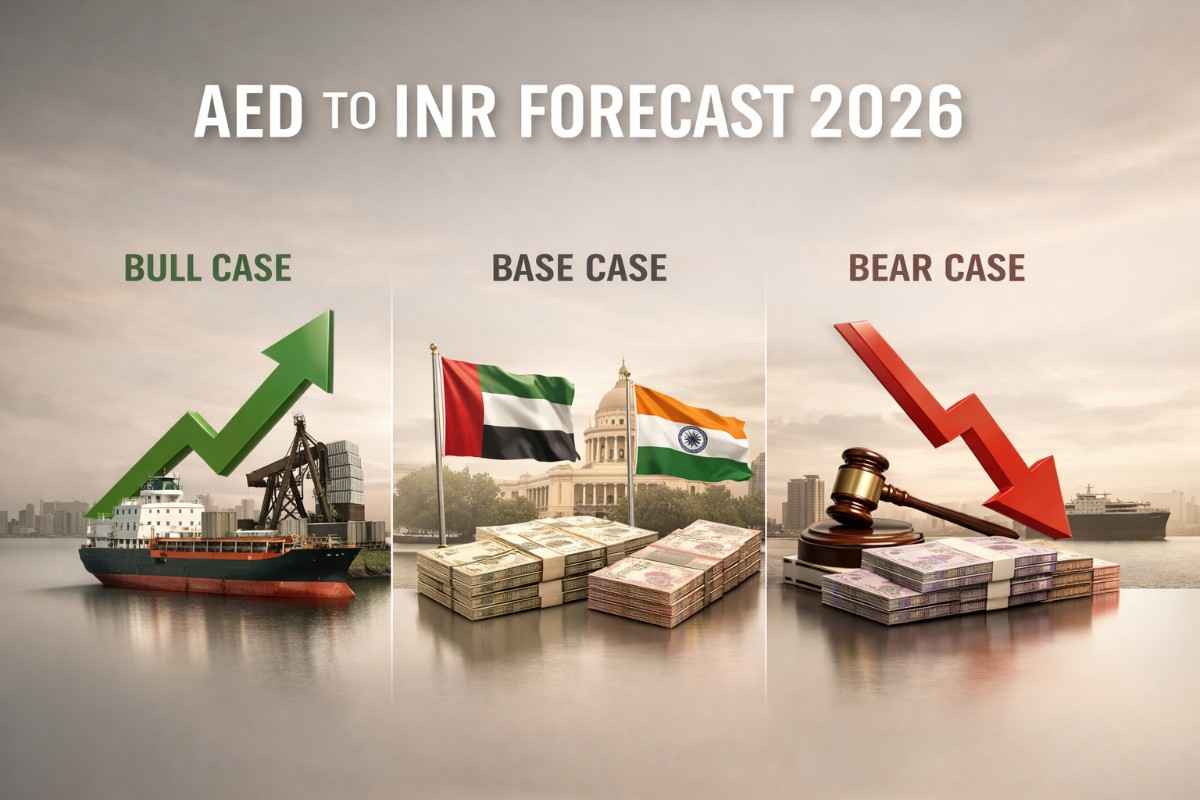
Our AED to INR forecast over the next 3 to 12 months points to a modestly higher cross, mainly because AED/INR is still a USD/INR story filtered through the UAE's dollar peg.
The base-case probability is set at 55%. This estimate is grounded in several factors: the CBUAE's fixed intervention band, the RBI's maintained repo rate of 5.25%, India's sensitivity to oil fluctuations in its external balance, and the RBI's caution regarding potential disruptions in West Asia and the Strait of Hormuz, which could impact both growth and inflation.
That case would require the Fed and CBUAE to stay broadly steady, oil to remain firm, and the RBI to smooth INR weakness rather than fully reverse it. The bull and bear cases are more defined, yet both are valid and important for traders.
| Scenario | Thesis | Probability | Key catalyst | Invalidation trigger | Target move |
|---|---|---|---|---|---|
| Base | AED/INR grinds higher as USD/INR stays firm and oil risk keeps INR under pressure. | 55% | RBI minutes, Apr. 22, 2026 | Fed turns clearly dovish and oil risk fades | +1% to +3% |
| Bull | AED/INR breaks higher if oil and shipping risk worsen and the dollar strengthens again. | 25% | FOMC, Apr. 28-29, 2026 | Oil retreats and India’s external data improve | +4% to +7% |
| Bear | AED/INR stalls or slips if West Asia risk cools, Fed easing resumes, and INR cushions dominate. | 20% | RBI MPC, June 3-5, 2026 | Fresh Hormuz disruption or renewed dollar surge | -2% to 0% |
*Official policy dates come from the RBI and Fed calendars, while the peg mechanics come from the CBUAE. All scenario probabilities and move ranges are our analysis based on the official data cited throughout.
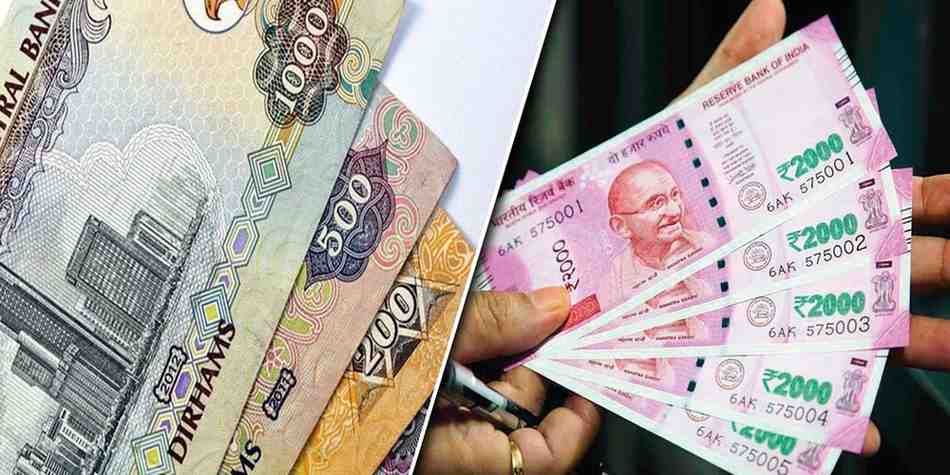
The first driver is structural. The CBUAE states it intervenes automatically to maintain the dirham peg at USD/AED 3.672 when buying US dollars and 3.673 when selling US dollars. That means AED/INR is not behaving like a fully independent bilateral cross. In practical terms, it is still mostly USD/INR translated through a stable AED/USD leg.
The second driver is India's external account. In Q3 FY2025-26, India ran a $93.6 billion merchandise trade deficit, but that was cushioned by $57.5 billion of net services receipts and $36.9 billion in personal transfers.
Over April to December 2025, the current-account deficit was $30.1 billion, or 1.0% of GDP. That mix matters because AED/INR can rise without implying macro breakage. India faces vulnerability due to its reliance on oil and goods imports, but it benefits from a robust services sector and strong remittance support.
The third driver is the mix between policy and inflation. India's March 2026 CPI inflation was 3.40%, against the RBI repo rate of 5.25%. The UAE outlook implies 1.8% inflation in 2026 with the CBUAE Base Rate at 3.65% after the March Fed hold. On a simple policy-minus-inflation lens, the real-rate gap is much narrower than the headline repo spread suggests. That is why nominal carry alone is not enough to stop rupee softness.
This real-rate comparison is based on our analysis of the official inflation and policy data.
| Macro scorecard | India | UAE / AED framework | Why it matters |
|---|---|---|---|
| Policy rate | 5.25% | 3.65% | Nominal carry still favors India |
| Inflation | 3.40% | 1.8% forecast | Real-rate gap is narrower |
| Current account / trade | CAD $13.2bn in Q3 | Peg regime | INR remains oil-sensitive |
| Reserve buffer | $698.346bn | Automatic FX intervention | Volatility can be managed |
| FX anchor | USD/INR sensitive | USD peg at 3.672/3.673 | AED/INR mostly inherits USD moves |
Table inputs are from RBI, MOSPI, and CBUAE releases. The "why it matters" column is our analysis.
Our base case is for AED/INR to edge higher over 3 to 12 months, with a 55% probability and an indicative range of 25.5 to 26.0. The core reason is simple: the pair still tracks USD/INR, and oil plus external-balance risk still matter more than standalone UAE macro.
The official backdrop supports that view. The RBI kept rates unchanged and retained a neutral stance on April 8, while explicitly warning that disruptions in the Strait of Hormuz, higher energy prices, and weather-related shocks could weigh on India's growth and inflation outlook.
Simultaneously, the RBI forecasts 6.9% GDP growth and 4.6% CPI inflation for 2026-27, indicating resilience rather than a crisis. The right shape is therefore upward pressure with controlled volatility. India's $698.3 billion reserve stock also argues against extrapolating short-term INR weakness into a free-fall thesis.
Fed and CBUAE policy remain broadly steady through the next meeting window.
Oil and West Asia shipping risks do not materially ease.
RBI keeps smoothing the pace of INR weakness rather than defending a hard level.
The bull case for AED/INR is a sharper upside move, with 25% probability and a possible +4% to +7% move from mid-April levels. That scenario would require a stronger dollar, firmer oil prices, and renewed stress on shipping and energy flows linked to West Asia.
If the FOMC on April 28-29 pushes back easing expectations, the dirham would inherit that support mechanically through its dollar peg.
If disruptions in freight, insurance, or energy occur, India's goods deficit becomes more significant than its nominal carry advantage. The RBI would still have reserves to slow the move, but the direction could remain higher.
A firmer Fed signal on April 28-29.
Renewed Hormuz or shipping disruption.
Deterioration in India's next external-account prints.
The bear case indicates that AED/INR may level off or slightly retrace, with a 20% likelihood of a move between -2% and 0%. That would likely require softer oil prices, a more dovish Fed path, and clearer signs of improvement in India's external balance.
This is not the case for a stronger independent dirham cycle. It is the case for a less-bad rupee backdrop. India's services exports, remittances, and reserves are real buffers, not narrative decoration.
If risks in West Asia diminish and the dollar weakens, the INR could stabilize without any significant changes from the RBI. That would cap AED/INR even if it does not produce a durable reversal.
A softer Fed message at the next meeting.
Better-than-feared India BoP data.
Falling oil and lower freight stress.
Three near-dated catalysts matter most. First, the RBI minutes on April 22, 2026, could reveal how strongly the committee worries about rupee weakness, oil, and transmission.
Second, the FOMC meeting on April 28-29, 2026, could reprice the entire dollar leg that AED/INR inherits.
Third, the RBI MPC meeting on June 3-5, 2026, matters because any shift away from neutral would change the market's view of the RBI's tolerance for INR weakness.
A material improvement in India's next BoP numbers, or a visible easing in Hormuz-related risk, would also force a downgrade of the bullish AED/INR bias.
"Elevated energy and other commodity prices, coupled with supply shock due to disruptions in the Strait of Hormuz, would act as a drag." Reserve Bank of India, Monetary Policy Statement, April 8, 2026.
The base case is a modest rise in AED/INR, with 55% probability. Our rationale is based on the AED's dollar peg, India's oil-sensitive trade position, and the RBI's current focus on managing volatility rather than enforcing a directional reversal.
A stronger dollar following the April 28-29, 2026, FOMC meeting, renewed disruption in the Strait of Hormuz, or surged in shipping and energy stress could all contribute to a higher AED/INR.
The main risks include lower oil prices, easing tensions in West Asia, and improved Indian external-account data. India's services receipts, remittances, and $698.346 billion reserve buffer mean rupee weakness can stay orderly, and sometimes smaller than macro headlines imply.