Published on: 2026-04-17
Updated on: 2026-04-17
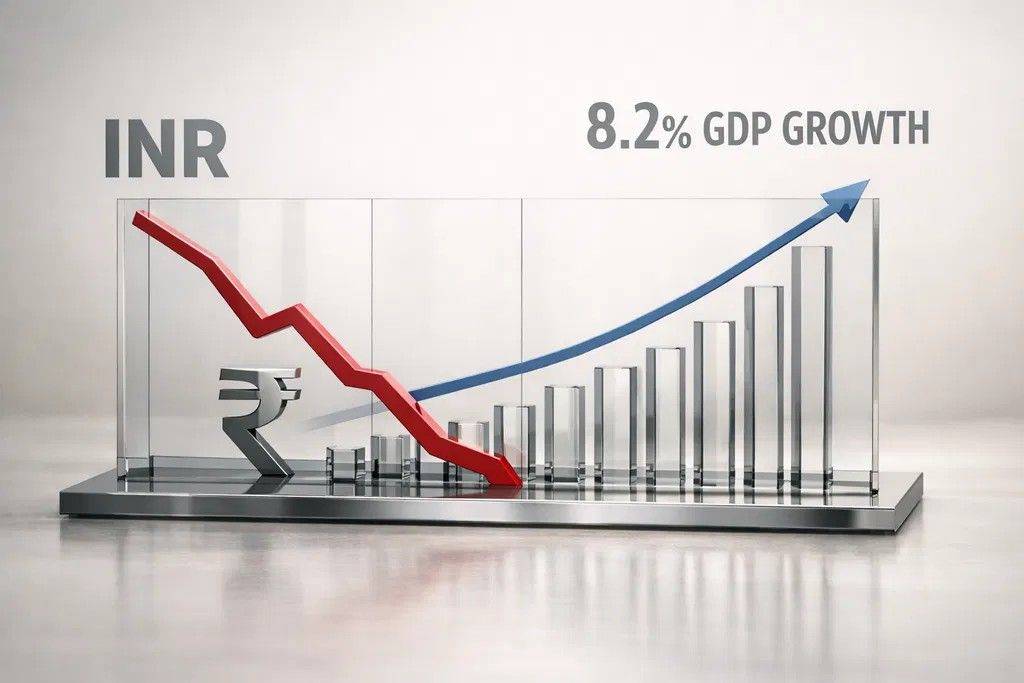
India's growth story remains intact, but the rupee is weakening because FX markets are not rewarding yesterday's output print. They are pricing today's external balance, oil-linked dollar demand, capital flows, and the US dollar's safe-haven bid.
India's FY2023-24 real GDP grew by 8.2%, yet the rupee recently hit a record low of 92.63 per US dollar amid intensifying trade and portfolio pressures.
The disconnect is visible in the external accounts.
India's FY2023-24 real GDP rose 8.2%, but nominal GDP grew 9.6%.
The external account is the real pressure point: Q3 FY2025-26 merchandise deficit was $93.6 billion, versus $79.3 billion a year earlier, even as net services receipts improved to $57.5 billion.
The rupee's latest weakness has been amplified by portfolio selling. NSDL data show net FPI outflows of about ₹1.78 lakh crore through April 16 in calendar 2026.
India still holds substantial buffers, including $697.12 billion in forex reserves and strong services receipts, but those buffers smooth volatility rather than eliminate structural pressure.
The RBI's policy aims to reduce excessive volatility rather than maintain a rigid USD/INR exchange rate. This indicates that a gradual depreciation can continue even with substantial reserves.
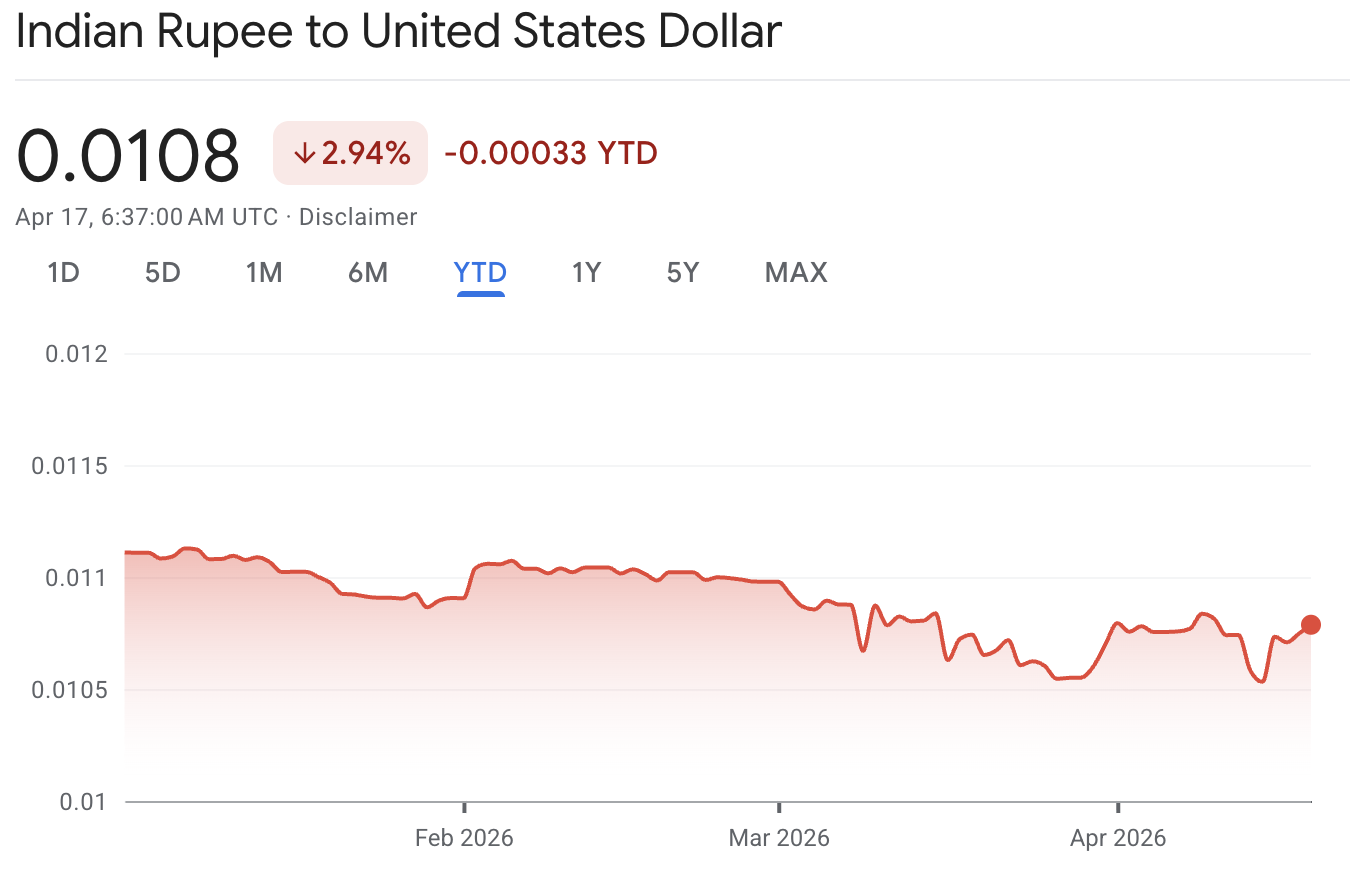
As explained above, India's rupee is falling because currency markets price external balances, not headline GDP alone. India's 8.2% FY2023-24 growth was real.
But the rupee is now being driven by a wider goods deficit, heavy oil-related dollar demand, portfolio outflows, and safe-haven strength in the US dollar, all of which matter more for near-term FX pricing.
| Indicator | Latest reading | Why it matters for INR |
|---|---|---|
| FY2023-24 real GDP growth | 8.2% | Strong domestic output, but not a direct FX support on its own |
| FY2023-24 nominal GDP growth | 9.6% | Better reflects current-value activity, still separate from dollar-flow dynamics |
| Q3 FY2025-26 current account deficit | $13.2 billion, 1.3% of GDP | Shows external funding pressure |
| Q3 FY2025-26 merchandise trade deficit | $93.6 billion | Large structural demand for foreign currency |
| Q3 FY2025-26 net services receipts | $57.5 billion | Important stabiliser, but not enough to erase the goods gap |
| USD/INR on Mar. 18, 2026 | 92.63 | Record low that signals acute external stress |
| Net FPI flow, 2026 through Apr. 16 | -₹1.78 lakh crore | Portfolio outflows add immediate dollar demand |
| Forex reserves, week ended Apr. 3, 2026 | $697.12 billion | Large buffer, but mainly for smoothing volatility |
*Table compiled from MoSPI, RBI, NSDL, and Reuters-linked market reporting through April 17, 2026.
The table shows the mismatch between domestic growth and the external-flow picture that drives FX markets. Output growth is solid, but the marginal flow picture is not. A $93.6 billion quarterly goods deficit, a 1.3% current account deficit, and a record-low exchange rate tell investors that India still needs a steady supply of foreign currency to fund growth.
Robust GDP growth does not necessarily lead to a stronger currency, as marginal foreign exchange flows primarily determine exchange rates. If growth is powered mainly by domestic demand, capex, and imported energy rather than export earnings, it can widen the trade gap, raise dollar demand, and leave the currency softer even as output expands rapidly.
The 8.2% figure refers to real GDP growth in FY2023-24. Exchange rates, by contrast, respond to actual foreign-currency flows: exports, imports, remittances, capital inflows, debt servicing, and hedging demand. A country can grow fast in real terms and still see its currency weaken if domestic demand pulls in more imports than exports generate in dollars.
That is close to India's current mix. The RBI said FY2025-26 growth was driven significantly by private consumption and fixed investment, while net external demand remained soft. That combination is constructive for domestic activity but not automatically supportive for the rupee.
There is also a timing issue. The market is not pricing FY2023-24 in isolation. It is pricing current pressure points: higher freight and insurance costs, elevated oil prices, portfolio outflows, and a stronger US dollar.
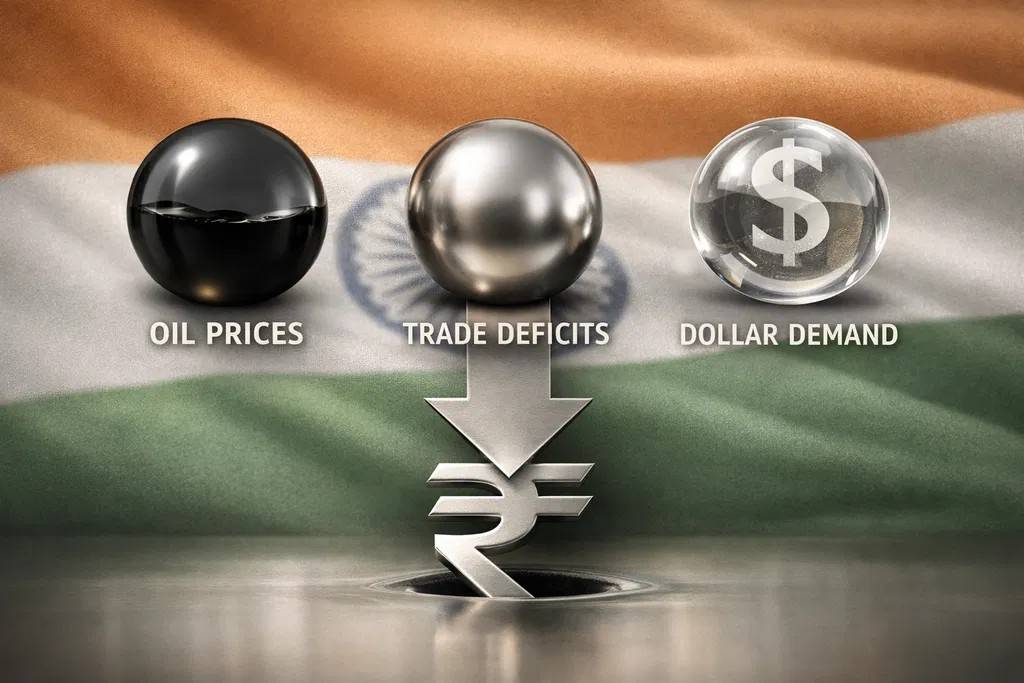
Oil prices are significant because India remains structurally dependent on imported energy, so every jump in crude widens the import bill and increases spot demand for dollars. When that pressure coincides with soft exports, higher freight costs, and a stronger US dollar, the rupee weakens even if domestic GDP remains resilient.
Higher crude prices raise the import bill, worsen the trade balance, and increase spot demand for dollars from refiners. Reuters reported Brent had risen about 40% since the Middle East war began, while the rupee had fallen more than 1.5% over the same period.
The BOP data show the same pattern at a broader level. India's merchandise trade deficit widened to $93.6 billion in Q3 FY2025-26 from $79.3 billion a year earlier. In March 2026, the goods deficit was $20.76 billion. Services and remittances still help, but they are working as shock absorbers rather than fully offsetting the goods gap.
Capital flows and central bank behavior shape the rupee because portfolio investors can move much faster than trade flows. When foreign funds sell Indian equities and the RBI focuses on smoothing volatility rather than defending a specific exchange-rate level, depreciation can continue in an orderly but persistent way.
Portfolio flows can overwhelm the day-to-day currency market because they reprice quickly. NSDL data indicates net FPI outflows totaling approximately ₹1.78 lakh crore from 2026 through April 16. Reuters also reported nearly $8 billion of foreign portfolio outflows from local stocks during the acute March selloff.
The RBI's own annual report says that foreign-exchange operations are aimed at curbing excessive volatility and ensuring an orderly movement in the exchange rate, not at targeting a fixed level. That distinction is crucial: reserves can slow disorderly depreciation, but they are not designed to erase every external shock.
That is why forex reserves should be read as insurance, not a guarantee. India's reserves stood at $697.12 billion for the week ended April 3, 2026. Yet even with that buffer, the RBI asked state-run refiners to limit spot-dollar purchases and instead use a credit line.

A weaker rupee raises imported inflation, pressures margins in oil-intensive sectors, and can tighten domestic financial conditions even when headline growth looks strong. Exporters and IT services gain some translation support, but the broader macro effect is to increase policy caution, especially when energy prices and external risks stay elevated.
A softer rupee raises the landed cost of imported energy and other traded inputs. The RBI's April policy already warned that conflict-driven supply disruptions and higher energy prices could weigh on growth and complicate inflation management.
Exporters in software services and pharmaceuticals may benefit from translation gains, but sectors dependent on imported fuel or components face cost pressure. That usually narrows equity leadership and makes foreign investors more selective.
A rapidly weakening currency limits the room for aggressive monetary easing, even when domestic growth remains respectable. With the repo rate at 5.25% and the RBI maintaining a neutral stance, policymakers appear focused on preserving flexibility while using liquidity and forex tools to prevent destabilising moves.
Not necessarily. In India's case, the problem is less about the quality of domestic growth and more about the external financing mix.
Partly, but not fully. India's net services receipts increased to $57.5 billion in Q3 of FY2025-26, continuing to serve as a major stabilizer. Even so, the merchandise trade deficit reached $93.6 billion in the same quarter, leaving the current account in deficit.
The RBI can smooth volatility and deter speculative overshoots, but it does not operate with an explicit fixed target for USD/INR. Its own framework is to maintain orderly market conditions.
Yes. Exporters and sectors with US dollar revenues can benefit, especially if their costs are mostly rupee-based. But for a large oil importer like India, the inflationary and balance-of-payments costs of depreciation usually matter more at the macro level than the export benefit alone.
India's 8.2% GDP growth and a falling rupee are not contradictory. They reflect two different scorecards. GDP measures domestic output. The exchange rate measures the balance between foreign-currency demand and supply. Right now, that balance is being shaped by a wider goods deficit, elevated oil exposure, portfolio outflows, and a stronger US dollar.
As long as services exports, remittances, and reserves remain strong, the rupee's adjustment can stay orderly rather than disorderly. But unless oil pressure fades, portfolio flows stabilise, and the external deficit narrows, strong growth alone will not be enough to deliver a stronger currency.