Published on: 2026-04-14
Updated on: 2026-04-14
The dollar rose as oil prices climbed, Treasury yields firmed, and geopolitical tensions intensified. Yet the move remained limited. That is what makes it worth studying.
In a more forceful risk episode, traders would normally expect a broader and cleaner safe-haven bid. Instead, the greenback advanced only modestly, suggesting the market was reacting to risk without fully embracing a worst-case macro scenario.
The dollar strengthened on April 13, but the move was limited relative to the scale of the shock. The ICE U.S. Dollar Index rose about 0.4% to 99, while Brent settled at $99.36, and the 10-year Treasury yield rose to about 4.342%.
That matters because macro markets are judged by confirmation, not direction alone. When an asset moves less than the backdrop would suggest, the restraint can be informative.
By April 14, Brent had eased to about $98.12 and U.S. crude to $96.92, while the dollar softened slightly against the euro and yen as hopes for renewed U.S.-Iran talks resurfaced.
March U.S. CPI rose 0.9% month over month and 3.3% year over year, while core CPI rose 0.2% and 2.6%, respectively, helping keep yields and rate expectations relevant to the dollar outlook.
The next major macro checkpoints are the IMF-World Bank Spring Meetings from April 13 to 18 and the FOMC meeting on April 28 to 29.
A muted rally is not the absence of a move. It is a move that falls short of what the macro backdrop would usually justify.
On April 13, the setup for a stronger dollar was unusually clear. Brent briefly traded above $100 before settling at $99.36, WTI finished at $99.08, and the 10-year Treasury yield climbed to about 4.342%. Against that mix of higher energy prices, inflation pressure, and geopolitical stress, a rise in DXY to only about 99 looked restrained rather than decisive.
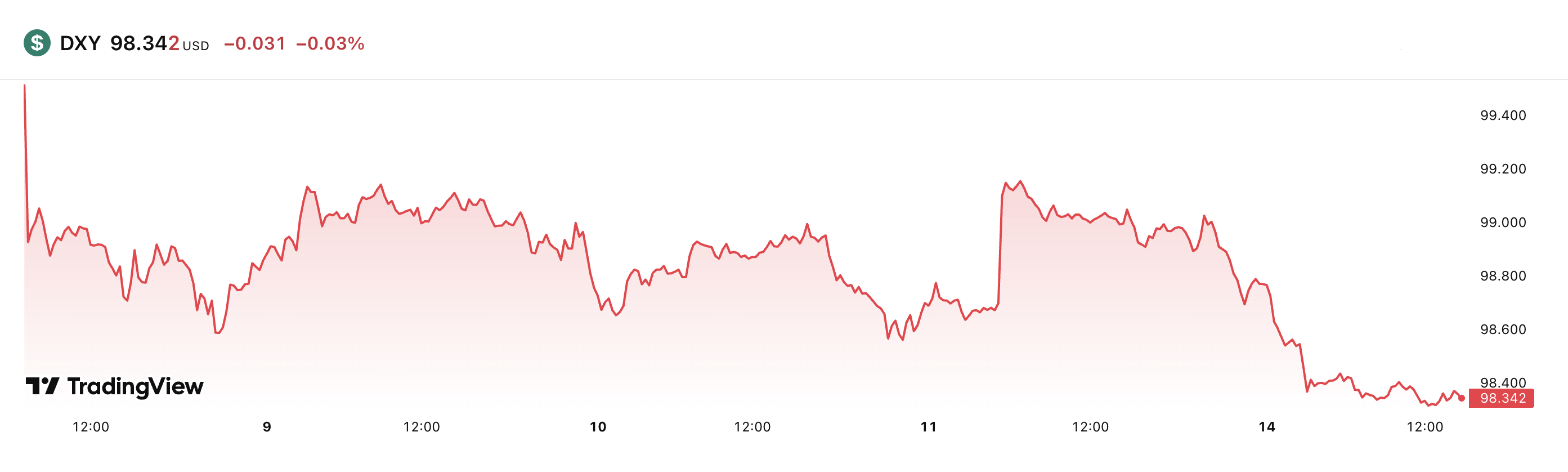 That distinction matters because markets reveal conviction through follow-through. A major headline shock paired with only a modest currency response often suggests traders are pricing risk with conditions attached, rather than fully committing to a one-directional outcome.
Macro markets are rarely about whether an asset moved at all. They are about whether the move matched the size of the catalyst.
That is why the dollar’s April reaction deserves attention. Oil moved like a market confronting supply risk. Inflation expectations remained relevant. Yields pushed higher. The dollar rose, but not with the kind of urgency that usually defines a full safe-haven scramble.
The restrained move should not obscure the fact that the dollar strengthened for valid reasons.
The first was safe-haven demand. The U.S. dollar remains the dominant reserve currency, and periods of acute geopolitical stress still tend to support flows into dollar-denominated assets. That floor of demand was visible in the April 13 session.
The second was relative energy exposure. Higher oil prices typically hurt large importing economies more than they hurt the United States, whose domestic energy position is far stronger than it was in earlier decades.
That does not make the U.S. immune to an oil shock, but it does make the damage less symmetrical across major economies. In relative terms, that can support the dollar.
The third was inflation and yield support. The U.S. Bureau of Labor Statistics reported that March CPI rose 0.9% on a seasonally adjusted basis and 3.3% over 12 months.
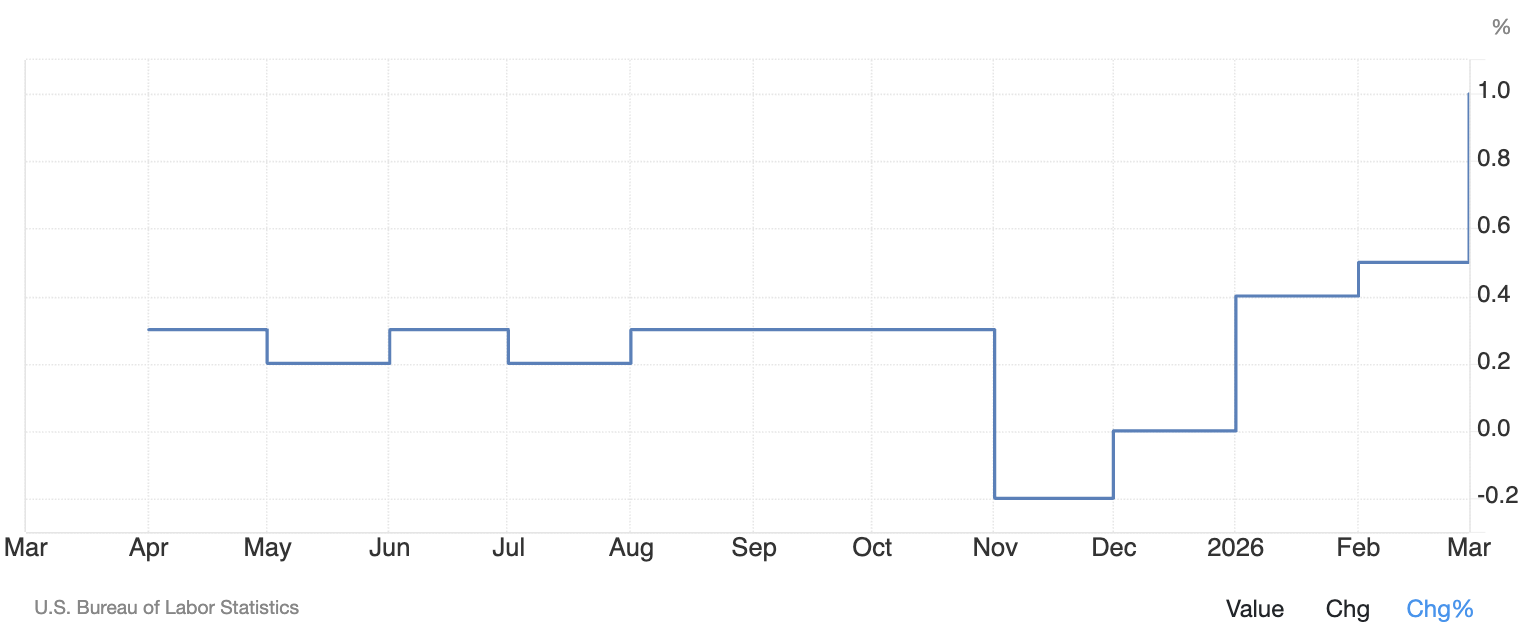
Core CPI rose 0.2% on the month and 2.6% over the year. Energy prices were a major driver, with the energy index up 10.9% in March and gasoline up 21.2%. That backdrop helped keep Treasury yields firm and supported the dollar through rate differentials.
The more revealing part of the move was not that the dollar rose, but that the advance remained limited.
By April 14, markets had already begun to scale back the most severe version of the shock. Brent crude eased to about $98.12, U.S. crude fell to roughly $96.92, and the dollar softened slightly against the euro and yen as hopes for renewed talks resurfaced. That shift suggested traders were treating the situation as fluid rather than entrenched.
In practical terms, the market was cautious, but not yet positioned for a prolonged one-way crisis. The greenback retained support from geopolitical risk and higher energy prices, but that support was capped by the view that diplomacy could still regain traction and that the oil spike might not prove durable.
One of the more useful concepts in macro analysis is confirmation. When a major headline shock occurs, the key question is whether the most sensitive assets respond in proportion.
When they do not, the absence of full confirmation can be informative. In this case, the market appears to be pricing risk with three conditions attached:
Energy constraint: Oil remains elevated, but does not sustain a move materially above $100.
Geopolitical containment: Diplomatic re-engagement prevents the ceasefire from fully breaking down.
Policy restraint: The Federal Reserve remains cautious rather than shifting toward renewed tightening. The next policy test comes at the April 28- 29 FOMC meeting.
If any of those conditions were to fail, the dollar calculus would change. A sustained move in oil above $100, a broader ceasefire breakdown, or a materially more hawkish Fed signal would likely give the safe-haven bid a sharper character and greater magnitude. That is the practical value of the muted-dollar thesis: it highlights not just what happened, but what did not happen.
Traders often use DXY as shorthand for the dollar, and for good reason. ICE describes the U.S. Dollar Index as a widely recognized benchmark for the international value of the dollar relative to a basket of currencies. Its six components are the euro, Japanese yen, British pound, Canadian dollar, Swedish krona, and Swiss franc.
But the Federal Reserve also publishes broader trade-weighted dollar indexes against a wider group of U.S. trading partners. That means “the dollar” is never just one line on one chart.
A muted move in DXY may still differ from what broader trade-weighted measures eventually show. For traders, that distinction matters because it prevents overreading one benchmark in isolation.
The dollar is being priced against more than oil and geopolitics. It is also being priced against a live policy calendar.
The 2026 Spring Meetings of the IMF and World Bank are taking place in Washington from April 13 to 18, bringing together policymakers at a moment when energy prices, inflation, and global growth risks are all in focus.
The Fed then meets on April 28 and 29. That sequence matters because it keeps growth, inflation, and policy communication in the foreground, even as geopolitical headlines drive day-to-day moves.
A muted rally in that setting does not signal indifference. It signals unresolved inputs.
Because the market still responded to higher oil, firmer yields, and geopolitical risk. “Muted” describes the scale of the move, not the absence of one.
It usually means price action did not fully confirm the apparent size of the catalyst. Traders reacted, but not with full conviction.
Partly, yes. But the move has also been shaped by oil, inflation expectations, and relative U.S. resilience, not just classic panic demand.
Oil affects inflation expectations, bond yields, and relative growth assumptions across economies. A sustained rise in oil can support the dollar, especially if other major economies look more exposed.
A stronger and more sustained dollar breakout, especially if paired with higher oil, firmer yields, and fading hopes for diplomacy.
The dollar’s recent move matters not because it was dramatic, but because it was restrained. It rose into a classic mix of higher oil, firmer yields, and geopolitical stress, yet it did not break out with the force usually associated with a full safe-haven rush.
That suggests traders are responding to risk while still leaving room for softer oil, renewed diplomacy, and a Federal Reserve that remains cautious rather than overtly hawkish. For traders trying to understand the dollar outlook, the more useful signal may not be that the greenback rose. It may be that it rose only modestly.
Disclaimer: This material is for general information purposes only and is not intended as (and should not be considered to be) financial, investment or other advice on which reliance should be placed. No opinion given in the material constitutes a recommendation by EBC or the author that any particular investment, security, transaction or investment strategy is suitable for any specific person.