Published on: 2026-04-08
There are currency crosses that trade on headlines, and there are crosses that trade on fundamentals. AUD/NZD belongs firmly to the second camp.
Strip away the dollar, the global risk cycle, and the noise of US rate expectations, and what remains is a purer question: what happens when two neighbouring economies, bound by geography, trade, and structural similarity, travel through genuinely different monetary cycles at the same time? The answer, right now, is AUD/NZD.

With Australia's cash rate at 4.10% and New Zealand's Official Cash Rate at 2.25%, the pair carries one of the most instructive policy gaps in the G10 universe. But treating it as a simple spread trade is to miss most of what the cross actually tells you.
Most traders learn macro through major pairs like EUR/USD, AUD/USD, and cable. The problem is that major pairs are noisy. AUD/USD does not just move on Australian data.
It moves on US payrolls, Fed tone, China demand, and broad risk sentiment. Isolating the Australian fundamental story inside that noise is genuinely difficult.
AUD/NZD removes most of that interference. When the pair moves, the dominant explanation lies in the relative position of the RBA and RBNZ, their rate settings, their inflation assessments, and their growth outlooks. The US dollar is not a variable here.
That makes this cross unusually clean for the kind of analysis that builds lasting understanding of how FX pricing actually works.
The core lesson it teaches: a currency does not strengthen simply because its central bank sounds firm. It strengthens when the entire macro backdrop supports that stance and sustains it.
The Reserve Bank of Australia raised the cash rate to 4.10% on March 17, 2026, judging that inflation was likely to remain above target for some time and that risks had tilted further to the upside, including inflation expectations.
This matters because it tells the market the RBA still sees enough demand and inflation pressure to justify a tighter stance. In FX, a higher rate only carries weight if the market believes it can persist. Australia’s current policy signal supports that view.
New Zealand’s signal is more complicated. The RBNZ left the OCR at 2.25% on April 8, 2026 and explained that higher fuel prices were likely to push inflation up to 4.2% in the June quarter.
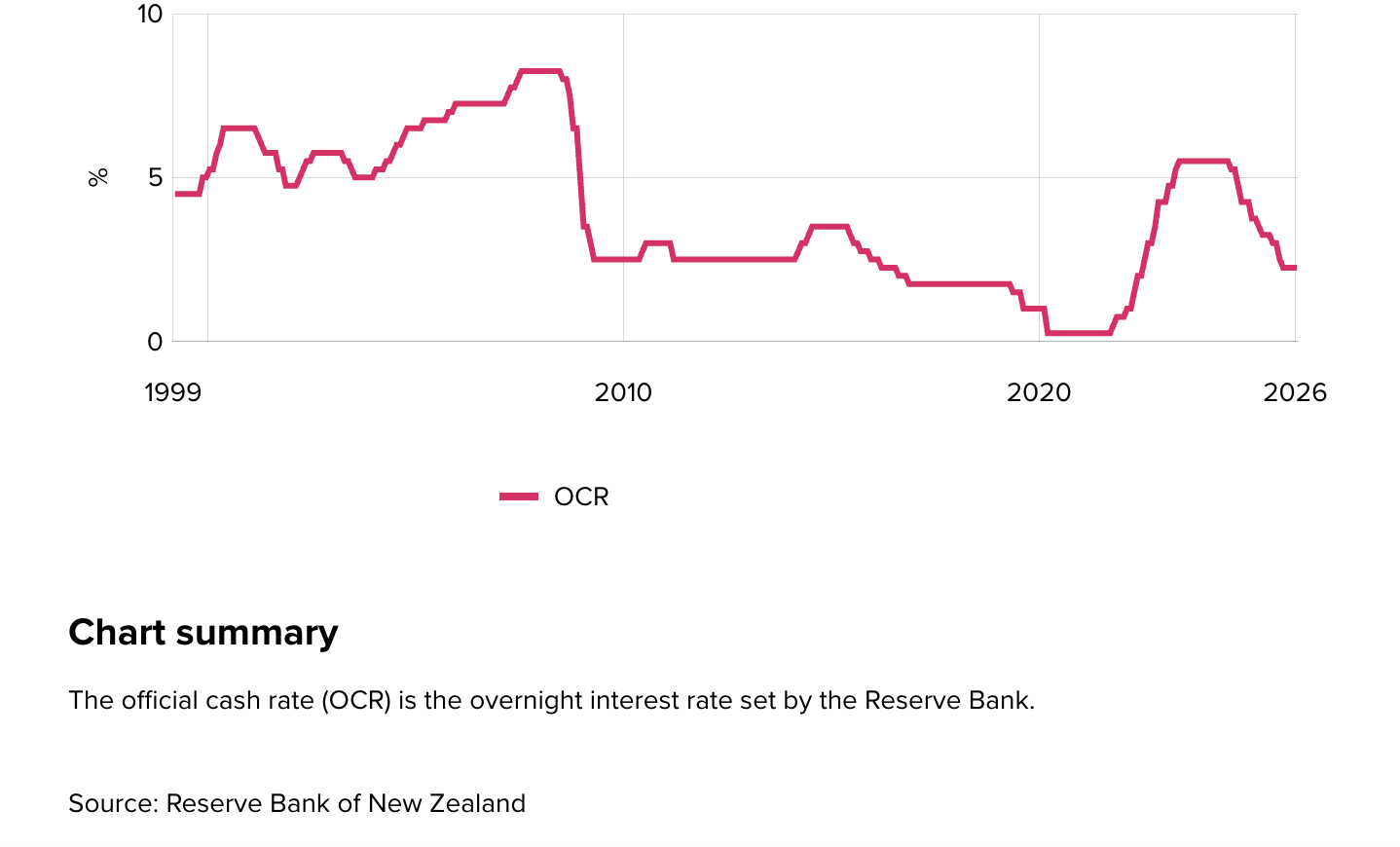
At the same time, it said those same fuel costs would squeeze household spending power and business margins, and that holding rates balanced the risk of responding too early against the cost of unnecessarily slowing the economy.
That is not a simple dovish pause or a simple hawkish hold. It is a balancing decision, and that nuance is exactly why the NZD response is less straightforward than the Australian dollar’s.
Interest rate differentials are most powerful in FX when growth differentials reinforce them. This is precisely the configuration AUD/NZD currently exhibits.
Australia's GDP expanded 0.8% in the December 2025 quarter and 2.6% over the year. New Zealand's economy grew just 0.2% in the same quarter and 0.2% through the year, barely registering momentum.
That gap matters because it tells the market that the higher-yielding currency belongs to the stronger economy. Yield and growth pointing in the same direction create more durable FX trends than yield alone.
The labour market data reinforce the same conclusion. Australia's unemployment rate rose to 4.3% in February 2026, but that remains meaningfully below New Zealand's 5.4% as of December 2025.
More slack across the Tasman means more room for activity to soften before the RBNZ needs to shift tone, and less urgency to defend the NZD through a tighter stance.
| Indicator | Australia | New Zealand | Signal for AUD/NZD |
|---|---|---|---|
| Policy rate | 4.10% | 2.25% | AUD holds the carry advantage |
| Latest CPI | 3.7% | 3.1% | Both face persistent inflation |
| Underlying inflation | Trimmed mean 3.3% | Above target band | RBA’s restrictive stance looks more justified |
| Unemployment | 4.3% | 5.4% | More labour slack in New Zealand |
| GDP growth | 0.8% q/q, 2.6% y/y | 0.2% q/q, 0.2% y/y | Australia has firmer domestic momentum |
These numbers are why AUD/NZD is best understood as a relative-policy and relative-growth cross, not a simple reaction to a single meeting or CPI print.
AUD/NZD is not a one-way trade dictated solely by rate differentials. Australia’s higher cash rate gives the Australian dollar a structural advantage, but that does not leave the New Zealand dollar without support.
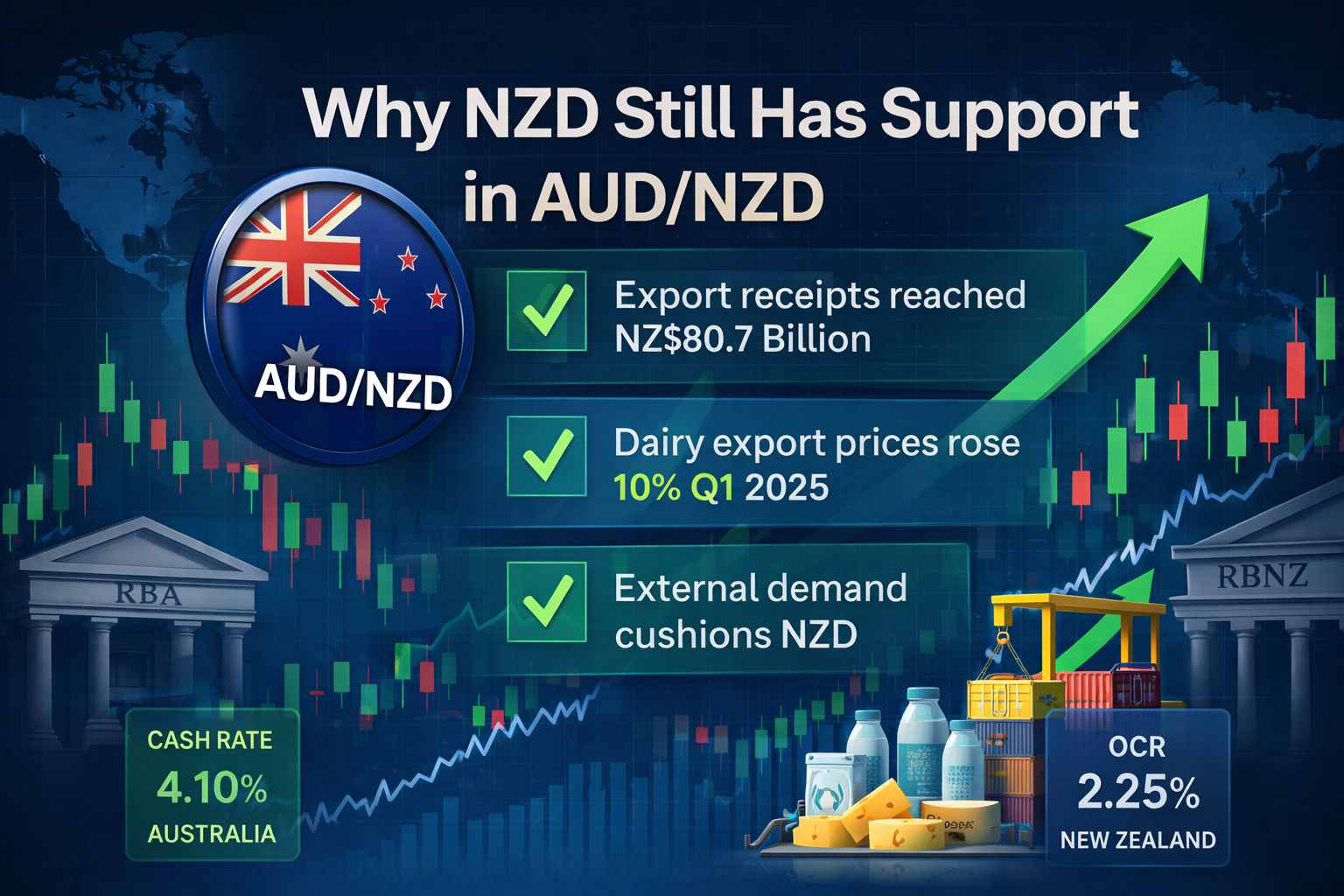
Crosses rarely move on monetary policy alone. Export income, terms of trade, and external demand can all moderate the effect of a policy gap.
New Zealand’s support base is still visible in three areas:
Export receipts remain firm. Goods exports reached NZ$80.7 billion in the year ended December 2025, the first time annual exports moved above NZ$80 billion.
Dairy pricing has strengthened. Dairy export prices rose 10% in the March 2025 quarter, while milk powder prices increased 13%.
External demand still matters. Stronger export earnings can cushion the NZD even when domestic interest rates remain below Australia’s. This helps explain why a rate gap does not always produce a clean, uninterrupted trend.
That is what makes the pair more instructive than a simple spread trade. Policy divergence may favour AUD, but trade performance can still underpin NZD.
When those forces pull in different directions, price action often becomes less linear, more uneven, and more sensitive to incoming macro data.
The cleanest framework begins with the rate gap. That is the first anchor, because it shapes carry and relative return. The second step is the growth gap. Higher rates backed by stronger GDP and a firmer labour market tend to carry more weight in FX than higher rates backed by weak activity.
The third step is inflation quality. Inflation driven by persistent domestic demand usually supports a restrictive currency story more than inflation driven by imported cost shocks. The fourth step is external support, including export income and terms of trade.
Applied to AUD/NZD, that framework still points to an Australian advantage. Australia combines higher rates, stronger growth, and a central bank that has recently tightened. New Zealand combines lower rates, weaker growth, and an inflation problem complicated by softer domestic demand.
But the cross is not a slogan. NZD still draws support from export strength, which is why the pair is best treated as a balance of forces rather than a one-directional narrative.
It means the RBA and the RBNZ are not operating on the same monetary path. Australia’s cash rate is 4.10%, and New Zealand’s OCR is 2.25%, so the pair reflects a meaningful difference in policy settings and the macro conditions behind them.
Because the hold reflected a trade-off rather than a cleanly hawkish signal. The RBNZ said fuel-price shocks would lift short-term inflation but also weaken spending power and activity, making the message more mixed for the currency.
No. The rate gap is the starting point, but growth, labour-market conditions, inflation persistence, exports, and terms of trade all shape the pair. That is why NZD can still find support even when Australia offers a higher yield.
AUD/NZD is not a complicated pair to understand. It is a complex pair to trade, which is a meaningful distinction.
The underlying framework is clear: Australia offers higher rates, stronger growth, and a central bank still actively concerned about inflation. New Zealand offers lower rates, softer growth, and a policy dilemma that is unlikely to resolve cleanly in the near term. That configuration favours the Australian dollar on most measures.
What makes the pair interesting is New Zealand's export strength, the nuance in the RBNZ's communication, and the reality that currency markets are always pricing a distribution of future outcomes rather than a single direction.
Disclaimer: This material is for general information purposes only and is not intended as (and should not be considered to be) financial, investment or other advice on which reliance should be placed. No opinion given in the material constitutes a recommendation by EBC or the author that any particular investment, security, transaction or investment strategy is suitable for any specific person.