Published on: 2026-07-16
Updated on: 2026-07-16
The fast-food giant that once seemed completely immune to inflation, market panic, and changing consumer tastes is facing a rare moment of reckoning. For decades, investors treated the company as a safe haven—a rock-solid cash machine that performed well in good times and even better in bad times. But that long-standing thesis is officially hitting a wall.
In a selloff that has caught many off guard, McDonald's stock has spent the last few months in a steady, painful decline. Shares recently tumbled to a 52-week low of $264.09, representing a massive slide of roughly 23% from its peak. This drop has effectively wiped out nearly two years of hard-won market gains and dragged the company’s valuation back to mid-2024 levels.
This isn’t just a minor blip on a chart. It is a fundamental shift in how Wall Street views the limits of fast-food pricing power. With McDonald's stock now hovering near multi-year lows, the market is reflecting a harsh reality that everyday diners have been talking about for a while: fast food has gotten expensive, and consumers are finally drawing a line in the sand.
To understand why the company is struggling to keep its footing, we have to look past the slick corporate presentations and examine what is actually happening at the cash registers.
For a stock traditionally known for its low volatility, the speed and depth of this correction have been brutal. As of mid-July 2026, the equity is testing major psychological support levels.
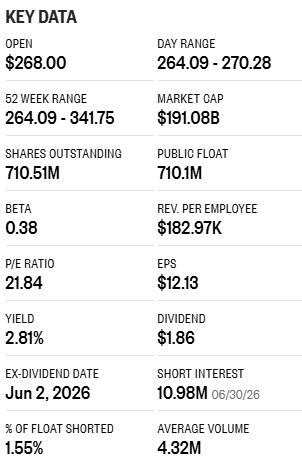
This selloff has compressed the company’s price-to-earnings (P/E) multiple to just under 22x, a sharp drop from its premium valuation of nearly 28x last year. While value investors are eyeing this drop as an attractive entry point, institutional money managers are hesitant. The core concern isn't today's earnings; it’s whether the company can sustain its historical growth when its customer base is actively looking for ways to spend less.
The downward pressure on McDonald's stock isn't the result of a single bad quarter or an isolated PR disaster. Instead, it is the cumulative impact of several structural challenges hitting the business at the exact same time.
For a long time, the quick-service restaurant industry relied on steady, incremental price hikes to offset rising food, paper, and energy costs. Because customers kept paying, corporate executives assumed the brand possessed unlimited pricing power. They were wrong.
After years of compounding menu inflation, a trip to the drive-thru is no longer a casual, low-thought transaction. When social media platforms are flooded with receipts of $18 meals and $3 hash browns, a brand loses its identity as a budget champion. The latest retail data shows that lower-income households—the historical engine of the brand's volume sales—are dropping out of the system. Foot traffic at U.S. stores has turned negative, forcing locations to rely on fewer, higher-paying customers rather than steady, reliable volume.
In a frantic effort to win back disgruntled diners, corporate launched a highly publicized $5 Value Meal. While the promotion did succeed in bringing some traffic back, it exposed a deep rift in the company’s business model:
Franchisee Burnout: Roughly 95% of McDonald's locations in the U.S. are owned and operated by independent franchise owners. These operators are currently dealing with historic labor costs and steep property bills. Being forced to sell a full meal for $5 leaves them with practically no profit margin.
Cannibalization of Regular Sales: Instead of bringing in entirely new, budget-conscious diners, cheap promotions often backfire. Regular customers who would have spent $12 on a premium combo are simply trading down to the $5 promo, which actively shrinks the average check size.
This internal friction is showing up clearly in the financial statements. Recent analysis shows that the company's gross margins have compressed from 58% in late 2025 down to 56% in early 2026. While a 2% drop might sound minor to an outsider, for a business of this scale, it represents hundreds of millions of dollars in lost operating income, triggering immediate downgrades from Wall Street analysts who watch these margins like hawks.
Even with McDonald's stock taking a beating, it is vital to remember that the corporate parent operates a very different business model than its competitors. McDonald's is not primarily a food business; it is a real estate empire.
The corporate entity in Chicago owns the physical land and buildings of the vast majority of its 40.000 global locations. The local operators are tenants who pay rent—often structured as a fixed base plus a percentage of store revenue—back to the parent company.
This franchise structure shields corporate from the worst of the operational headaches. If food costs spike or a local kitchen struggles to find staff, the franchisee absorbs the blow. Corporate still collects its rent and royalty checks. This high-margin real estate income is why the parent company consistently generates over $7 billion in annual free cash flow. This steady cash is the primary safety net protecting the stock's dividend yield, which has climbed to a highly competitive 2.8% during this downturn.
Analysts are deeply split on whether McDonald's stock is a value trap or a generational buying opportunity.
On one side, the bears argue that the brand’s core competitive advantage—affordability—has been permanently damaged. Rebuilding that trust with consumers will require years of cheap promotions, which will weigh heavily on franchisee health and corporate profit margins. Furthermore, with same-store sales slowing down across the wider restaurant sector, there is no easy catalyst to turn things around in the near term.
On the other hand, the bulls point out that the company has a massive digital weapon in its pocket. The mobile app has become a runaway success, allowing the brand to collect rich customer data, push personalized discounts to users, and drive high-margin digital sales. If the broader economy slides into a recession, the natural "trade-down" effect will almost certainly push middle-class consumers away from sit-down dining and back into the drive-thru lane.
Traders who want to capitalize on this consumer value shift through single-stock equity exposure can access MCD.N (McDonald's) as a stock CFD through EBC’s share CFDs platform. This approach allows you to express your thesis on the fast-food giant directly, utilizing flexible leverage and the ability to go long or short as the company navigates its current valuation lows.
There is no sugarcoating the reality: the recent drop in McDonald's stock is a clear signal that the company’s post-inflation honeymoon is over. You cannot raise prices indefinitely without eventually breaking the consumer's back.
However, writing off a brand with this level of scale, real estate backing, and cash-generating power is usually a bad bet. The business is not structurally broken, but it is going through a necessary, painful transition. If corporate can successfully balance the needs of its struggling franchisees with the budget realities of everyday families, the golden arches will eventually find their footing again. But until we see clear evidence of foot traffic recovering and profit margins stabilizing, the stock is likely to remain in the penalty box.