Published on: 2026-05-06
India stock market in 2026 is being shaped by a rare contest between persistent foreign selling and unusually strong domestic liquidity.
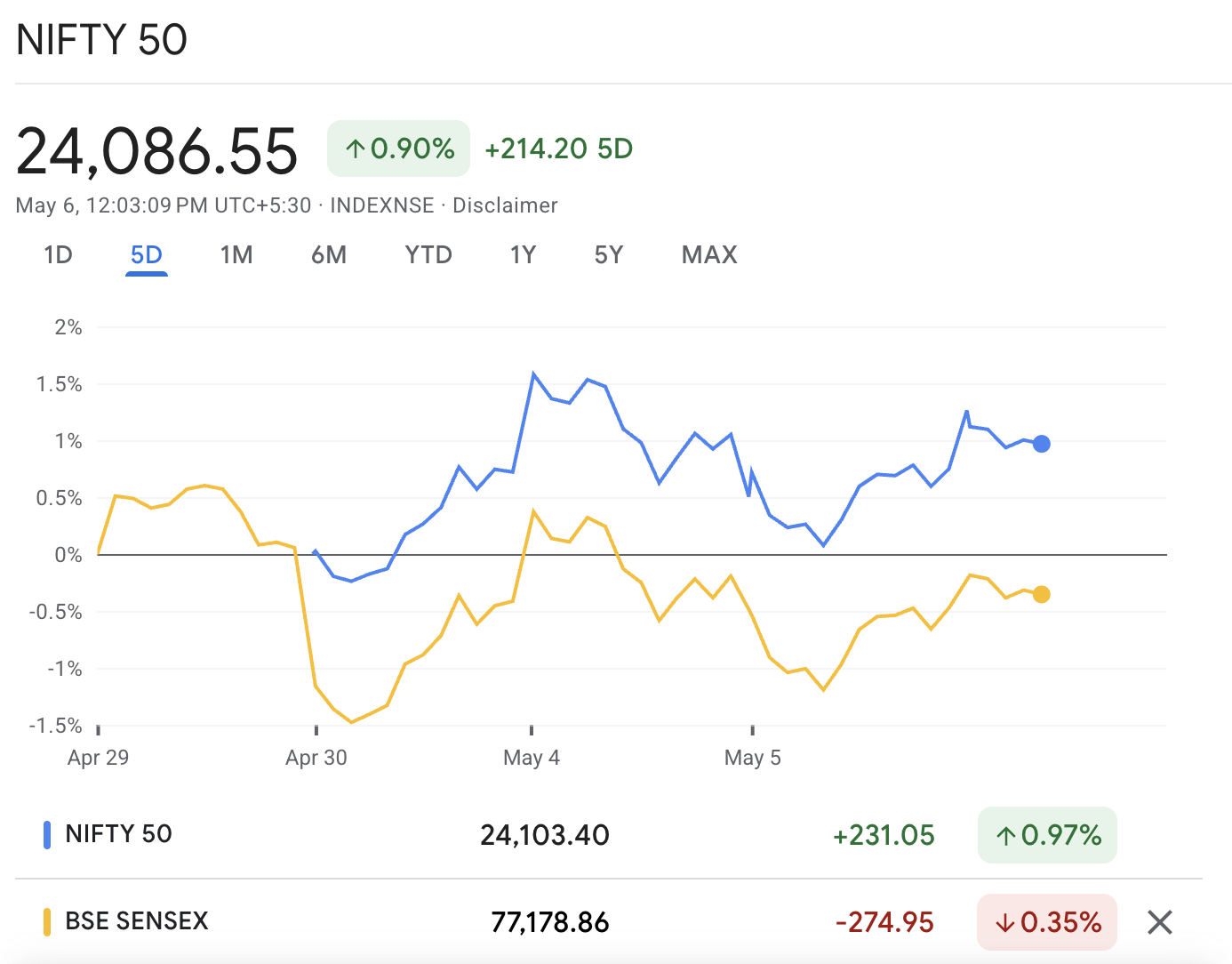
As of May 6, 2026, the Nifty 50 was trading near 24,100, after closing at 24,032.80 on May 5. The Sensex ended that session at 77,017.79. The market is not reacting to one event alone. It is repricing oil risk, rupee pressure, equity valuations, foreign portfolio withdrawals and the rising role of Indian household savings in listed equities.
India’s macro story remains strong, but the equity market is no longer being valued only on growth potential. It is being tested by the quality and durability of liquidity. Domestic flows have become large enough to cushion selling pressure, but not strong enough to neutralize every shock from crude oil, currency depreciation or earnings disappointment.
Foreign selling has pressured Indian equities, but domestic liquidity has prevented a deeper disorderly correction.
SIP inflows and mutual fund assets show that Indian household savings have become a structural force in listed equities.
Oil prices and rupee weakness remain the main macro transmission risks for inflation, margins and foreign flows.
Nifty valuation has cooled from peak levels, but a P/E near 21 still requires steady earnings delivery.
A broader market recovery needs confirmation beyond Nifty heavyweights, especially from midcaps, smallcaps and cyclical sectors.
Foreign selling in 2026 reflects more than stretched valuation. It points to a broader emerging-market risk adjustment.
A stronger US Dollar, higher global yields, Middle East conflict risk, elevated crude oil prices and rupee weakness have made Indian equities more exposed to external de-risking. India’s valuation premium also became harder to defend after the market’s earlier rally.
Even after the correction, the Nifty 50 still traded near 21 times earnings, which is far from distressed territory. For global allocators comparing India with cheaper Asian markets, premium pricing requires visible earnings upgrades, currency stability and lower input-cost uncertainty.
The selling has been strong enough to affect sentiment, but it has not created a disorderly market break. Earlier cycles often saw foreign outflows transmit quickly into deeper index damage. In 2026, domestic liquidity has absorbed a meaningful part of the pressure.
The strongest counterweight to FPI outflows is the rise of mutual fund and SIP-led buying. The Indian mutual fund industry’s assets under management stood at ₹73.73 lakh crore on March 31, 2026. That is almost six times the level recorded in March 2016.
March 2026 was especially revealing. Mutual fund AUM fell from February because of market-to-market losses and debt redemptions, yet equity funds still received ₹40,450 crore of net inflows. Equity schemes also recorded positive inflows for the 61st consecutive month.

This domestic bid receives less attention than the headline FPI number, yet it is central to the India stock market outlook. Domestic liquidity is no longer limited to tactical dip-buying. It has become systematic, rules-based and recurring. SIP assets stood at ₹15.11 lakh crore in March, equal to about 20.5% of total mutual fund assets.
The stabilizing power has limits. SIP money arrives gradually, while foreign selling can accelerate quickly. Domestic flows can reduce drawdowns, but they cannot fully neutralize a sharp oil spike, large rupee depreciation or broad earnings downgrades.
The India stock market remains highly sensitive to crude oil because India imports most of its energy needs. When oil rises, pressure moves quickly through inflation, currency markets, corporate margins and monetary policy expectations.
Higher crude raises India’s import bill. A larger oil import bill can widen the current account deficit and increase demand for US Dollars.
A weaker rupee can intensify imported inflation. Energy, fertilizers, electronics, chemicals and other imported inputs become costlier when the rupee depreciates.
Corporate margins face uneven pressure. Airlines, paint companies, logistics firms, chemicals producers and consumer businesses often see higher costs before they can fully pass them on.
The RBI has less room to ease policy. Even when headline inflation looks contained, a sustained oil shock can lift inflation expectations and keep monetary policy cautious.
Foreign flows become more sensitive to currency risk. A falling rupee can reduce US Dollar returns for foreign institutions, making Indian equities less attractive during global risk-off periods.
March CPI was still contained at 3.40%, with food inflation at 3.87%, but the larger concern is pass-through risk. If crude oil remains elevated while the rupee weakens, the market may begin pricing lower margins, slower rate cuts and tighter financial conditions.
Oil and the rupee sit at the center of the India stock market outlook in 2026. They influence inflation, earnings quality, FPI behavior and Nifty valuation stability.
Nifty 50 valuation has moved away from peak optimism, yet it still demands earnings support. The April 2026 Nifty factsheet shows a P/E of 20.94, P/B of 3.29 and dividend yield of 1.3%. These numbers suggest normalization, not deep value.
| Indicator | Latest Reading | Interpretation |
|---|---|---|
| Nifty 50 P/E | 20.94 | Valuation has corrected, but still needs earnings growth |
| Nifty 50 P/B | 3.29 | Balance-sheet premium remains intact |
| Dividend Yield | 1.3% | Income support is modest |
| Financial Services Weight | 35.27% | Banks remain the market’s main engine |
| Oil, Gas and Fuels Weight | 10.83% | Energy prices directly influence index behavior |
The concentration in financials cuts both ways. Strong credit growth, stable asset quality and improving margins can lift the index quickly. Deposit-cost pressure, slower loan growth or risk aversion in lenders can also cap upside.
The Nifty 50 remains the cleanest benchmark for India’s large-cap market, but it does not capture the full depth of domestic equity participation. A stronger India stock market recovery needs confirmation from midcaps, smallcaps and sector breadth, not only from banks and heavyweight index stocks.
When foreign selling is heavy, market breadth becomes a useful signal. If domestic liquidity stays concentrated in large-cap financials and index leaders, the recovery may remain defensive. If flows broaden into consumption, industrials, autos and export-linked sectors, the market structure would look healthier.
This also answers a less obvious question: whether domestic liquidity is only supporting the index or strengthening the wider market.
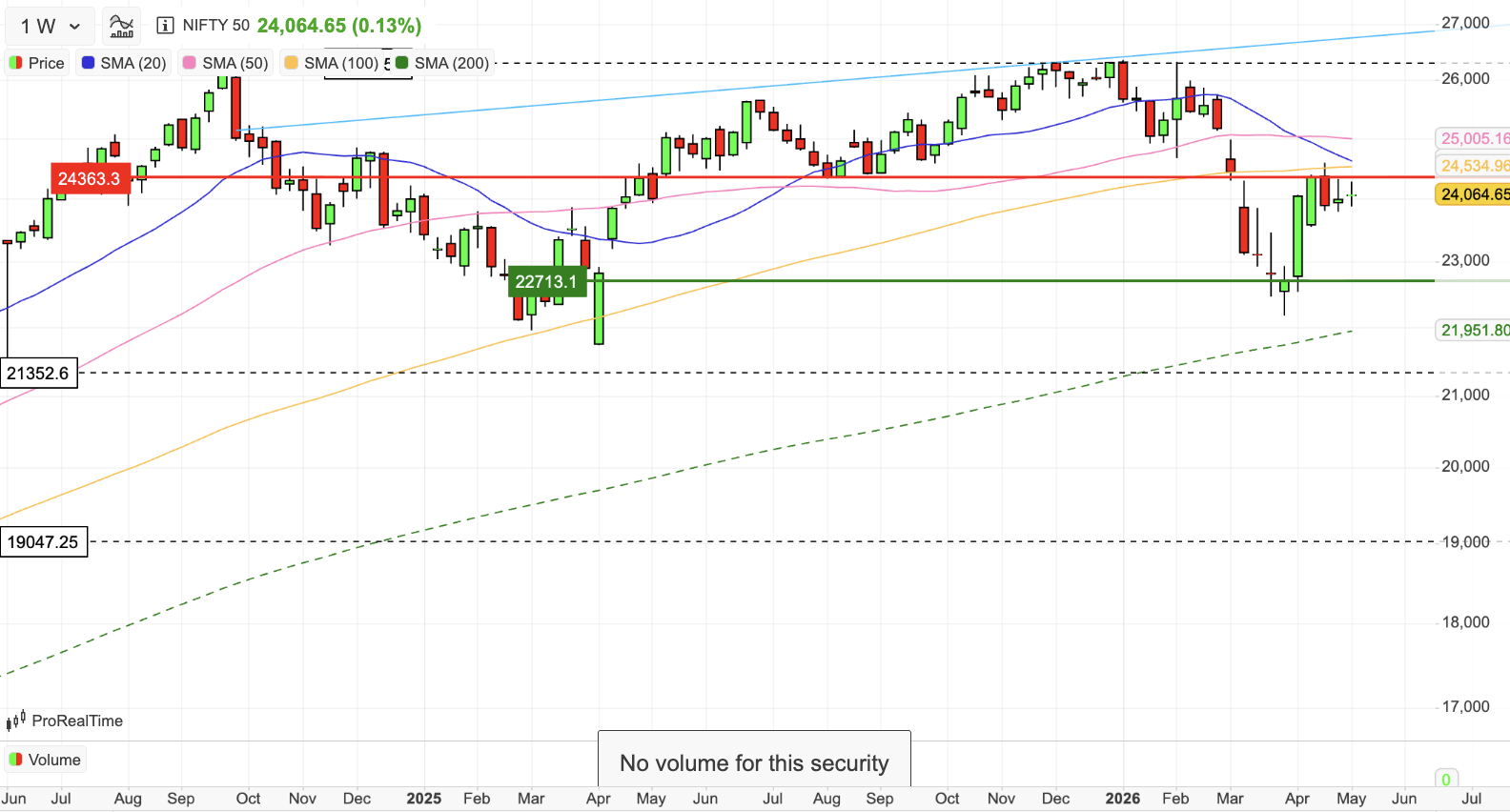
The Nifty’s near-term structure remains range-bound rather than decisively bullish. Around early May, the broader trading band sat near 23,500 to 24,800, with resistance around 24,500 to 24,800 and support near 23,500 to 23,700.
| Technical Area | Level or Signal | Market Reading |
|---|---|---|
| Immediate resistance | 24,500 to 24,800 | Breakout zone for stronger momentum |
| Immediate support | 24,000 | Psychological and tactical support |
| Deeper support | 23,500 to 23,700 | Demand zone if selling resumes |
| 50-day EMA signal | Nifty stayed below it for several sessions | Medium-term caution remains |
| Momentum | RSI showed weak momentum signals | Recovery needs confirmation |
A sustained move above 24,500 would indicate that domestic liquidity and earnings support are overpowering foreign selling. A break below 24,000 would shift attention back to crude oil, the rupee and global risk appetite.
Domestic liquidity can offset foreign selling only under three conditions.
First, FPI outflows must remain orderly. SIP flows and domestic institutional allocations are powerful, but they work best against steady selling rather than panic liquidation.
Second, earnings must hold. Liquidity can support valuations for a period, but durable market gains still require profit growth in banks, industrials, consumption, telecom and export-linked sectors.
Third, crude oil must stabilize. If Brent remains elevated and the rupee weakens, inflation expectations can rise, margins can narrow and the RBI’s room to ease can shrink.
The least discussed shift is behavioral rather than cyclical. Indian households are no longer using equities only as a tactical product. Mutual funds, SIPs, passive funds and retirement-linked allocations have created a domestic bid that did not exist at this scale a decade ago. That makes the market more resilient, although not immune.
The main drivers are global risk aversion, high crude oil prices, rupee pressure, firm US yields and valuation discipline. India still offers strong growth, but foreign capital has become more selective when equity multiples remain above many regional peers.
SIP flows provide steady support, especially during corrections. March 2026 contributions of ₹32,087 crore show strong recurring domestic demand. Still, SIP flows arrive gradually, while foreign outflows can occur quickly, so they reduce volatility rather than eliminate it.
The market is not deeply cheap. A Nifty P/E near 21 and P/B near 3.3 imply that earnings delivery remains essential. Valuation risk rises if oil prices stay high, the rupee weakens or corporate profit estimates are cut.
Financial services are the most important because they represent more than one-third of the Nifty 50. Energy, IT, automobiles and consumption also influence the index, but banks remain the primary transmission channel for liquidity, credit and earnings confidence.
India Stock Market 2026 is best understood as a liquidity stress test. Foreign selling has been large, persistent and macro-driven. Domestic liquidity has been equally important, supported by record SIP contributions, rising mutual fund assets and steady equity fund inflows.
The result is a market under pressure, not a broken market. A durable recovery depends on crude oil stabilization, rupee calm, sustained earnings growth and a decisive Nifty move above resistance. Domestic liquidity can offset foreign selling in phases, but it cannot replace macro stability.