Published on: 2026-05-14
Updated on: 2026-05-14
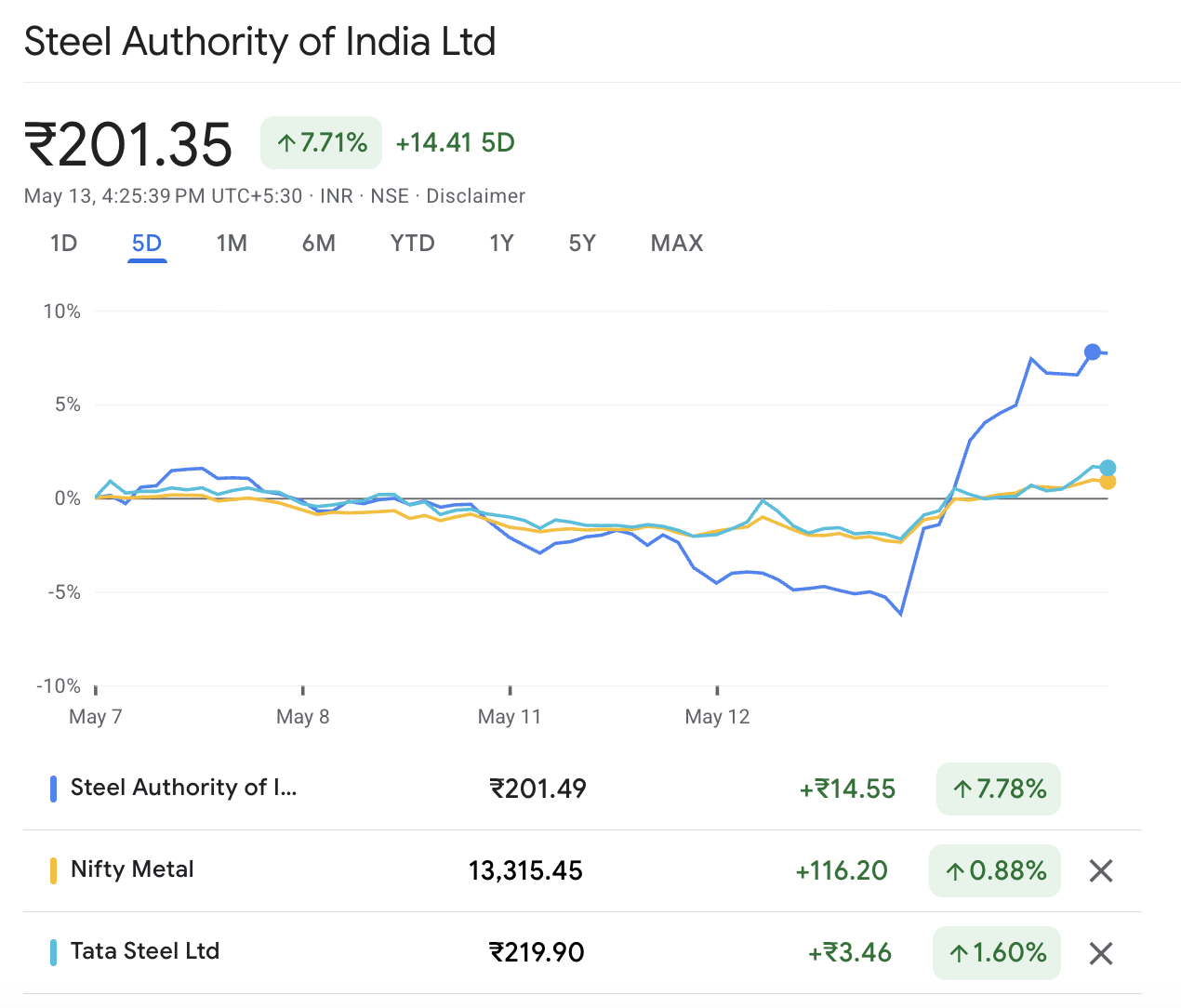
The SAIL share price jumped 14.32% to ₹201.31 as heavy volume and short covering pushed Steel Authority of India to a fresh 52-week high of ₹202.35. The move stood out in a narrow market rebound, with Nifty Metal rising 3.18% while the Nifty 50 gained only 0.14%.
The rally puts SAIL at the centre of India’s metal trade, but the signal remains mixed. Sector momentum has improved, while the scale of the move suggests derivatives positioning played a larger role than a clear earnings-led re-rating.
SAIL share price closed at ₹201.31, up 14.32%, after reaching a fresh 52-week high of ₹202.35.
NSE volume rose to 173.47 million shares, almost 10 times the previous session’s 17.09 million shares.
Market value stood near ₹828.62 billion, placing the rally in a large PSU context rather than a small-cap liquidity event.
Nifty Metal gained 3.18%, while Tata Steel rose 3.63% to ₹219.70, confirming peer-level strength.
Technical readings are stretched, with RSI at 72.5 and MFI at 71.8, both signalling overheated momentum.
| Instrument | Latest Level | 1-Day Move | Signal |
|---|---|---|---|
| SAIL | ₹201.31 | +14.32% | Short-covering breakout |
| Nifty Metal | 13,290.80 | +3.18% | Sector leadership |
| Nifty 50 | 23,412.60 | +0.14% | Narrow recovery |
| Sensex | 74,608.98 | +0.07% | Limited breadth |
| Tata Steel | ₹219.70 | +3.63% | Peer confirmation |
The dominant near-term driver was positioning pressure. SAIL had become a crowded derivatives counter, with open interest close to the market-wide position limit. As the share broke higher, traders holding short futures positions were forced to cut exposure. Stop-loss triggers, margin pressure, and cash-market buying then turned the move into a short-covering squeeze.
The F&O ban intensified the price reaction. Under exchange rules, a share enters the ban period when aggregate open interest crosses 95% of its market-wide position limit. During the ban, traders can only reduce existing positions and cannot create fresh futures or options exposure. Normal derivatives trading resumes only after open interest falls to 80% or below.
For SAIL, the restriction reduced the market’s ability to absorb the move through fresh derivatives positioning. With futures activity constrained, price discovery shifted more heavily to the cash market, where rising volume accelerated the breakout.
The earnings calendar also raised event risk. SAIL’s board is scheduled to consider audited results and a final dividend, putting the share in a pre-results window. Traders are less willing to carry crowded short exposure into earnings because margin commentary, steel spreads, and dividend guidance can reset valuation expectations quickly.
Fundamentals have improved, but they do not fully explain a 14.32% single-session advance. The rally looks more like a positioning-led breakout within a stronger metal tape than a pure earnings-led re-rating.
SAIL’s move was supported by strong sector breadth. Nifty Metal’s 3.18% rise outpaced the broader market, while Tata Steel’s 3.63% gain showed that demand was not limited to one PSU counter. The sector tape improved as traders shifted toward steel, mining, and commodity-linked shares after a cautious phase in the broader market.
The macro backdrop remains favourable for Indian steel producers. Global finished steel demand is expected to rise only 0.3% in 2026 to 1,724 million tonnes, but India is projected to grow 7.4% in 2026 and 9.2% in 2027. China’s steel demand is expected to contract 1.5%, keeping global pricing fragile despite near-term recoveries in commodity sentiment.

SAIL benefits from India’s domestic-demand profile. Its exposure to long steel, infrastructure-linked consumption, public-sector capital expenditure, railways, and construction gives the share a stronger domestic anchor than producers more exposed to export cycles.
Execution now becomes the test. Steel spreads, coking coal costs, freight, employee expenses, capacity utilisation, and debt reduction will decide whether investors continue to pay a higher multiple after the results.
| Indicator | Level / Reading | Signal |
|---|---|---|
| RSI | 72.5 | Overbought |
| MFI | 71.8 | Overbought money flow |
| SMA 50 | ₹166.00 | Medium-term support |
| SMA 200 | ₹144.30 | Long-term support |
| Support | ₹176 to ₹180 | Breakout base |
| Resistance | ₹202 to ₹205 | Immediate supply zone |
| Trend | Bullish | Price above key averages |
| Momentum | Strong but extended | Pullback risk elevated |
The technical structure is constructive but stretched. Price is trading well above the 50-day and 200-day averages, confirming trend strength across medium and long horizons. RSI above 70 and MFI above 70 show that both price momentum and money flow have moved into overheated territory.
The ₹202 to ₹205 band is the immediate resistance zone. A close above this area with sustained volume would improve the breakout structure. A fall below ₹176 to ₹180 would weaken the setup and suggest that short covering carried most of the move.
F&O ban risk: Restrictions on fresh derivatives positions reduce hedging options. Once the ban lifts, renewed futures activity can bring short-sellers back quickly.
Profit-taking risk: A 14.32% one-day advance leaves late buyers vulnerable. Existing holders with lower entry prices may reduce exposure before results.
Steel-price risk: India’s demand outlook is strong, but global steel demand remains weak. Any reversal in China-linked steel indicators could pressure metal shares.
Margin risk: SAIL remains sensitive to coking coal, freight, energy, employee costs, and operating leverage. A weaker spread environment would challenge the re-rating.
Macro risk: Rupee weakness near record lows and crude-price volatility can reduce equity-market risk appetite, even when metal shares outperform.
SAIL’s rally has improved the technical structure of the share, but the move still needs confirmation from earnings and follow-through volume. The 14.32% advance reflects real strength in metal shares, while the scale of the surge shows how much derivatives positioning contributed to the breakout.
For now, ₹202 to ₹205 is the level that decides whether momentum extends. A failure to hold ₹176 to ₹180 would weaken the breakout and shift attention back to short-covering exhaustion.
SAIL remains well placed within India’s infrastructure-led steel cycle, but after such a sharp move, the trade has become more demanding. The next phase will depend on whether results support the price action, not merely whether momentum traders continue to chase it.