Published on: 2026-03-26
Updated on: 2026-03-26
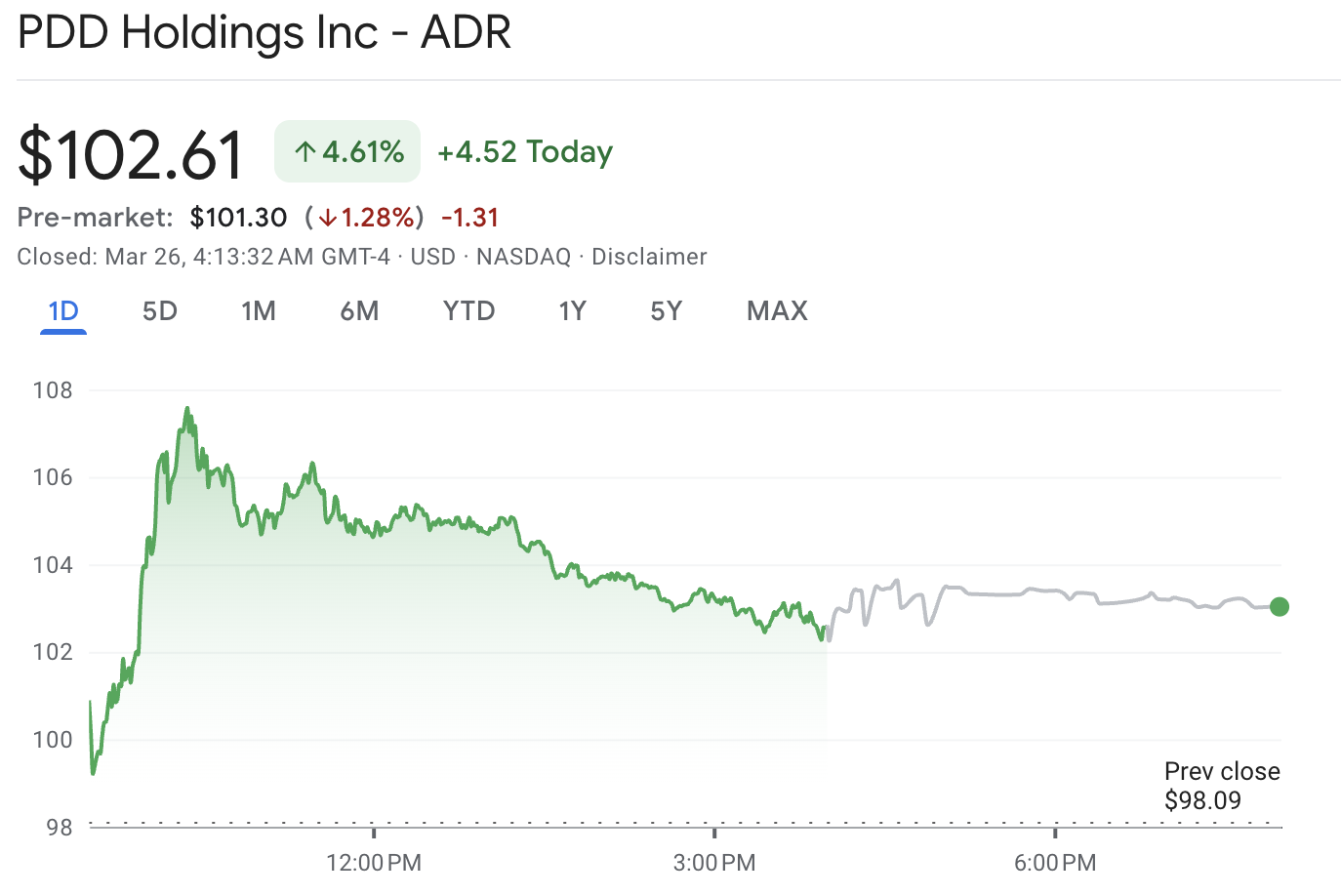
PDD Holdings reported mixed earnings, but the stock increased. On March 25, 2026, PDD stock closed at $102.61, rising 4.61% for the day, after reaching a high of $107.63. That gain came even though the company's fourth-quarter results missed Wall Street expectations on both revenue and adjusted earnings per ADS.

The market seemed to react less to the disappointing headline and more to management's indication that 2026 will involve increased investment in the supply chain, supported by a strong balance sheet and continued steady growth in transaction services.
In effect, investors treated the weaker quarter as the cost of deliberate reinvestment rather than a sign that the business model is breaking down.
The first reason is simple. A miss does not always matter equally. PDD still posted 12% revenue growth, which is not explosive by its old standards, but it is still meaningful for a company already generating more than RMB431.8 billion in annual revenue.
The stronger 19% growth in transaction services also suggested that marketplace activity and monetisation did not stall.
Investors tend to react more positively to a company that misses its targets while still experiencing growth than to one that exceeds expectations but shows signs of decline. That seems to be part of what happened here. The quarter showed pressure, but not a collapse in user activity or platform relevance.
The second reason is the tone management used. Co-CEO Jiazhen Zhao said 2026 marks the beginning of PDD's next decade and that supply chain investment is where the company will place its "greatest conviction." Finance executive Jun Liu added that these investments are "firm and long-term" and will "inevitably affect" financial performance.
Normally, a warning about near-term pressure would hurt a stock. In this situation, it may have had the opposite effect, as investors were already aware that PDD faced competition and regulatory pressures.
What they needed was clear evidence that management still had a plan. Instead, they received the message that PDD is willing to endure the pressure of spending rather than prioritize short-term profit margins at the expense of long-term positioning. This seems to have reassured buyers.
This may be the most underrated part of the story. PDD ended 2025 with RMB422.3 billion in cash, cash equivalents, and short-term investments. That is a huge financial cushion. It gives the company room to invest in logistics, merchant support, fulfilment, servers, and international scaling without facing the kind of funding pressure weaker peers might face.
That balance-sheet strength is one reason a disappointing quarter did not automatically trigger a deeper selloff. Investors may be willing to tolerate softer profit growth when a company has this much liquidity and remains strongly cash generative over a full year. PDD generated RMB106.9 billion in net cash from operating activities in fiscal 2025.
PDD stock was not entering earnings from a euphoric setup, as it had already been under pressure in recent months, with shares down about 25% over the past six months before the earnings reaction.
When expectations are low, missing the mark can be less damaging if the company continues to demonstrate growth and a clear strategic direction. That helps explain why the stock could rise despite disappointing headline numbers.
The market might have expected worse results due to competition in China and the rising costs of adapting Temu's business to a more challenging cross-border environment. The end of the U.S. de minimis rule is also raising supply-chain costs for Temu and other low-cost Chinese sellers.
PDD's quarter was good enough to show resilience, but soft enough to confirm that growth is getting harder and more expensive.
| Metric | Q4 2025 actual | Year-over-year change | What it suggests |
|---|---|---|---|
| Total revenue | RMB123.91B | +12% | Growth continued, but not at old hypergrowth levels |
| Online marketing services and others | RMB60.01B | +5% | Slower domestic ad-type growth |
| Transaction services | RMB63.90B | +19% | Stronger marketplace and ecosystem activity |
| Operating profit | RMB27.72B | up from RMB25.59B | Core business stayed profitable |
| Net income attributable to ordinary shareholders | RMB24.54B | -11% | Profit came under pressure |
| Non-GAAP diluted EPS per ADS | RMB17.69 / $2.53 | down from RMB20.15 | Missed expectations |
| Cash, cash equivalents, short-term investments | RMB422.3B | up from RMB331.6B | Very strong balance sheet |
The quarter does not eliminate the risks associated with PDD; it merely shifts the focus of the discussion. Investors must now determine if 2026 will represent a year of lower margins or the beginning of a more sustained slowdown.
Management's comments strongly lean toward the first interpretation. Still, the next few quarters will need to confirm it with stronger transaction activity, stable user engagement, and evidence that higher spending is productive.
Analysts may also need to lower near-term margin assumptions, especially after management openly said heavy investment will affect financial performance. That does not automatically break the long-term thesis.
Still, it shifts attention away from headline EPS toward operating efficiency, merchant support, and the pace of transaction-services growth.
| Level Type | Price / Zone | What it means |
|---|---|---|
| Support | ~$100.88 | Opening price on the earnings-reaction day; first area buyers need to defend |
| Support | ~$98.09 | Prior close; a move below this would erase the full earnings-day gain |
| Invalidation | $94.75 | Intraday low; a break below this would weaken the bullish reaction |
| Resistance | $107.63 | Session high; a break above this would extend the rebound |
PDD stock rose because investors focused on the bigger picture: revenue still grew 12%, transaction services rose 19%, management recommitted to long-term supply-chain investment, and the company's cash balance remains extremely strong.
Yes. PDD missed on both revenue and adjusted EPS, with Q4 revenue of RMB123.91 billion versus about RMB124.5 billion expected, and adjusted EPS of RMB17.69 versus about RMB20.84 expected.
Yes. Revenue still grew 12% year over year, transaction-services revenue rose 19%, and PDD ended the year with RMB422.3 billion in cash, cash equivalents, and short-term investments.
In conclusion, PDD stock increased because the market viewed the earnings miss primarily as intentional reinvestment rather than a sign that the business is faltering.
The main point is that investors are now evaluating PDD based on whether its spending in 2026 can support growth and enhance its ecosystem. The upcoming quarter will be the first significant test of this perspective.
Disclaimer: This material is for general information purposes only and is not intended as (and should not be considered to be) financial, investment, or other advice on which reliance should be placed. No opinion given in the material constitutes a recommendation by EBC or the author that any particular investment, security, transaction, or investment strategy is suitable for any specific person.