Published on: 2025-12-15
Updated on: 2025-12-15
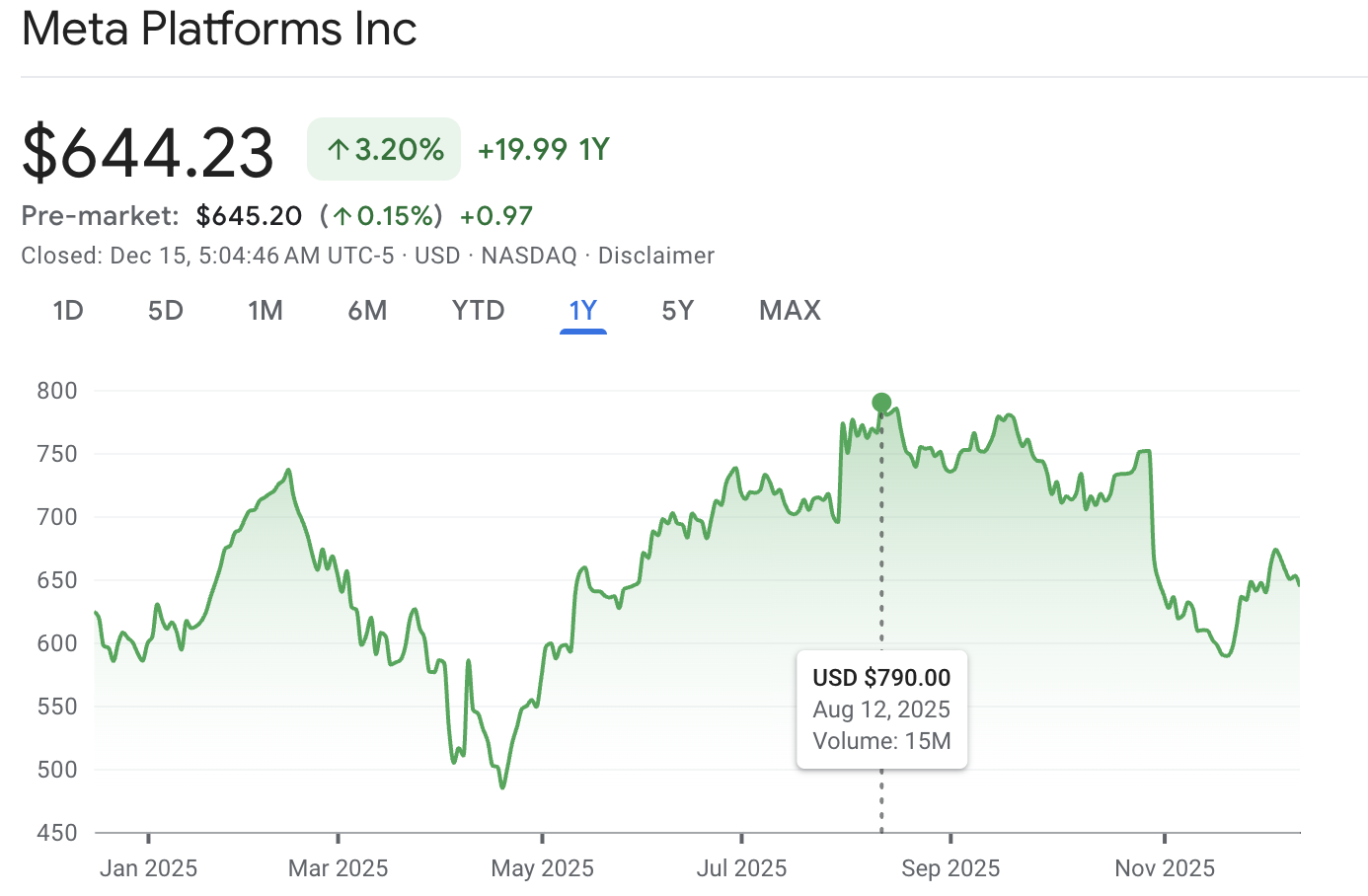
Meta has gone from "ad business with a metaverse problem" to a $1.6 trillion AI and social media powerhouse whose stock trades in the mid-$600s and has already kissed the high-$700s.
META is also the only Magnificent Seven stock that has never executed a stock split, precisely why it now tops nearly every stock-split watchlist.
With Wall Street talking about Meta as a serious 2026 earnings and AI winner, the obvious question is whether Mark Zuckerberg finally uses a split to make META "look cheaper" and broaden retail access.
| Metric | Latest reading (approx.) | Interpretation |
|---|---|---|
| Last close | $644.23 on 12 Dec 2025 | Meta has cooled from the August peak but still trades far above its 52-week low. |
| 52-week range | $479.8 – $796.3 | Stock is roughly one-third below its high and one-third above its low, sitting in the middle of a wide, volatile band. |
| Market cap | ≈$1.62–1.64 trillion | Confirms Meta as a top-10 global mega-cap and a key index heavyweight. |
| 50-day simple MA | ≈$667–672 | Price is currently below the 50-day, signalling short-term corrective phase after the run toward $800. |
| 200-day simple MA | ≈$671 | Trading below the 200-day suggests the longer-term uptrend has paused and that the stock is consolidating gains. |
| Average True Range (50-day) | ≈$19 (≈3% of price) | Daily swings of 2.5–3.5% are normal, so “stock-split rumours” can amplify moves but are not the whole story. |
| Analyst stance | Strong consensus "buy", with a median target around the high-$700s and some targets above $1,000. | Street still sees upside versus current price, even after a stellar multi-year run. |
Recent price data show Meta Platforms in a consolidation phase after a huge two-year rally.
Latest close (12 December 2025): about $644.23 per share.
After-hours quote: around $643.56 per share.
52-week range: roughly $479–796, with an all-time high near $789–796 in mid-August 2025.
Market capitalisation: about $1.6–1.7 trillion at current prices.
Meta remains one of the best-performing "Magnificent Seven" names since the 2022–23 tech wash-out, with the share price more than doubling from late-2023 levels as digital advertising recovered and AI-related revenue opportunities scaled up.
Under the hood, the business is still growing hard.
Q3 2025 revenue hit $51.2 billion, up 26% year on year, with ad revenue growing at the same pace; operating margin for the quarter reached about 40% before a one-off tax hit distorted GAAP profit.
Daily active people across the "Family of Apps" (Facebook, Instagram, WhatsApp, Messenger, Threads) reached 3.54 billion, up 8% year on year, with ad impressions up 14% and price per ad up 10%.
Since 2021, Meta's metaverse division, Reality Labs, has accumulated more than $70 billion in total losses. Consequently, Meta is discussing a budget cut of up to 30% starting in 2026, reallocating resources to AI-powered innovations such as smart glasses.
At the same time, Meta is a buyback machine. It spent over $17 billion on repurchases in the first quarter of 2025, after buying back more than $92 billion between 2021 and 2023, and it still had around $81 billion authorised at the end of 2023. It has even introduced a modest dividend yielding roughly 0.3–0.4%.
Thus, you have a stock that is:
Enormously profitable on the core ads side.
Spending heavily on AI infrastructure.
Still cleaning up a metaverse misadventure.
Returning huge amounts of cash through buybacks and a small dividend.
That is the backdrop for any realistic discussion about a 2026 Meta stock split.
As mentioned earlier, Meta Platforms, formerly Facebook, has never carried out a stock split since its IPO in 2012.
However, there was an interesting near-miss:
In 2016, Facebook shareholders approved a Class C share class with no voting rights, which functioned like a stock split while preserving Mark Zuckerberg's control.
After a shareholder lawsuit and changing circumstances, the company shelved that plan in 2017.
Since then, management has remained silent on any formal split, even as the stock surged from its $38 IPO price to nearly $800 at its 2025 peak.
Meta now sticks out for a simple reason. Every other Magnificent Seven name has split in recent years:
Apple and Tesla executed splits in 2020 and again in 2022.
Alphabet and Amazon delivered 20-for-1 splits in 2022.
Nvidia and Broadcom have done large splits, including Nvidia's 10-for-1 in 2024 and Broadcom's 10-for-1 in 2024.
For context, Meta and Microsoft were the only Magnificent Seven members without a recent split, and by 2025, Meta is the only one left with a four-digit pre-split "equivalent" price.
That has put Meta on almost every "next big stock split" list for 2025–2026, even though the company itself has not promised anything.
A lot of splits in big tech have come once share prices sustainably move above the $600–$800 area. That is where the sticker shock becomes real for:
Employees want to build positions through stock grants and ESPPs.
Retail traders who do not use fractional shares.
Options traders who require contracts at more accessible notional sizes.
Meta trades around $640 today, has a 52-week high near $796, and sits on long-term analyst targets with a median near $780 and high cases above $1,100.
If AI monetisation lands close to the bullish forecasts, with some analysts modelling $285 billion of revenue by 2027 and a 2026 earnings "floor" near $30 per share, a stock price north of $800 again is not a stretch.
At that point, a 3-for-1 or 4-for-1 split would put META back in a more psychologically comfortable $200–$260 range.
Meta already has three return-of-capital levers running:
Heavy buybacks are shrinking the share count.
A new quarterly dividend that is small in yield but big in signalling.
No split yet, which keeps the share price visually "premium."
If you are Mark Zuckerberg and you want to send a message that Meta has moved from "turnaround" to steady compounder, a split in 2026 alongside healthy AI-driven growth and a cleaner Reality Labs budget would be a visible way to do it.
There is also a simple "peer pressure" dynamic:
Netflix executed a 10-for-1 split in 2025 to bring its share price into a more accessible trading range.
Nvidia, Tesla, Apple, and Alphabet have all used splits over the past decade to prevent prices from becoming unwieldy amid rallies.
As of mid-December 2025:
Meta's SEC filings, earnings transcripts and press releases contain no formal declaration of a stock split or authorised split ratio.
Any blog or social post labelling a specific date or ratio for a "confirmed 2026 Meta split" should be treated as rumour unless and until Meta's board votes and the company files official documentation.
If Meta does act in 2026, the most realistic possibilities, based on market practice and commentary, would be:
3-for-1 split
Takes a $750–800 share price into the $250–270 range.
Keeps shares in a mid-price band similar to post-split Nvidia or Alphabet.
4-for-1 split
Brings a $750–800 price down towards $190–200.
More aggressive in terms of optics and retail appeal.
A 10-for-1 split, like Netflix, is possible but less likely for Meta at current levels, unless the share price pushes well above $900–1,000 and management explicitly wants to mirror that template.
Again, these are hypothetical structures, not guidance. So far, Meta has not shown its hand.
Meta has had plenty of opportunities to split:
It ran from $38 at IPO to above $380 before the 2022 crash.
It then ran from the 2022 lows below $100 back to nearly $800 in 2025.
Through all of that, management has never felt the need to implement a split. Several articles that track Meta's split "history" make the same point: this is deliberate, not an oversight.
The combination of huge buybacks and a small dividend already gives Meta all the tools it needs to manage capital structure and shareholder appeal. Management may prefer:
To keep the share price high as a status symbol and as a signal of quality.
To focus on reducing share count, which is clearly accretive when the business is growing at 20–25% and margins are strong.
Remember, a split does not lower the P/E ratio, increase free cash flow, or change real ownership. It is entirely an optical and liquidity decision.
2026 is also shaping up to be noisy:
Meta faces ongoing legal and regulatory pressures in the US and EU, including antitrust cases that could, in extreme scenarios, lead to structural remedies involving Instagram and WhatsApp.
The company is committing tens of billions of dollars to AI infrastructure, which will hit 2026 expenses hard before all the revenue upside shows through.
Against that backdrop, management may decide that a split is unnecessary noise and keep the focus on delivering earnings, AI product milestones and margin discipline.
No. As of mid-December 2025, Meta has not officially announced any stock split for 2026 in its SEC filings, earnings calls or press releases.
No, Meta (formerly Facebook) has never completed a stock split since going public in 2012.
There is no official guidance, but based on current prices and market precedent, a 3-for-1 or 4-for-1 split looks most plausible.
A stock split would make individual shares cheaper but wouldn't alter Meta's overall valuation.
In conclusion, Meta is exactly where you would expect the next big-tech split candidate to be: a trillion-plus market cap, a four-digit "equivalent" share price pre-split, and a powerful AI-driven growth story that could carry earnings higher well into 2026.
It is also the only Magnificent Seven name with a clean, zero-split history, run by a founder who has shown no urgency to change that.
Yet Meta's leadership has never used stock splits before and has said nothing concrete about introducing one now. Against that backdrop, the smart way to think about a "Meta stock split 2026" is as an interesting upside, not as part of your base-case valuation.
Disclaimer: This material is for general information purposes only and is not intended as (and should not be considered to be) financial, investment or other advice on which reliance should be placed. No opinion given in the material constitutes a recommendation by EBC or the author that any particular investment, security, transaction or investment strategy is suitable for any specific person.