Published on: 2026-03-12
Updated on: 2026-03-12
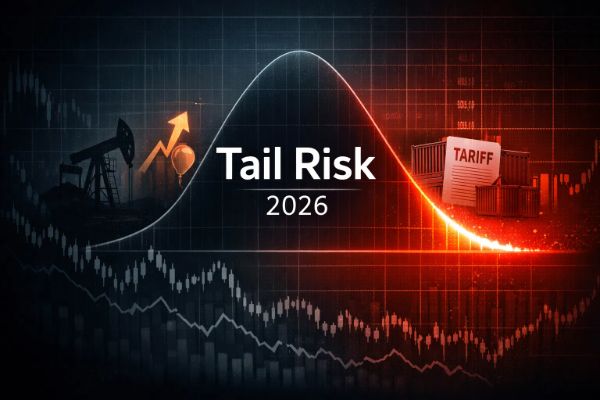
Tail risk is the risk of a market move so large that it sits in the far edge of the return distribution, where normal day-to-day models stop being very useful. In short, it is the kind of shock that feels unlikely until it arrives, and then suddenly resets prices, positioning, and liquidity all at once.
In 2026, tail risk is back on every trader's radar, not because a crash is the base case, but because the range of plausible outcomes has widened sharply.
The VIX stood at 24.97 early on March 12, up from a closing value of 24.23 on March 11. Real GDP growth slowed to 1.4 percent in the fourth quarter of 2025, and February payrolls declined by 92,000. The Federal Reserve has indicated that uncertainty regarding the economic outlook remains high.
Interestingly, the market is not yet pricing in a complete systemic breakdown. Credit spreads are relatively stable, with the ICE BofA US High Yield Option-Adjusted Spread at 2.97 percent on March 4 and the BBB corporate spread at 1.04 percent on March 5. This is occurring even as Treasury yields remain strong and energy risks have resurfaced.
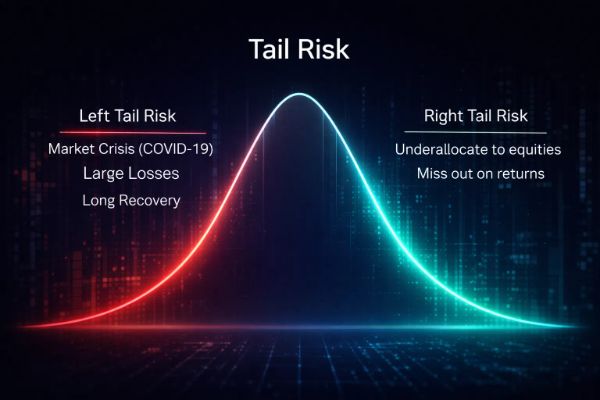
In market language, tail risk refers to the risk of extreme returns that lie far from the center of the distribution. When equity traders refer to this term, they typically mean left-tail risk, which is the risk of a sharp downside movement rather than an unexpected pleasant upside surprise.
Tail risk is not the same thing as ordinary volatility. It refers to outcomes that sit at the edge of expected distributions, where a portfolio does not simply decline but behaves in a non-linear way because liquidity thins, correlations rise, and hedges that looked sensible in normal conditions stop working as expected.
That is why traders worry less about the average forecast than about the shape of the distribution. A market can look calm on headline growth or inflation data and still carry substantial tail risk if one or two shock channels can suddenly reprice everything at once.
In 2026, that is exactly the concern. Growth is slower, inflation is no longer falling decisively, trade policy is active again, and geopolitics has put energy back into the center of the macro conversation.
| Normal volatility | Tail risk |
|---|---|
| Markets move in a range traders broadly expect. | Markets move far beyond normal expectations. |
| Positioning can usually adjust in an orderly way. | Positioning can be forced to unwind quickly. |
| Liquidity is thinner, but still present. | Liquidity can disappear exactly when it is needed most. |
| Safe havens often behave normally. | Correlations can break, and “safe” assets may fail to hedge. |
| Losses are uncomfortable. | Losses can become nonlinear and portfolio-shaping. |
The first reason is the macro mix. Real GDP grew at an annualized 1.4 percent in the fourth quarter of 2025, down from 4.4 percent in the third quarter. February payrolls then fell 92,000, while the unemployment rate held at 4.4 percent. By itself, that does not indicate a recession. But it is weak enough to make the economy more vulnerable to additional shocks.
At the same time, the Fed is not in a position to provide immediate insurance. Its January statement kept the policy rate at 3.50 percent to 3.75 percent, said inflation remains somewhat elevated, and stressed that uncertainty about the outlook remains elevated.
In other words, the central bank remains data-dependent and constrained. That is classic tail-risk territory, because policy flexibility is lower when markets want it most.
The second reason is that the nature of inflation risk has evolved. February CPI was orderly. Headline CPI rose 0.3 percent on the month and 2.4 percent on the year, while core CPI rose 0.2 percent on the month and 2.5 percent on the year. Shelter rose 0.2 percent and remained the largest contributor to the monthly increase. That is not a crisis print.
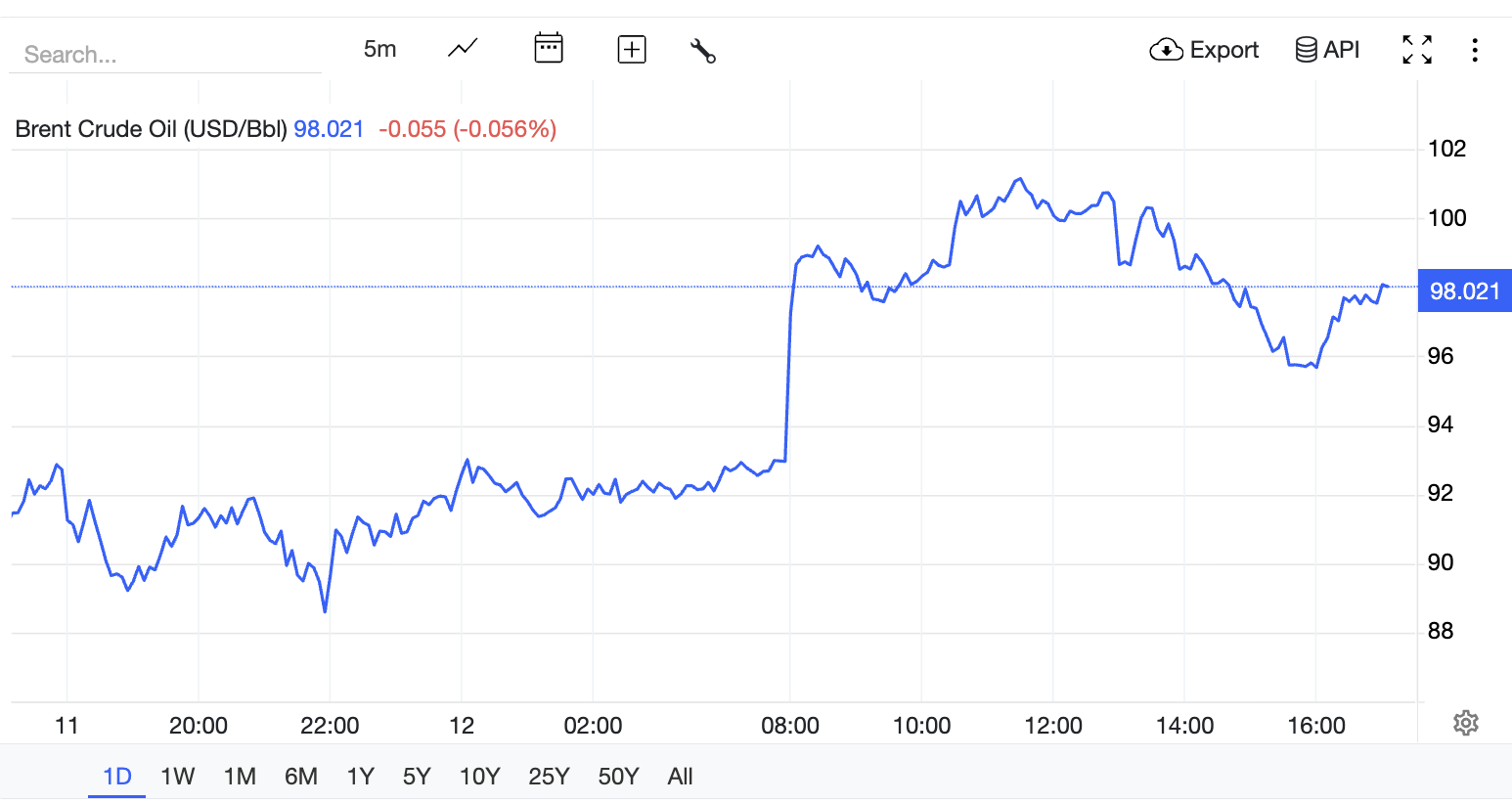
The problem is that February data describe the past, while tail risk is about the next shock. For context, Iranian attacks on shipping and energy infrastructure on March 12 pushed oil briefly above $100 a barrel, while the IEA agreed to release the largest volume of emergency reserves in its history to calm markets.
That means the inflation tail is no longer coming mainly from shelter or wages. It is due to energy and supply disruptions.
The third reason is policy volatility. On February 20, the White House announced a temporary 10 percent ad valorem import surcharge, effective for 150 days starting February 24. A separate order clarified that this surcharge remains unchanged despite the termination of certain earlier tariff measures.
Even before the effects are fully reflected in consumer prices, such a policy shift creates a wider range of potential outcomes for inflation, profit margins, and supply chains.
Tail risk often involves accumulated uncertainty rather than just a single event. Therefore, while a slower economy can typically absorb one shock, it faces a different challenge when dealing with restrictive interest rates, rising oil prices, and renewed tariff uncertainties.
This conclusion arises from considering the interplay between current growth rates, inflation, interest rates, and trade conditions.
The final reason is market structure. S&P Global reports that the concentration of market capitalization in the US equity market among a few mega-cap companies has reached levels not seen in over fifty years.
Concentration is not automatically bearish, but it does make index performance more dependent on a narrow leadership group. When that leadership is crowded, drawdowns can become faster and more correlated than investors expect.
One reason tail risk may appear dormant until it suddenly reemerges is that a concentrated market can produce strong index returns for several months. However, it can reprice drastically if factors such as earnings, regulation, interest rates, or geopolitics simultaneously affect the same major companies.
In 2026, this concentration exists within a slower macroeconomic environment, which increases the sensitivity of broad indices to any potential disappointments.
Tail-risk management is rarely about finding a perfect hedge. It is about accepting that some protection will cost money in normal times in exchange for surviving abnormal times.
| Tool | What it helps hedge | Main advantage | Main limitation |
|---|---|---|---|
| Index put options | Equity crash risk | Direct downside convexity | Premium decay can be expensive |
| VIX futures or calls | Volatility spikes | Responds quickly to panic repricing | Term structure can erode returns |
| Short-duration cash and bills | Liquidity shocks | Preserves optionality | Does not offset mark-to-market losses |
| High-quality duration | Growth shock | Can rally in recessionary stress | Less reliable if inflation is the shock |
| Gold and select commodities | Geopolitical and inflation tails | Helps when real assets reprice higher | Can be volatile and imperfect |
| Broader diversification and lower concentration | Single-theme drawdowns | Reduces dependence on crowded leaders | Works gradually, not instantly |
In 2026, that last limitation is crucial. Long-duration bonds are not the clean hedge they were in some past equity selloffs because part of the current tail is inflationary.
If oil, tariffs, and shipping disruption are the shock, yields can stay firm even while equities weaken. That is one reason traders are watching volatility instruments and cash buffers more closely again.
Tail risk refers to the chance of an infrequent but significant market movement, typically a sharp loss, that lies far outside of normal expectations.
No. A higher VIX means investors are paying more for near-term equity protection, not that a crash is certain.
Not always. Diversification helps in ordinary drawdowns, but tail events often cause correlations to rise just when investors need diversification most.
In conclusion, tail risk is back on traders' radar in 2026 because the market's downside distribution has widened.
Economic growth is slowing, interest rates remain restrictive, oil prices have brought back inflationary pressure, trade policies introduce further uncertainty, and increased market concentration makes equity indices more vulnerable than the overall calm suggests.
The warning signs are not all in full crisis mode, but that is precisely the point. Tail risk matters most when markets start buying protection before the damage is obvious.
Disclaimer: This material is for general information purposes only and is not intended as (and should not be considered to be) financial, investment or other advice on which reliance should be placed. No opinion given in the material constitutes a recommendation by EBC or the author that any particular investment, security, transaction or investment strategy is suitable for any specific person.