Published on: 2026-03-12
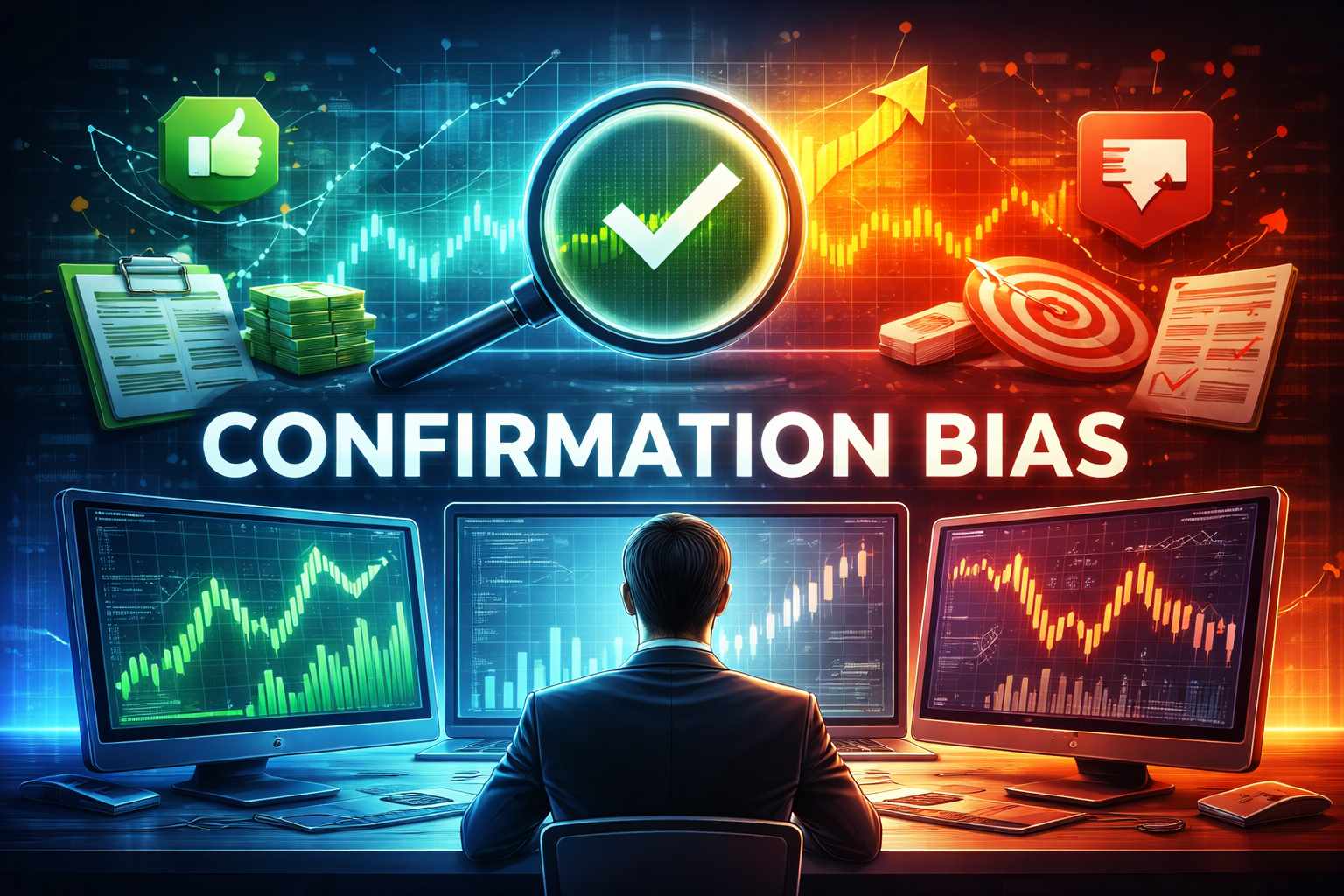
A bad trade rarely starts with bad information alone. More often, it starts when a trader sees only the evidence that supports an existing view and filters out the rest.
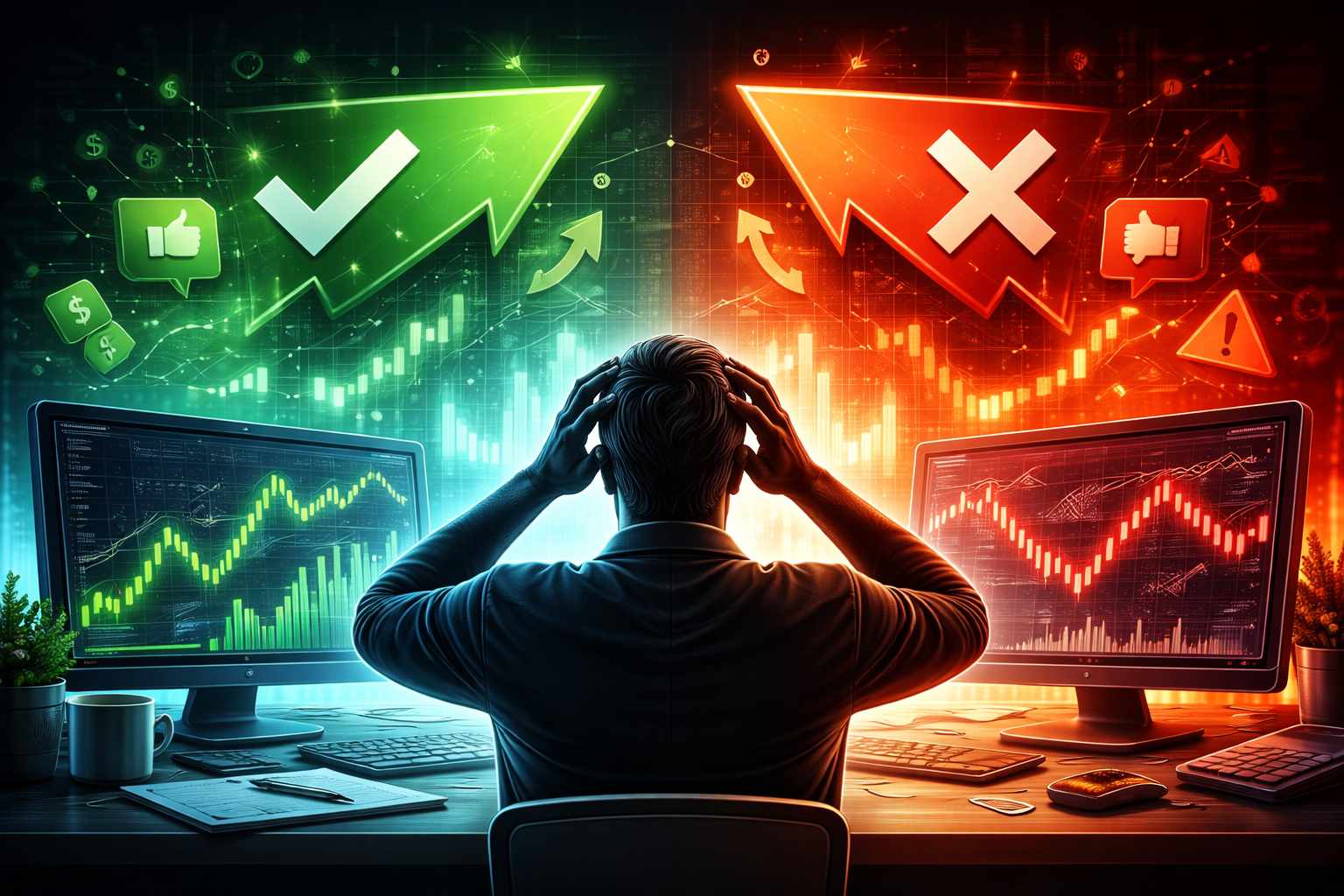
That trap is called confirmation bias, and it matters even more in today’s market because social media, group chats, and algorithm-driven feeds keep serving traders the same bullish or bearish story on repeat.
Confirmation bias is one of the most common and costly psychological traps traders fall into.
It causes traders to seek out information that supports their existing views while ignoring contradictory evidence.
Recognising this bias is the first step toward making more objective, data-driven trading decisions.
Simple but deliberate habits can significantly reduce its impact on your portfolio.
Confirmation bias is the tendency to search for, interpret, and remember information in a way that confirms what you already believe. In trading, this means a bullish trader may unconsciously prioritise positive news while dismissing bearish signals.
It was first formally studied by psychologist Peter Wason in the 1960s and has since become a cornerstone concept in behavioural finance. The problem is not a lack of intelligence. Even experienced professionals fall victim to it.
Traders encounter confirmation bias in several recognisable patterns:
Selective research: Only reading analyst reports that agree with your trade thesis.
Echo chambers: Following social media accounts or forums that reinforce your views.
Ignoring stop-losses: Finding reasons to hold a losing trade instead of cutting it.
Overweighting past wins: Remembering the times your instinct was right and forgetting when it was not.
These behaviours feel rational in the moment. That is precisely what makes confirmation bias so dangerous.
The financial impact of confirmation bias is well-documented in behavioral finance literature. Traders who fall into this trap tend to overtrade on conviction-driven positions, hold losing trades too long, and exit winners too early out of fear of contradicting evidence.
| Behaviour | What It Feels Like | What It Actually Is |
|---|---|---|
| Holding a losing trade | “It will recover” | Ignoring counter-signals |
| Only reading bullish news | “Doing my research” | Selective information gathering |
| Dismissing bearish analysts | “They don’t understand” | Confirmation-seeking |
| Adding to a losing position | “Averaging down logically” | Doubling down on bias |
A common example is a trader who is long on a stock after a strong earnings move. They notice upbeat commentary, bullish posts, and a supportive chart, but ignore insider selling, weak follow-through volume, or guidance that was less impressive than the headline suggests.
Understanding this bias in theory is one thing. Seeing how it has played out in real markets makes the cost of it undeniable.
During the late 1990s, retail and institutional investors alike poured money into internet companies with little to no revenue. Analysts who raised concerns were widely dismissed as people who simply failed to grasp the so-called new economy.
When the bubble burst, the warning signs had already been there. Many investors ignored them because they conflicted with the dominant narrative.
Enron’s collapse is a textbook case of confirmation bias operating at scale. Analysts covering the stock maintained buy ratings deep into the crisis despite growing evidence of accounting irregularities.
Investors who questioned the company’s opaque financial disclosures were often told they simply did not understand the business model.
The GameStop short squeeze made confirmation bias highly visible. Reddit communities became echo chambers where bearish perspectives were mocked and dissenting views were drowned out by collective conviction.
Many retail traders held positions far beyond rational exit points, convinced the squeeze would continue indefinitely. When prices reversed sharply, those who had ignored the counter-arguments faced heavy losses.
| Case | The Bias in Action | The Outcome |
|---|---|---|
| Dot-com bubble | Ignoring valuation fundamentals | Nasdaq fell nearly 80% |
| Enron | Dismissing accounting red flags | Stock went to zero |
| GameStop | Echo chamber-driven conviction | Sharp price collapse |
Each of these events involved traders and investors filtering out credible, available information because it conflicted with an existing belief. The information was not hidden. It was simply unwelcome.
Trading environments are uniquely fertile ground for confirmation bias because of the sheer volume of available information. At any given moment, you can find credible-sounding arguments on both sides of any trade.
The human brain, under pressure and uncertainty, naturally gravitates toward information that reduces cognitive dissonance. Markets are inherently uncertain, which means the psychological pull to confirm existing beliefs is near-constant.
Add in real money, ego, and social validation from online communities, and the bias intensifies considerably.
Overcoming confirmation bias does not require becoming emotionless. It requires building systems and habits that offset the brain’s natural tendencies.

Before entering any trade, force yourself to answer:
What is the strongest argument against this trade?
What would have to happen for me to be wrong?
Have I sought out bearish analysis if I am bullish, and vice versa?
This process, sometimes called a “pre-mortem,” is used by professional portfolio managers to stress-test ideas before committing capital.
Algorithmic or rules-based approaches remove discretion from the equation. When your entry, exit, and position sizing are governed by pre-set criteria, there is less room for bias to creep into execution.
A detailed trading journal forces accountability. When you record your reasoning at entry and exit, patterns of biased thinking become visible over time. Reviewing past trades with hindsight is one of the most effective self-correction tools available.
Make it a rule to read at least one credible bear case for every bullish trade you are considering. This is not about second-guessing yourself. It is about stress-testing your thesis against real opposing arguments.
X (formerly Twitter), Reddit trading communities, and Telegram signal groups are bias amplifiers. They reward conviction and punish nuance. During an active trade, minimising exposure to these channels reduces the risk of groupthink reinforcing your bias.
An outside perspective from someone with no stake in your trade is one of the most underused tools in retail trading. A good mentor or accountability partner will challenge your assumptions in ways your own mind simply will not.
A bullish trader ignores bearish analyst downgrades and slowing earnings reports, only reading positive news that supports their position. When contradictory data surfaces, they dismiss it rather than reassess the trade.
It causes investors to hold losing positions too long, over-concentrate in familiar sectors, and resist diversification. Decisions end up reflecting personal belief rather than objective evidence, gradually eroding portfolio performance.
Rarely. Conviction in a well-researched thesis can help you hold through short-term noise. But once conviction blocks traders from updating their views in light of new evidence, it becomes a liability.
Institutional traders use structured decision frameworks, risk committees, and devil’s advocate reviews. Systematic funds remove discretion by design. Retail traders can replicate this through journaling, pre-trade checklists, and accountability partners.
Confirmation bias in trading is not a sign of weakness or inexperience. It is a deeply wired human tendency that affects traders at every level of the market. The difference between traders who manage it and those who do not often comes down to awareness and process.
By building pre-trade checklists, keeping a journal, actively seeking opposing viewpoints, and limiting exposure to echo chambers, traders can significantly reduce the grip this bias has on their decision-making.
The goal is not to eliminate emotion from trading entirely. It is to ensure that the analysis drives decisions, not the other way around. Confirmation bias sits alongside other cognitive biases, including anchoring bias, recency bias, and the sunk cost fallacy, all of which compound in a live trading environment.
Disclaimer: This material is for general information purposes only and is not intended as (and should not be considered to be) financial, investment or other advice on which reliance should be placed. No opinion given in the material constitutes a recommendation by EBC or the author that any particular investment, security, transaction or investment strategy is suitable for any specific person.