Published on: 2026-03-13
Inflation is one of the most closely watched economic indicators in financial markets. When economists, central banks, and traders discuss inflation, they often reference two key measures: the Consumer Price Index (CPI) and the Producer Price Index (PPI).
While both track price changes over time, they do so from different perspectives. CPI focuses on the prices households pay for goods and services, whereas PPI tracks prices producers receive for their output. Understanding both indicators can help investors anticipate inflation trends, central bank decisions, and market reactions across forex, stocks, and bonds.
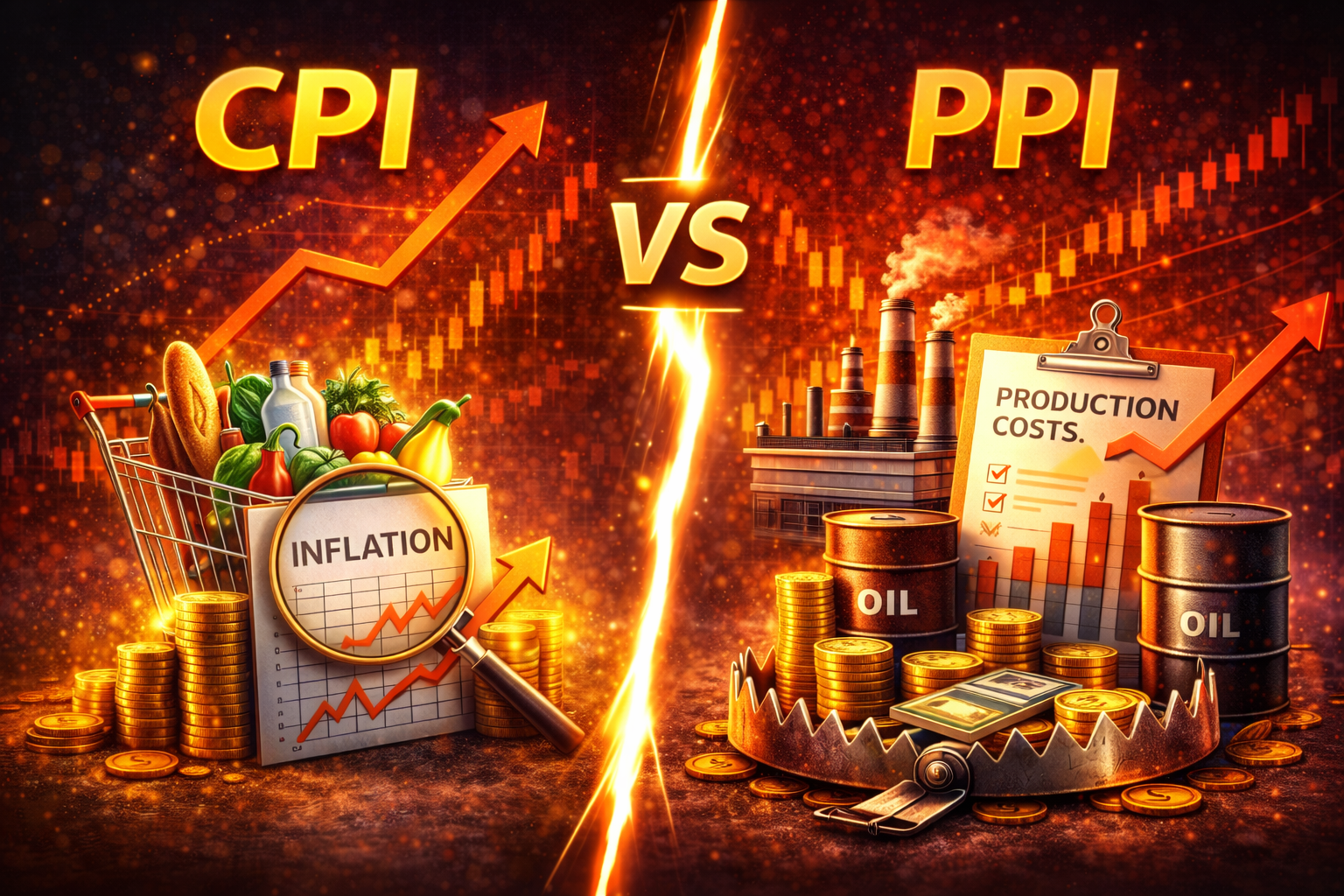
CPI vs PPI measure inflation at different stages: CPI at the consumer level, PPI at the producer level.
CPI reflects the cost of living, while PPI signals wholesale price trends.
Central banks primarily use CPI to guide interest rates.
PPI provides early insight into inflation pressures and potential market reactions.
Both indicators can significantly impact forex, stock, and bond markets.
The Consumer Price Index (CPI) measures the average change in prices that consumers pay for a basket of goods and services over time. It is widely considered the most direct gauge of cost-of-living changes.
Government agencies, such as the U.S. Bureau of Labor Statistics (BLS), calculate CPI by tracking prices for categories such as:
Housing and rent
Food and beverages
Transportation
Healthcare
Clothing
Education
Each component is weighted based on typical consumer spending patterns. When prices rise across this basket, CPI increases, signalling that the cost of living is rising.
If a basket of goods cost $100 last year and $103 this year, the CPI rose by 3%, indicating that, on average, consumers are paying 3% more for the same goods and services.
CPI is directly relevant to households and policymakers:
Adjusting wages: Employers and governments use CPI to adjust salaries and pensions.
Social programs: Social security and benefits are often indexed to CPI.
Monetary policy: Central banks monitor CPI to guide interest rate decisions.
Because it reflects retail prices, CPI is often the headline inflation measure that moves markets most visibly.
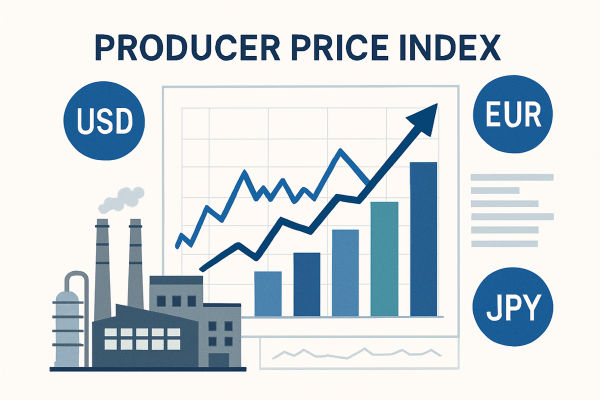
The Producer Price Index (PPI) measures the average change over time in the prices producers receive for their goods and services. Unlike CPI, which tracks consumer prices, PPI provides insight into trends in wholesale and input costs.
Agencies monitor prices that producers receive for:
Raw materials (e.g., steel, timber, crude oil)
Intermediate goods used in manufacturing
Finished goods sold to other businesses
Rising PPI often signals that production costs are increasing, which may eventually feed into consumer prices and CPI.
If a manufacturer pays more for steel or plastic, production costs rise. To maintain profit margins, the company may raise prices for finished products, which could later be reflected in CPI.
For businesses and traders, PPI highlights input costs, pricing power, and inflationary pressures within supply chains. It serves as a leading indicator of consumer price changes and provides insight into corporate profit margins.
CPI directly influences consumer spending, monetary policy, and market sentiment.
Rising CPI reduces purchasing power, increasing the cost of living.
Core CPI, excluding volatile items like food and energy, reflects underlying inflation trends.
Central banks, including the Federal Reserve, ECB, and Bank of England, rely on CPI as a key reference for interest rate decisions. Higher-than-expected CPI can lead to:
Rate hikes to curb inflation
Reduced economic stimulus
Conversely, low CPI may justify lower rates to encourage growth.
Forex: Higher CPI may strengthen a currency as markets anticipate higher interest rates.
Bonds: Rising inflation erodes fixed-income returns, pushing yields higher.
Stocks: Inflation can squeeze corporate margins, particularly in sectors sensitive to wages and input costs.
PPI serves as a leading indicator of inflation. Rising producer prices can signal that consumer inflation may accelerate, offering traders foresight into CPI movements.
Rising PPI may indicate higher production costs.
Companies with pricing power can pass costs to consumers; otherwise, profit margins shrink.
Sectors with thin margins, such as manufacturing, transportation, and retail, may be most affected.
Traders monitor PPI to anticipate:
Potential CPI surprises
Shifts in corporate earnings expectations
Early signals for interest rate adjustments
Example: A U.S. CPI print above market expectations often strengthens the USD, as traders anticipate the Federal Reserve will raise interest rates to control inflation.
CPI usually garners more immediate attention due to its direct relevance to consumers and central bank policy. PPI is a valuable leading indicator of inflation trends.
PPI can foreshadow CPI movements, but the relationship is not exact. Differences in cost pass-through and consumption patterns mean PPI trends may only partially reflect future consumer prices.
CPI and PPI are usually published monthly, but exact release dates vary by country. Traders closely watch these schedules to anticipate market reactions and adjust investment strategies accordingly.
Yes. CPI influences immediate market moves, while PPI provides early signals of inflation and potential effects on corporate profits, helping traders anticipate currency, equity, and bond price changes.
CPI and PPI are two key measures of inflation that capture price changes from different angles. CPI reflects the prices consumers pay for goods and services, directly influencing the cost of living and central bank decisions. PPI tracks prices producers receive, offering an early signal of inflation pressures that may later show up in consumer prices.
Together, these indicators help traders and investors understand inflation trends, anticipate monetary policy moves, and make informed decisions across forex, stock, and bond markets.
Disclaimer: This material is for general information purposes only and is not intended as (and should not be considered to be) financial, investment or other advice on which reliance should be placed. No opinion given in the material constitutes a recommendation by EBC or the author that any particular investment, security, transaction or investment strategy is suitable for any specific person.