Published on: 2026-03-30
Updated on: 2026-03-30
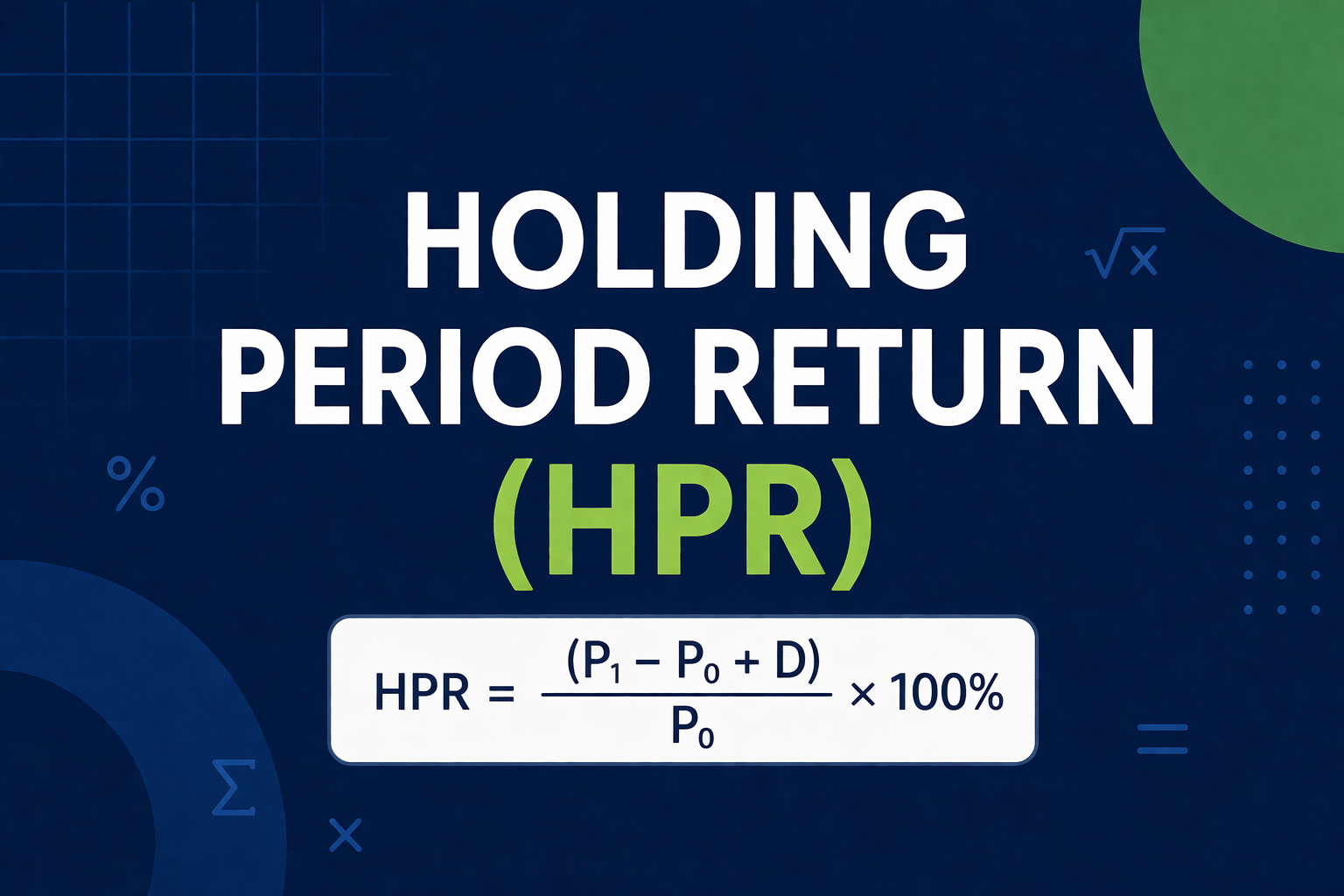
Investing successfully requires not only selecting the right assets but also understanding the returns generated over time. Holding Period Return (HPR) is a key metric that measures the total return earned from holding an asset, including both price appreciation and income, such as dividends or interest. By evaluating HPR, investors can compare performance across different assets and make more informed portfolio decisions.
HPR measures total return over a specific holding period, incorporating capital gains and income.
Annualised HPR allows comparison across different time frames and investment types.
Understanding HPR helps evaluate portfolio performance and inform reinvestment decisions.
HPR is simple to calculate but should be considered alongside risk and market conditions.
Both stocks and bonds can be analysed using HPR for a complete view of returns.
Holding Period Return quantifies how much an investment has earned during the period it is held. It includes:
Capital Gains (or Losses): The difference between the asset’s selling price and its purchase price.
Income Received: Dividends, interest payments, or other distributions during the holding period.
Tech stocks like Apple Inc. (AAPL) have experienced moderate growth amid rising interest rates, which are affecting valuations.
Dividend-paying stocks such as Johnson & Johnson (JNJ) have remained attractive due to consistent payouts.
HPR allows investors to compare the total returns of different asset types, rather than focusing solely on price movements.
The formula for HPR is:
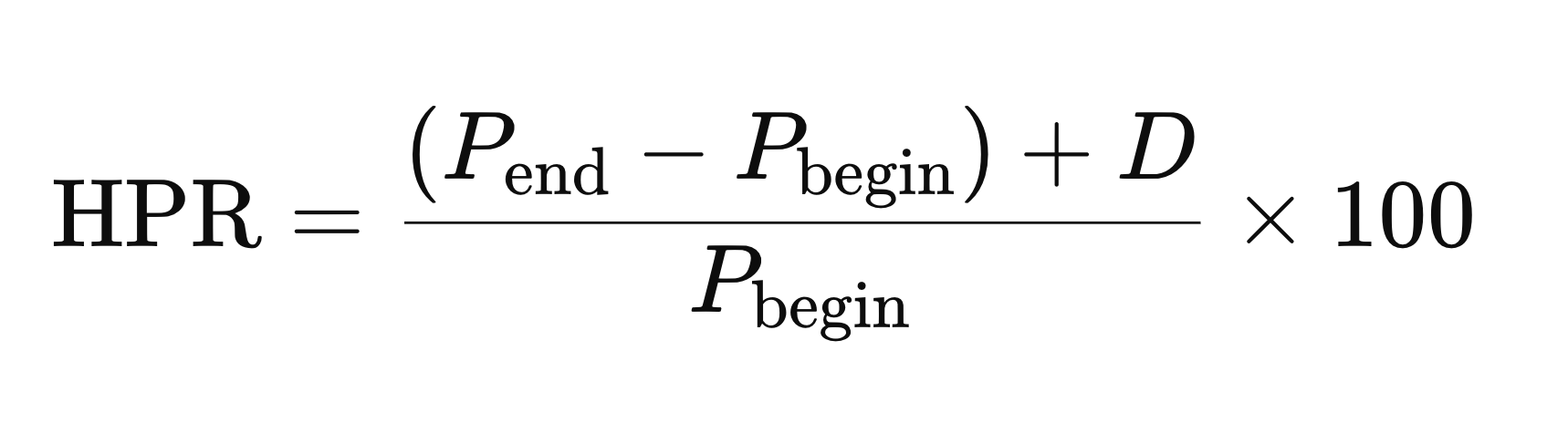
Where:
P(end) = Ending price of the asset
P(begin) = Initial purchase price
D= Income received during the holding period (dividends, interest, etc.)
Example:
Suppose you bought 100 shares of AAPL at $150 per share at the start of 2026. By year-end, the stock price is $165, and you received $3 per share in dividends.
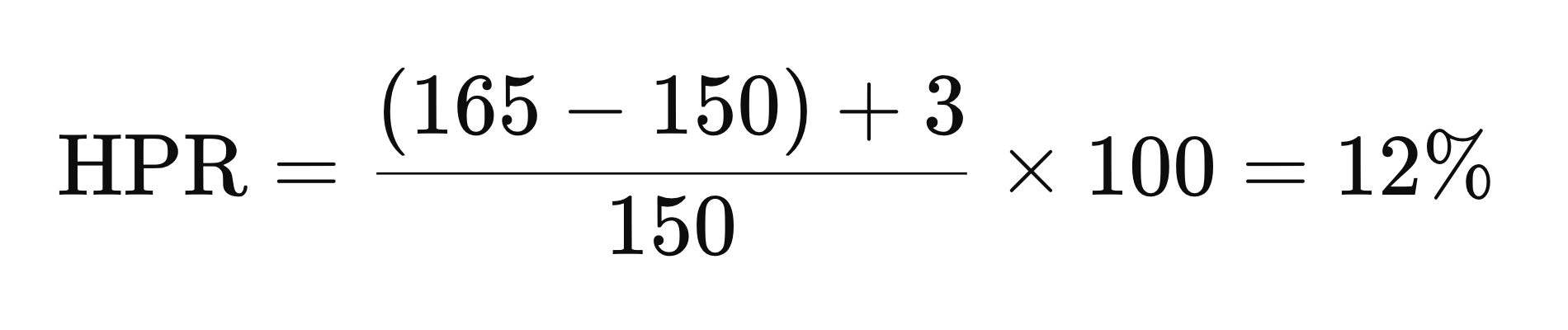
This 12% represents the total return for the year, including both capital gains and dividends.
For investments held longer than one year, annualised HPR helps compare returns across assets or periods:

Where n = number of years held.
Example:
If the same AAPL investment achieves a cumulative HPR of 25% over 2 years:

Investors and portfolio managers use HPR to:
Evaluate Performance: Determine how a stock, ETF, or bond performed over the holding period.
Compare Assets: Standardise returns to compare stocks, ETFs, and bonds.
Analyse Dividend Strategies: Assess the benefit of holding dividend-paying stocks.
Inform Portfolio Decisions: Identify which holdings contribute most to total returns.
Pro Tip: Always consider dividend reinvestment to capture the full benefit of total returns.
Market Volatility: Price swings can significantly impact HPR, especially for growth stocks.
Dividends & Interest: Higher payouts can boost HPR even if price growth is moderate.
Holding Period Duration: Short-term returns may fluctuate more; long-term returns are often smoother.
Macro Trends: Inflation, interest rates, and global economic events (like the 2026 rate hikes) influence both capital gains and income.
While HPR is useful, investors should be aware:
Does Not Account for Risk: A high HPR could come from high volatility.
Backwards-Looking Metric: Past performance does not predict future returns.
Excludes Costs: Taxes, fees, and transaction costs reduce actual returns.
Time Value of Money Ignored: HPR does not adjust for compounding or inflation unless annualised.
Yes, HPR essentially measures total return over a specific period, including capital gains and dividends or interest income.
Yes, if the asset’s price declines or income does not offset losses, HPR can be negative, indicating a loss over the holding period.
The basic HPR formula does not include taxes, brokerage fees, or transaction costs, which can reduce actual investor returns.
HPR measures total return for the period held, while annualised HPR adjusts for the time period, allowing comparisons across different investment durations.
Absolutely. HPR is applicable to any investment, including bonds, where it accounts for interest payments and changes in bond prices over the holding period.
Holding Period Return is a critical metric for measuring investment performance. Accounting for both price changes and income distributions, it provides a comprehensive view of how an asset performs over time. Understanding HPR helps investors make informed comparisons across stocks, ETFs, and bonds, aiding in portfolio decisions and long-term financial planning.
Disclaimer: This material is for general information purposes only and is not intended as (and should not be considered to be) financial, investment or other advice on which reliance should be placed. No opinion given in the material constitutes a recommendation by EBC or the author that any particular investment, security, transaction or investment strategy is suitable for any specific person.