Published on: 2026-05-14
Updated on: 2026-05-14
The TDIC stock surge shows how quickly the market can turn a small Nasdaq listing into an AI proxy. Dreamland Limited did not announce a completed platform, a signed customer rollout or a revenue contract. It announced a non-binding MoU for an AI-powered image library. The share price did the rest.
That gap is the story. TDIC moved from $2.36 to $23.05 in one session, after already rising 126.92% the day before. A latest quote feed showed a $2.73 to $34.51 intraday range and volume above 109 million shares. The move is no longer just about an artificial intelligence headline. It is about whether price discovery has outrun the business case.
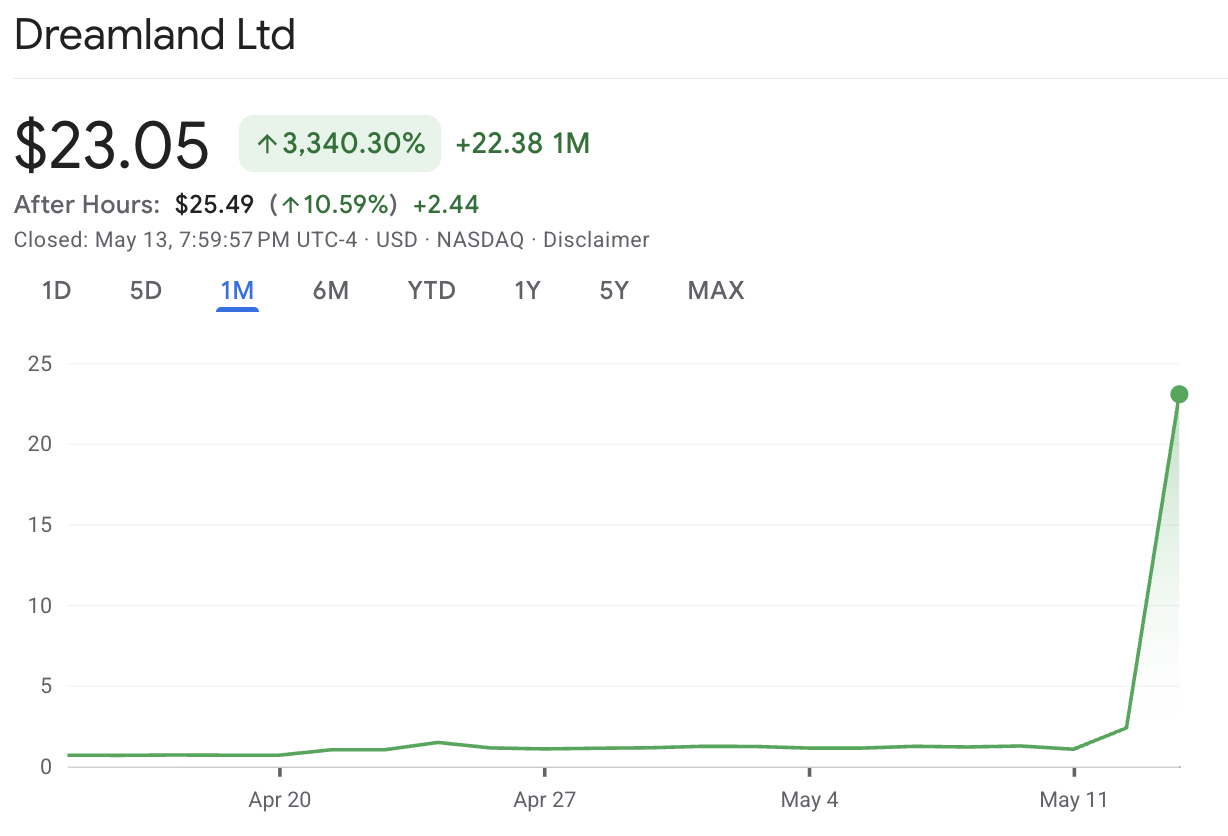
TDIC closed at $23.05 after a two-session breakout that pushed the stock from $1.04 to $23.05.
Volume exceeded 100 million shares for two consecutive sessions, turning a quiet listing into a liquidity event.
The AI catalyst is an MoU, not a definitive service agreement, product launch or contracted revenue stream.
The proposed platform has a logical business fit because event companies handle large image libraries, tagging, search and content workflows.
Dreamland’s latest reported operating base remains small, with HK$40.0 million in six-month revenue and a HK$37.0 million net loss.
Recent filings add share-supply context, including a registered resale framework tied to an $18 million equity line of credit.
Dreamland’s subsidiary, Trendic International Limited, signed a non-binding memorandum of understanding with LinkFung Innovation Limited to explore an AI-powered intelligent image library platform.
The proposed system would combine face detection, automated tagging, intelligent filtering, sentiment recognition, cloud infrastructure and databases using vector embeddings for AI search and recommendations.
The use case is not random. Dreamland operates in event management, including themed walk-through experiences and event services. An AI image library could help sort, search, tag and retrieve media assets faster.
Three conditions decide whether the idea becomes material:
First: the MoU must become a definitive service agreement with pricing, milestones and payment terms.
Second: the platform must prove practical use inside Dreamland’s event workflow or through external customers.
Third: the project must show commercial economics, not only technical ambition.
The current disclosure does not yet meet those tests. The project is estimated to run for 12 months, with binding provisions covering intellectual property, confidentiality and data protection. The broader transaction remains generally non-binding, and there is no assurance that a final agreement will be executed or completed.
TDIC was already volatile before the AI headline captured attention. The stock rose 126.92% on May 12, with volume of 111.9 million shares. It then surged 876.69% on May 13, with historical volume of 104.6 million shares and a closing price of $23.05.
| Market Signal | Latest Reading | Why It Matters |
|---|---|---|
| Latest close | $23.05 | Repriced far beyond pre-MoU levels |
| Previous close | $2.36 | Extreme gap risk after the AI headline |
| Latest intraday range | $2.73 to $34.51 | Wide price discovery |
| Latest volume | Above 109 million shares | Momentum flow dominated normal trading patterns |
| May 12 move | +126.92% | Speculation started before the largest surge |
| May 13 move | +876.69% | AI catalyst became a full liquidity shock |
This is why the TDIC stock surge needs a market-structure lens. A move of this size can attract more momentum, but it can also reverse when volume fades. The closing price matters less than the next consolidation range.
Dreamland’s financial base gives the rally important context. Annual revenue reached HK$45.8 million for the fiscal year ended March 31, 2025, up 124.08% from the prior year. The later interim report showed HK$40.0 million revenue for the six months ended September 30, 2025, up 29.0% from the same period in 2024.
The quality of that growth is less clean. Net loss reached HK$37.0 million for the six-month period, compared with a HK$2.7 million profit a year earlier. The loss was driven largely by higher general and administrative expenses, including share-based payment costs and IPO-related professional and listing expenses.
That does not invalidate the AI project. It means TDIC is now pricing a shift in business identity before the financial statements show technology revenue.
TDIC also has a capital-structure story. Dreamland listed on Nasdaq in July 2025 at $4.00 per Class A ordinary share. The IPO involved 2.0 million shares, including 1.34 million sold by the company and 660,000 by an existing shareholder. Dreamland received gross proceeds of $5.36 million before fees.
More recent filings add another layer. Dreamland regained Nasdaq minimum bid-price compliance after its Class A shares held above $1.00 for 10 consecutive business days from April 21 through May 4.
The company also registered up to 18 million Class A shares for resale under an equity line of credit tied to Hudson Global Ventures. That registration does not automatically mean immediate selling, but it keeps dilution and potential share supply in the valuation debate.
The next phase depends on proof. The cleanest signals would be:
A signed service agreement replacing the MoU.
Clear project economics, including fees, milestone payments and deployment scope.
A working product demo tied to event-media management.
Customer adoption beyond internal use.
Disclosure on cloud costs, data protection, technical staffing and expected margin impact.
Fewer signs of share-supply pressure while the stock tries to establish a new base.
Without those signals, TDIC remains a high-volatility AI optionality trade. With them, the story can start moving from speculation to execution.
The TDIC stock surge has turned Dreamland Limited into one of the market’s most aggressive AI-linked small-cap stories. The image-library MoU gives the company a plausible technology angle, especially because event businesses need better tools for organizing large volumes of digital media.
The weakness is not the concept. It is the distance between concept and revenue. TDIC has already delivered the price reaction that normally follows a major strategic shift, while the available disclosure still describes an early-stage, non-binding project.
The next reset will come from evidence. Signed terms, product milestones and commercial demand would strengthen the case. If those details do not follow, the rally risks being remembered as a liquidity shock that priced AI potential faster than Dreamland could prove it.