Published on: 2026-04-02
Updated on: 2026-04-02
Investing is both an art and a science. For many investors, whether evaluating a bond, a private investment, a real estate project, or a capital budgeting decision, understanding how much return an investment generates relative to its cost and timing is fundamental. The Internal Rate of Return (IRR) is one of the most widely used financial metrics for this purpose.
IRR is the discount rate that makes the present value of future cash flows equal to the initial investment.
IRR helps compare investments with different cash flow patterns and horizons.
A higher IRR generally signals a more attractive investment, all else equal.
IRR alone can be misleading without considering scale, duration, and risk.
IRR is most useful when used alongside complementary metrics such as NPV and payback period.
Internal Rate of Return (IRR) is a financial metric that estimates the profitability of an investment by calculating the expected annualised return over its life. It answers the question: “What is the rate of return that equates all expected future cash inflows and outflows to the initial cost?” For investors, IRR serves as a benchmark for comparing opportunities, such as stocks, projects, and private deals, even when cash flows are uneven over time.
At its core, IRR is the discount rate that sets the Net Present Value (NPV) of cash flows to zero:
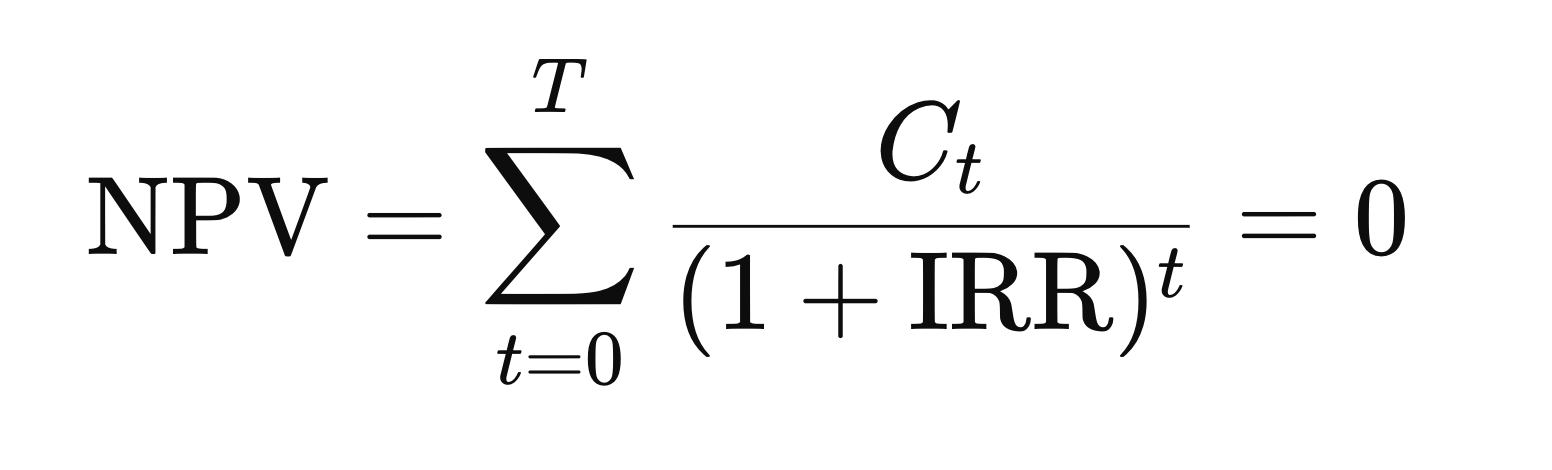
Where:
(C_t) = Cash flow at time (t)
(T) = Total number of periods
When calculating IRR, positive cash inflows (returns) are balanced against cash outflows (costs) so that the net present value equals zero. This rate reflects the annualised return you would earn if the project or investment performs exactly as projected.
Suppose you invest $10,000 in a private digital infrastructure fund in early 2026. You expect the following cash flows over the next four years:
Finding the IRR involves solving for the discount rate that sets the above cash flows to zero. Financial calculators or spreadsheet functions, such as Excel’s =IRR(), make this process simple. If, in this case, the IRR is approximately 16.7%, you would interpret that as an expected annualised return of roughly 16.7% over the four years.
Corporate finance teams use IRR to choose among competing projects. If Project A has an IRR of 12% and Project B has an IRR of 19%, Project B would be preferred, assuming similar risk profiles.
These investors often evaluate opportunities with irregular and unpredictable cash flows. IRR helps them quantify the time value of money and compare deals across industries.
Real estate cash flows can include rent, operating costs, refinancing, and sale proceeds. IRR captures both interim cash flows and terminal value in a single return metric.
Public market investors rarely use IRR for a single stock because stock returns are realised only upon sale or dividend receipt. However, IRR is useful when modelling expected returns from periodic dividends or projected stock exits in a private placement.
While IRR is powerful, it has limitations:
Scale Insensitivity: A small project with a 30% IRR may be less attractive than a large one with a 20% IRR if absolute dollar returns differ substantially.
Multiple IRRs: Unconventional cash flows (switching between positive and negative) can yield multiple valid IRRs.
Reinvestment Rate Assumption: Traditional IRR assumes that intermediate cash flows are reinvested at the same IRR, which may be unrealistic; Modified IRR (MIRR) addresses this.
NPV measures the absolute value created, while IRR expresses return efficiency. Ideally, an investor should consider both.
In early 2026, global central banks are navigating a delicate balance between inflation pressures and slowing growth. As investors seek real returns above inflation and interest rates priced into the market, understanding IRR can inform decisions across asset classes. For example:
Dividend‑paying ETFs like high‑yield equity funds rely on steady cash flows, making IRR useful in long‑term return projections.
Green energy infrastructure projects often promise phased cash inflows; IRR can help quantify project viability relative to the cost of capital.
A higher IRR suggests a more efficient return, but it should not be evaluated in isolation. Consider project scale, risk, duration, and NPV as well.
Yes. A negative IRR indicates that the investment’s cash flows are insufficient to recover the initial cost at any positive return rate.
When an investment’s cash flows alternate between positive and negative more than once, the IRR calculation can yield multiple solution rates.
ROI is a simple profit‑to‑cost ratio that ignores timing. IRR accounts for when cash flows occur, making it a time‑adjusted return measure.
IRR does not inherently account for risk levels. Investors must separately adjust discount rates or use complementary metrics to account for risk.
Internal Rate of Return (IRR) is a foundational metric in investment and capital budgeting. It expresses the annualised return that equates future cash flows with the initial investment. IRR’s time‑value focus makes it invaluable when comparing dissimilar investment opportunities across public and private markets. Used alongside measures like NPV and IRR, IRR equips investors with a nuanced view of potential returns, aligning decision‑making with financial goals and market conditions.
Disclaimer: This material is for general information purposes only and is not intended as (and should not be considered to be) financial, investment or other advice on which reliance should be placed. No opinion given in the material constitutes a recommendation by EBC or the author that any particular investment, security, transaction or investment strategy is suitable for any specific person.