Published on: 2026-06-08
USD/ZAR technical analysis for June has shifted from rand-strength support pressure to dollar-led breakout risk. The pair jumped 1.59% on June 5 to close near 16.55, its sharpest one-day rise in weeks, after a much stronger-than-expected US jobs report revived dollar momentum and lifted rate expectations.
By June 8, the pair was trading closer to the 16.60 area, keeping the 16.55 to 16.60 resistance band under direct pressure.
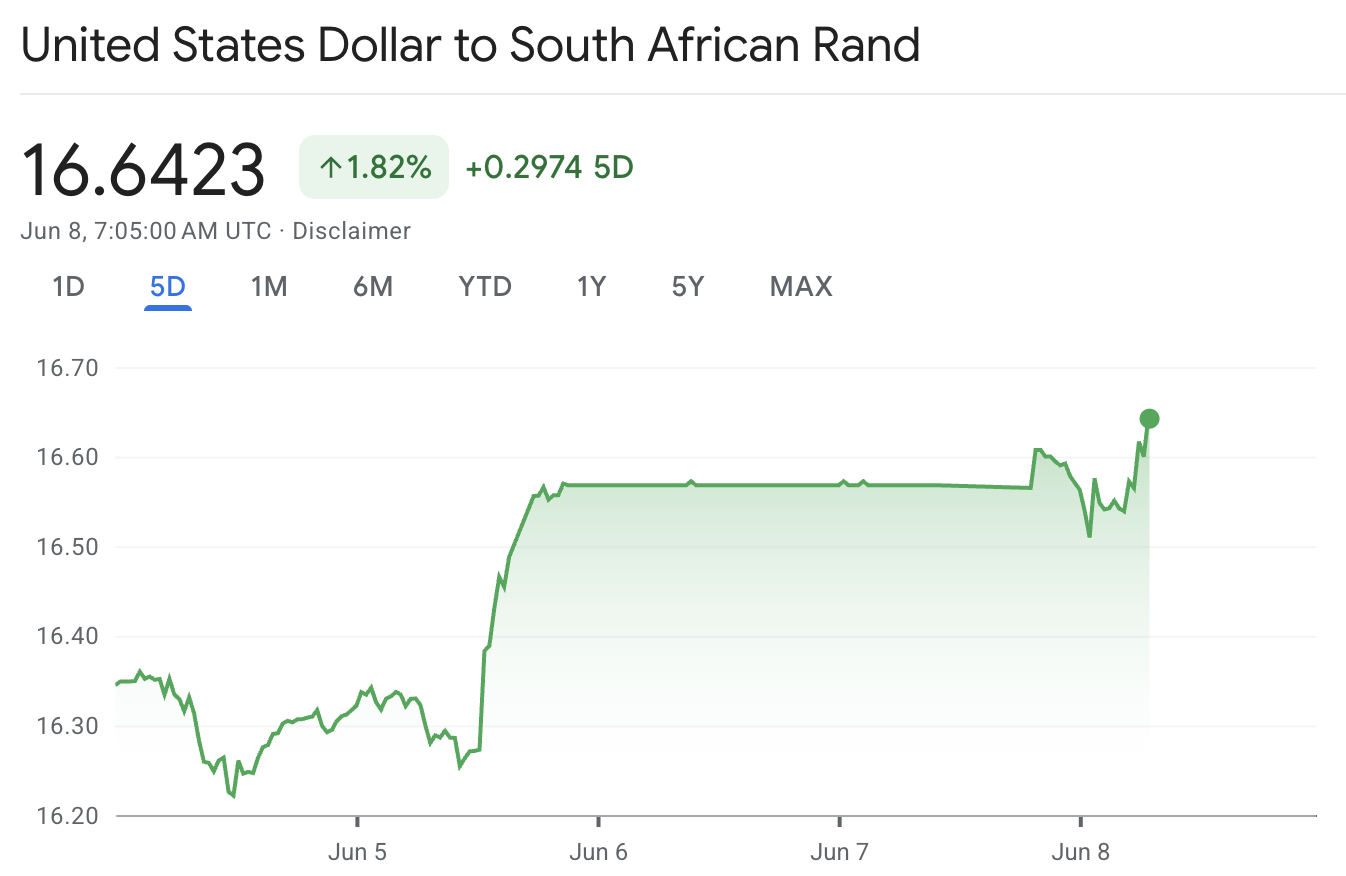
The pair remains closer to the lower end of its 52-week range than the upper end, so June’s setup is not a confirmed trend reversal yet. It is a breakout-risk test inside a broader rand-strength structure.
USD/ZAR is testing the 16.55 to 16.60 resistance band after a 1.59% surge on June 5, with the May swing high at 16.68 capping the zone.
A daily close above 16.60, confirmed through 16.68, would expose the upper half of the 2026 range, with 16.75 the next reference.
Failure to hold 16.50 on a pullback would weaken the rebound and bring the late-May congestion near 16.35 to 16.38 back into play, with 16.25 the deeper line.
Momentum has flipped dollar-positive, but the speed of the move argues for confirmation rather than chasing strength into resistance.
US yields, the SARB’s renewed tightening stance, gold and platinum-group-metal prices, and broad risk sentiment are the live macro triggers.
The daily readings below show a USD/ZAR technical snapshot on June 8 and will move with the market. Confirm levels on a live chart before trading.
| Indicator | June 8 Daily Reading | Signal | Interpretation |
|---|---|---|---|
| RSI 14 | 68.96 | Buy, near overbought | Momentum favors USD/ZAR, but the pair is close to the 70 zone where pullback risk rises. |
| MACD 12,26 | +0.056 | Buy | Positive MACD confirms that the dollar rebound has technical backing. |
| ADX 14 | 33.65 | Buy | Trend strength is firm enough to support breakout risk above 16.60. |
| ATR 14 | 0.0417 | Moderate volatility | Volatility expanded on the jobs-report move but is not yet disorderly. |
| Williams %R | -10.23 | Overbought | Reinforces waiting for confirmation rather than chasing into resistance. |
| EMA 20 | 16.5214 | Buy | Holding above the short-term EMA keeps the rebound intact. |
| EMA 50 | 16.4289 | Buy | The medium-term recovery structure remains supported above this level. |
| EMA 100 | 16.3752 | Buy | A break below this zone would weaken the broader rebound. |
| EMA 200 | 16.3662 | Buy | Price above the long-term EMA supports the shift away from pure rand-strength pressure. |
| Resistance | 16.60 / 16.68 / 16.75 | Breakout zone | A close above 16.60 and 16.68 would confirm stronger upside risk. |
| Support | 16.50 / 16.35 to 16.38 / 16.25 | Invalidation zones | Loss of 16.50 weakens the bullish setup; 16.35 and 16.25 restore rand-strength pressure. |
Technical readings are daily-timeframe indicators as of June 8, 2026, and may vary by chart provider, timestamp and pricing feed.
RSI is strong but close enough to overbought territory to make a clean daily close above 16.60 more important than the intraday move itself.
MACD and ADX confirm that momentum has turned dollar-positive, while price trading above the 20-, 50-, 100- and 200-period EMAs gives the rebound a stronger technical base than a one-day data reaction alone would suggest.
The caution signal is Williams %R, which is already overbought. That strengthens the case for waiting for confirmation through 16.60 and 16.68 rather than treating the first spike as a completed breakout.
The EMA ladder also stacks bullishly from 16.37 up to 16.52. That means the rebound structure sits inside a tight 15-cent band: constructive while it holds, but quick to unwind if 16.50 gives way.
USD/ZAR’s rebound was driven by a dollar shock rather than a deterioration in South Africa’s domestic story. May US payrolls rose 172,000 against expectations near 80,000, pushing Treasury yields higher and forcing markets to reprice the path of Fed policy. That shift lifted the dollar across emerging-market FX, with high-beta currencies such as the rand absorbing the larger move.
The timing was unfavorable for ZAR. Gold and platinum-group metals weakened alongside the broader metals pullback in early June, reducing one of the rand’s key external supports. When US yields rise at the same time commodity prices soften, USD/ZAR tends to move quickly because both sides of the pair are being repriced at once.
South Africa still has a defensive anchor. The SARB raised its repo rate by 25 basis points to 7% on May 28, its first hike since 2023, citing fuel costs, food inflation and second-round price risks. That keeps the rand supported by a wide carry differential, even as the dollar regains short-term momentum.
That is why 16.60 matters. A break above the level would signal that US rate repricing is overpowering South Africa’s carry support. A rejection would suggest the rand’s yield cushion is still strong enough to absorb the dollar rebound.
A sustained daily close above 16.60 would suggest the market is repricing dollar strength rather than simply correcting an extended rand rally.
The first confirmation test sits at the 16.68 May swing high. Clearing both levels would open 16.75 and shift the conversation toward the middle of the yearly range. In that case, pullbacks toward 16.55 to 16.60 become the zone buyers defend, and the January-to-May rand-strength narrative goes on hold until the US rate picture clarifies.
The stronger version of this scenario needs help from the calendar. Continued firm US data, or further weakness in gold and PGM prices, would give the breakout fundamental fuel rather than leaving it as a positioning squeeze.
Failure near 16.60, particularly a reversal candle or a lower high under 16.68, would suggest the rebound is running on one data point. A slip back below 16.50 would be the first warning, exposing the late-May congestion at 16.35 to 16.38 where the pair spent most of the month.
Below that, the 16.25 area separates a normal pullback from renewed rand-strength pressure toward the January low.
This scenario gains probability if US inflation data soften, if metals prices stabilize, or if the SARB signals further tightening. Any of those would restore the carry-and-commodity mix that drove the pair down from 18.20.
Four triggers will decide which scenario wins:
US inflation prints and Fed communication. The entire dollar leg rests on the rate-hike repricing that began with the June 5 jobs report, so each data point either feeds or starves the breakout.
Gold and platinum-group-metal prices. Metals are the rand’s commodity anchor. Renewed weakness removes the export-revenue cushion, while stabilization restores it.
SARB follow-through. Any signal of further tightening after the May hike widens the rate differential that has anchored rand demand this year.
Broad risk appetite. The rand remains a high-beta proxy for emerging-market sentiment, so stressed sessions tend to hit it harder than macro data alone would justify.
USD/ZAR is no longer just consolidating after a rand rally. The June setup is about whether dollar momentum can force a clean break above 16.60, confirmed through the 16.68 May high.
Until that happens, the pair remains a range trade with rising breakout risk: bullish above 16.60 with 16.75 in view, neutral-to-bearish on a rejection that loses 16.50, and vulnerable to a deeper test of 16.35 and 16.25 if the dollar rebound fades as quickly as it arrived.