Published on: 2026-06-05
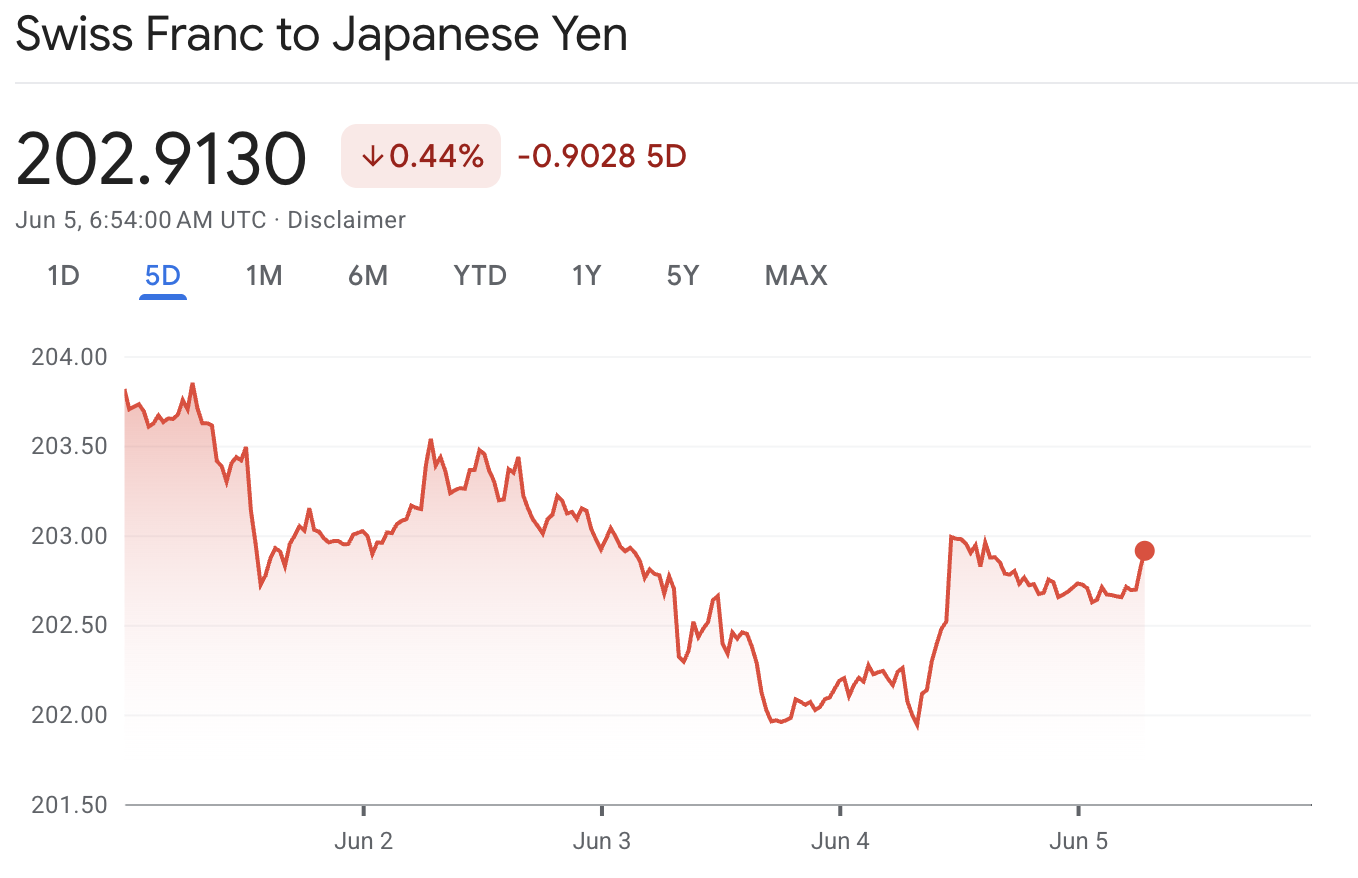
CHF/JPY is pressing the top of its range, trading near 203 after a year-long grind higher that has lifted the cross roughly 16% over the past twelve months. The pair sits just below its record high near 204.40, and the question that defines the outlook is simple: does the franc break to new highs, or does this ceiling finally produce a pullback?
The trend is up, but price has coiled into a tight range just beneath resistance, with momentum still positive rather than exhausted. That combination, a constructive trend pressing a hard ceiling, is where outlooks earn their keep.
| Metric | Reading | Signal |
|---|---|---|
| Spot, approx. | 202.89 | Trading near the top of its 52-week range |
| Day range | 202.49 to 202.90 | Tight session, still holding elevated levels |
| 52-week range | 174.80 to 204.42 | Price remains close to record/52-week resistance |
| Key resistance | 204.40, then 205 to 206 | Breakout zone |
| Near-term support | 200.00, then 198.00 | First pullback areas |
| EMA 20 | 202.65 | Bullish, price holding above short-term trend support |
| EMA 50 | 202.65 | Bullish, trend still constructive |
| EMA 200 | 202.73 | Bullish, price remains above long-term trend gauge |
| RSI 14 | 61.62 | Positive momentum, not deeply overbought |
| MACD 12,26 | +0.07 | Bullish momentum signal |
| Overall daily technical summary | Strong Buy | Trend bias remains upward while price holds above key averages |
The most common mistake with CHF/JPY is to read it as a yield play. It is not. Both the Swiss franc and the Japanese yen are traditional low-yielding, safe-haven, funding currencies, and the rate gap between them is narrow.
With the Bank of Japan holding its policy rate at 0.75% and biased toward further normalization, the yen arguably carries the slight rate advantage. Yet the cross is near record highs, which tells you the move is being driven by something other than interest-rate differentials.
Two forces explain it. First, persistent yen weakness: the BoJ has been cautious about the timing of its next hike, positioning data has shown heavy short-yen exposure, and the currency has stayed soft even as inflation forecasts have risen.
Second, safe-haven demand for the franc: bouts of geopolitical and macro uncertainty tend to pull capital into the Swissie, and that bid has been a recurring feature of this rally.
The practical takeaway is that CHF/JPY behaves as a risk-and-positioning barometer more than a rates spread. When global risk appetite is shaky, the franc tends to firm; when the yen finds a reason to strengthen, such as a hawkish BoJ shift or official intervention, the cross can reverse quickly because so much of the move rests on one-sided positioning.
Price is holding just above a tight cluster of exponential moving averages, with the 20-, 50-, and 200-EMAs all compressed in the 202.65 to 202.75 zone and spot at 202.89. That convergence is itself a signal. It reflects a market that has stopped trending hard and started consolidating directly beneath resistance.
Coiling like this near the top of the range tends to resolve with an expansion in volatility, in one direction or the other, rather than a slow drift.
Momentum still leans positive. The 14-day RSI near 62 shows constructive buying pressure with room before overbought territory, and the MACD sits marginally above its signal line. A mechanical daily technical summary reads Strong Buy, which simply reflects price holding above those averages.
The caveat is that such gauges describe the present, not the breakout. With the averages compressed and 204.40 directly overhead, the real read is binary: momentum is supportive, but the cross still needs fresh fuel, most likely renewed yen weakness or a safe-haven bid for the franc, to convert a Strong Buy reading into an actual new high.
Bullish continuation. A daily close above the 204.40 record opens unexplored territory, with the round 205 to 206 zone the first upside reference. Confirmation would be stronger if it comes with a momentum expansion rather than a marginal new high. In that case, dips toward the prior resistance near 204 would be the area buyers look to defend.
Rejection and pullback. A failure to clear 204.40, especially a reversal candle or a lower high, would first put the 202.60 to 202.70 average cluster in play. Losing that band cleanly favors a pullback toward 200.00, a round-number and psychological support, and then 198.00. The uptrend only comes into real question on a sustained loss of 195, which would mark a clear lower low.
The catalysts that matter most are policy and positioning, not chart lines in isolation. The timing of the Bank of Japan’s next rate move is the single biggest swing factor; any hawkish surprise or firm signal on normalization could spark a sharp yen recovery and pressure the cross. Japanese intervention risk is a related tail: authorities have stepped into the market before to defend the yen, and such moves tend to hit yen crosses hard and fast.
On the franc side, watch the Swiss National Bank’s stance and broad risk sentiment, since safe-haven flows have been a core pillar of the advance. A calmer global backdrop would remove some of the franc’s support, while renewed uncertainty would reinforce it.
CHF/JPY is a healthy uptrend meeting a stubborn ceiling. The bias stays constructive while price holds above its moving-average cluster near 202.70 and the 200.00 support, and a confirmed break of 204.40 would extend the trend into record territory.
But with momentum flattening at the highs and the entire move resting on yen weakness and safe-haven demand rather than yield, this is a cross that can turn quickly. Traders are better served reacting to a clean break or a clean rejection of 204.40 than anticipating one.
This analysis is for educational and informational purposes only and is not investment advice or a recommendation to trade any instrument. Foreign exchange trading carries substantial risk, including the loss of capital, and leverage can amplify losses. Price levels are approximate and should be verified on a live chart. Conduct your own research and consider consulting a licensed financial professional.