Published on: 2026-04-14
USD/ZAR technical analysis has become a support story before it becomes anything else. The pair is trading near 16.35 to 16.36, almost exactly on top of the same floor that has defined the 2026 range, after falling from 16.81 on April 7 to 16.36 on April 14.
The backdrop matters because the chart is no longer moving in isolation. South Africa still offers a 6.75% policy rate with headline CPI at 3.0% for February, while the next SARB MPC press conference is scheduled for May 28, 2026.
Support levels only matter when the market keeps returning to them. That is what makes 16.35 important now. EBC’s January technical map identified 16.35 to 16.40 as immediate support and said a sustained close below 16.35 would expose 16.00 as the next magnet.
Three months later, the pair is back on that shelf with spot at 16.3654 and the classic daily pivot at 16.3479. The market is no longer debating where support is. It is debating whether support is being defended or slowly exhausted.
The short-term price record reinforces that point. On April 14, USD/ZAR traded between 16.3178 and 16.4275. On April 13, it printed a high of 16.6214 before closing at 16.3959. On April 8, it swung as low as 16.2571 after trading near 16.90 intraday.
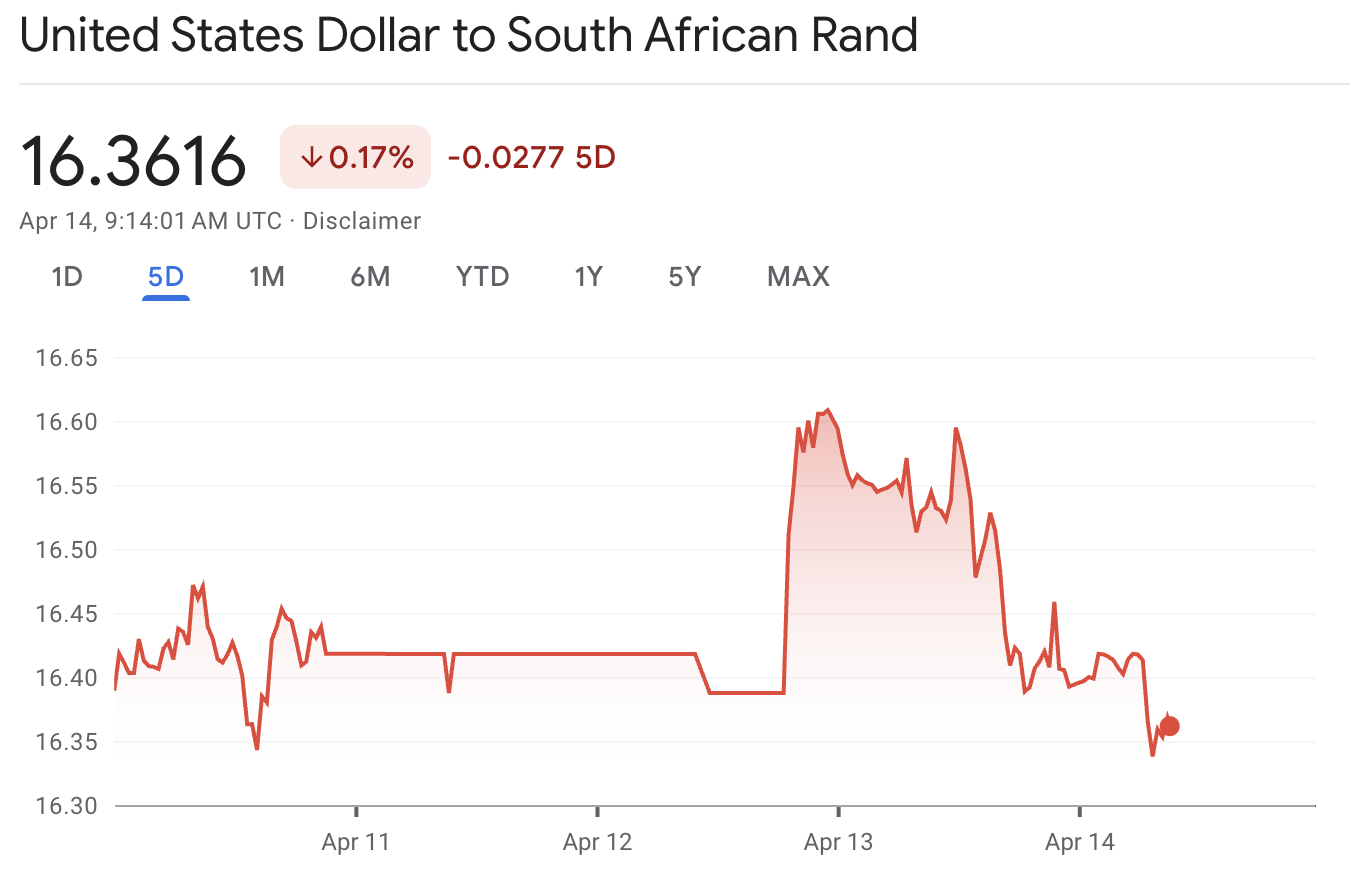
That sequence shows two things at once: volatility remains high, and sellers keep pushing the pair back to the same floor even after sharp rebounds. That is usually how a level turns from support into pressure point.
The daily technical board is not neutral. It is leaning clearly bearish.
| Signal | Current read |
|---|---|
| Spot area | 16.36 |
| RSI (14) | 37.653 |
| MACD (12,26) | -0.024 |
| EMA 20 | 16.4210 |
| EMA 50 | 16.4426 |
| EMA 200 | 16.6181 |
| Classic S1 | 16.3295 |
| Classic S2 | 16.2994 |
| Classic S3 | 16.2810 |
| Pivot | 16.3479 |
| Classic R1 | 16.3780 |
| Classic R2 | 16.3964 |
| Classic R3 | 16.4265 |
| Trend | Bearish below major EMAs |
| Momentum | Weak, but not capitulation |
Those numbers are important because they tell a consistent story. An RSI below 40 signals weak momentum without yet reaching an extreme washout. MACD below zero confirms downside momentum is still intact.
More importantly, spot is trading below the 20-day, 50-day, and 200-day moving-average cluster, which means the pair is not just soft on an intraday basis. It is also trading beneath the medium-term trend envelope. In plain terms, rallies are still corrective until price proves otherwise.
The moving-average structure also explains why rebounds have struggled. When the market sits below the 20-day and 50-day averages, those levels often stop acting as support and become supply.
For USD/ZAR, the first real repair zone is above the current price, not below it. Even if the pair bounces, it still has to clear the 16.42 to 16.47 area before the rebound starts to look structurally credible.
The rand does not need a domestic boom to strengthen. It often only needs a softer dollar, stable local rates, and fewer external shocks. That is roughly the mix in front of the market now.
The SARB calendar shows the policy rate at 6.75%, while Stats SA’s latest inflation story shows headline CPI cooled to 3.0% in February from 3.5% in January. That leaves South Africa with a real-rate backdrop that remains meaningful in an environment where the dollar has softened, and broad risk appetite has stabilised.
The external backdrop has also improved marginally. For South Africa, lower oil prices matter because they ease imported inflationary pressures and reduce strain on the external balance. That link is never perfect, but it is direct enough to matter for USD/ZAR pricing when the pair is already testing a critical floor.
That does not make the rand one-way bullish. It makes it more credible amid dips in the dollar. The next SARB event is not until May 28, so the near-term driver is more likely to be global dollar direction than a surprise domestic policy shift.
The bearish continuation remains the cleaner scenario, but it needs confirmation. A daily close below the 16.32 to 16.35 support band would first shift attention to 16.2994 and then to 16.2810, the next two classic support markers on the verified daily pivot grid.
Below that, 16.00 becomes the obvious psychological reference point, but that is still a second-step target rather than the next printed support.
The bullish counter-scenario is narrower. Buyers first need to hold the lower band on a closing basis. After that, they need to reclaim the 16.3479 pivot, then break above 16.3780 and 16.3964.
Only once that sequence is in place does the market begin to repair the short-term damage. Even then, the broader structure would still have to contend with the EMA20 at 16.4210 and the EMA50 at 16.4426 overhead.
USD/ZAR is no longer drifting lower without structure. It is pressing a live support zone with bearish momentum still intact, major moving averages still overhead, and a macro backdrop that remains modestly supportive for the rand.
That combination makes the setup clear. Either buyers defend the lower band and force a repair, or the pair closes through it, opening the way to the next downside markers. For now, the evidence still favours pressure over recovery.
Disclaimer: This material is for general information purposes only and is not intended as (and should not be considered to be) financial, investment or other advice on which reliance should be placed. No opinion given in the material constitutes a recommendation by EBC or the author that any particular investment, security, transaction or investment strategy is suitable for any specific person.