Published on: 2025-05-02
Updated on: 2026-07-31
As of July 2026, the USD/ZAR exchange rate trades near 16.51. The rand is about 8% stronger against the dollar than it was a year ago, and it has spent 2026 in a far tighter range.
Two forces have replaced the drivers which is oil. Conflict in the Middle East pushed crude toward 100 dollars a barrel and closed much of the Strait of Hormuz, which raised the import bill for a country that buys almost all of its crude abroad. The second is the South African Reserve Bank’s new 3% inflation target, which changed how the central bank responds to those price shocks.
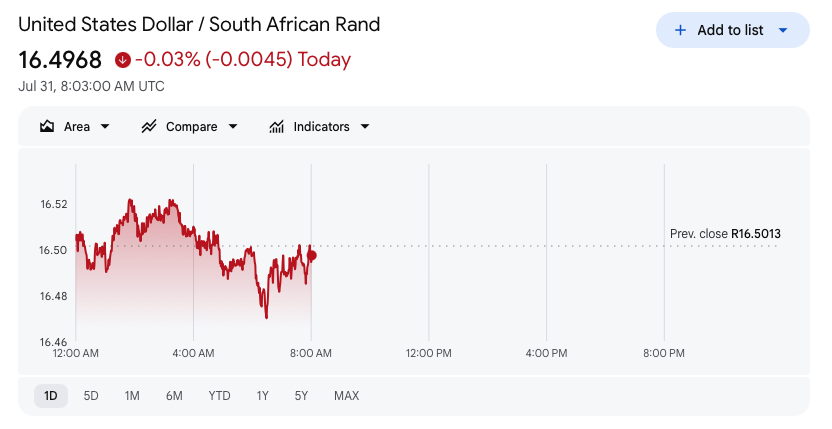
USD/ZAR has traded between 15.73 and 17.19 so far in 2026, averaging about 16.43. The low came on January 28 and the high on March 30. That range of roughly 1.46 rand is narrow compared with 2025, when the pair reached a record 19.93 in April.
The most recent move came on July 23, when the Reserve Bank held rates instead of raising them. The rand weakened to around 16.98 in the days that followed, its weakest level in more than three months, before recovering as oil prices fell.
Technical Analysis and Market Sentiment
Three levels frame the pair right now:
15.73 is the 2026 low, set in January. It marks the strongest the rand has been this year.
17.19 is the 2026 high, set in March. The pair has approached but not broken it since.
19.93 is the record from April 2025, and remains the reference point for how far the pair moved during a genuine risk shock.
Traders commonly read USD/ZAR against its 50-day and 200-day simple moving averages. Because the pair spent most of 2026 inside a 1.5 rand band, those averages have converged, which is typical of a range rather than a trend. Momentum readings such as RSI carry less weight in these conditions, since they oscillate around the midpoint without producing a directional signal.
Economic Indicators Influencing the Rand
South Africa’s monetary policy. The repo rate is 7.00%, and the prime lending rate is 10.50%. The Reserve Bank raised the rate by 25 basis points in May 2026, then held in July on a four-to-two vote, with two members preferring a further hike. The Bank has set policy around a new target of 3% inflation, with a tolerance band of one percentage point either side, announced by the National Treasury on November 12, 2025.
South African inflation. Headline CPI rose to 5.0% in June 2026 from 4.5% in May, the highest reading in two years. Core inflation reached 4.1%. Transport costs rose 12.7% year on year and fuel prices rose 34.3%. Both measures sit above the new target band.
US monetary policy. The Federal Reserve’s target range for the federal funds rate is 3.50% to 3.75%. That leaves an interest rate gap of roughly 3.25 percentage points in the rand’s favor, which is what makes holding rand attractive to yield-seeking investors and what makes a long US dollar position against the rand expensive to carry.
Oil and global conditions. South Africa imports crude and exports metals, so the terms of trade swing with both. Higher oil prices widen the import bill and feed straight into the CPI readings above. On the export side, the country accounts for roughly 70% of world platinum production, 46% of chromium, 40% of manganese and 38% of palladium, so metal prices support the rand when they rise.
Fiscal position and credit ratings. The National Treasury projects gross loan debt stabilising at 78.9% of GDP in 2025/26 and falling to 76.5% by 2028/29. All three major rating agencies moved in South Africa’s favour between November 2025 and June 2026, though the country remains below investment grade.
What official institutions actually publish
No central bank or government body publishes a target for the rand. The Reserve Bank targets inflation and treats the exchange rate as one input into that forecast, not as an objective in itself. Its published projections are therefore about prices and growth, and the rand path is an assumption inside them rather than a prediction.
What the Bank has said matters more than any number. Governor Lesetja Kganyago described the inflation outlook as slightly improved at the July 2026 meeting, while noting that inflation remains too high and growth remains weak. The Bank expects slower growth through the second and third quarters of 2026, with recovery in the second half of the year, and has flagged that further tightening may be needed if fuel costs feed into broader prices.
What the drivers point to for the rest of 2026
Three inputs decide the direction from here, and they currently pull against each other:
The interest rate gap of roughly 3.25 percentage points supports the rand, as long as the Reserve Bank keeps policy restrictive.
Oil prices push the other way. Every sustained rise raises the import bill and the inflation path.
The Federal Reserve is the wild card. A shift in the US rate path moves USD/ZAR regardless of what happens in South Africa.
When drivers conflict, range conditions are more common than trends. That has been the pattern for most of 2026.
Long-Term Outlook (2027 to 2030)
The structural picture is different from the 2025 one. A currency with persistently higher inflation than its trading partners loses value against them over time, which explains most of the rand’s long decline. The move to a 3% target narrows that gap if it holds, which slowly reduces the structural pressure pushing USD/ZAR higher.
Working against that: unemployment stood at 32.7% in the first quarter of 2026, per Statistics South Africa, and weak growth limits how far the Bank can raise rates to defend the currency. Debt stabilisation and further rating improvements would help. None of this moves the pair this quarter. It shapes where it sits in a decade.
By purchasing power parity, yes, and by a wide margin. PPP compares what a basket of goods costs in each country, and the World Bank publishes a PPP conversion factor for South Africa that has sat far below the market exchange rate for years.
The gap is real, but its usefulness is limited. PPP is a decade-scale anchor with almost no power to explain moves over months. Emerging market currencies routinely trade below PPP for long periods because investors demand compensation for inflation risk, fiscal risk and liquidity risk. A currency can stay 40% below its PPP value for years without any pressure to correct.
What would strengthen the rand?
Falling oil prices, rising platinum and gold prices, a wider interest rate gap, further progress on debt stabilisation, and a weaker US dollar.
What would weaken it?
A renewed oil shock, a global move away from emerging market assets, disappointing fiscal news, or a US rate path that narrows the interest rate gap.
Holding a position in either direction carries a financing cost. Because South African rates sit well above US rates, a long USD/ZAR position pays daily overnight funding that accumulates against it, while a short position generally receives it. Over a multi-week hold, that cost can be material relative to the expected move.
The repo rate is 7.00%, and the prime rate is 10.50%. The Reserve Bank raised rates in May 2026 and held in July 2026 on a four-to-two vote.
Markets expected a rate hike at the July 23 meeting. The Reserve Bank held instead, which narrowed the expected interest rate gap and pushed USD/ZAR to around 16.98, its weakest level in more than three months.
Yes. South Africa imports nearly all its crude, so higher oil prices widen the trade deficit and raise inflation. Fuel prices rose 34.3% year on year in June 2026 and drove headline CPI to 5.0%.
The Reserve Bank’s rate decision (six times a year), the Stats SA inflation print (monthly), and the US Federal Reserve decision (eight times a year). You can track these on the EBC economic calendar.
The driver that matters depends on the horizon. Over days, USD/ZAR responds to the dollar and global risk appetite, and South African news is mostly noise. Over months, the interest rate gap and the oil price dominate, which is why the July rate decision moved the pair more than any domestic data release this year. Over years, the inflation gap and the fiscal path decide direction.
For background on the currency itself, see our guide to the currency of South Africa and the rules covering forex trading in South Africa. For a broader approach to trading pairs like this one, read our guide to trading currencies with confidence.