Published on: 2026-06-08
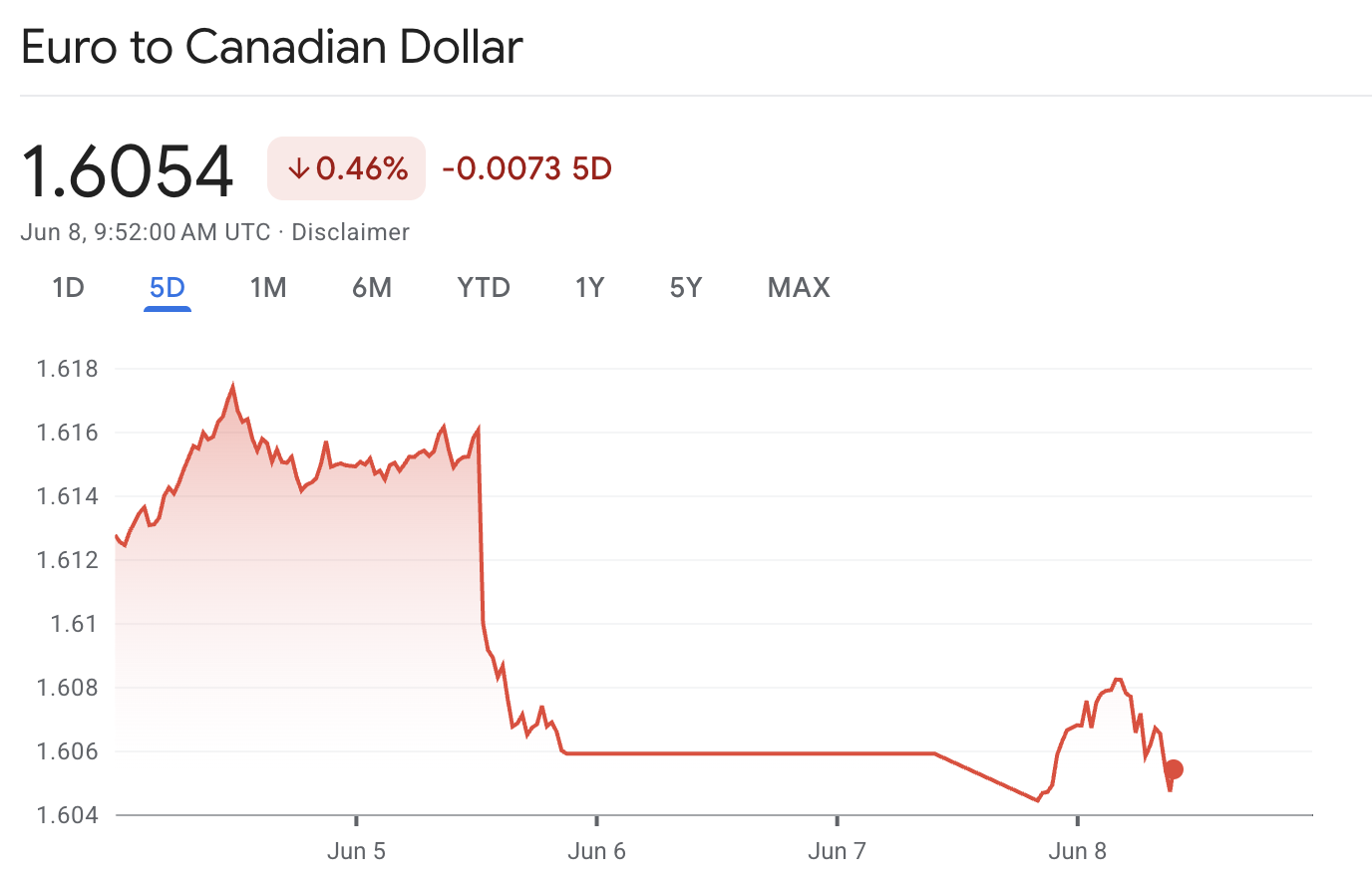
EUR/CAD enters the second week of June in a state of pronounced volatility compression, oscillating between 1.6060 and 1.6150, almost exactly astride its 2026 mean of 1.6064. The pair’s behaviour this year has been textbook mean reversion: sharp, oil-driven displacements followed by an orderly drift back toward equilibrium.
The 30-day range (1.5958-1.6150) now spans less than a third of the full 2026 range, which runs from the January high at 1.6333 to the March low at 1.5674. Ranges this tight rarely survive a dense catalyst window, and this one is dense. Crude has reclaimed $96, the Bank of Canada decides on June 10, and the ECB follows on June 11.
| Zone | Level(s) | Significance |
|---|---|---|
| Resistance 1 | 1.6148-1.6160 | Late-May supply band; breakout trigger on a daily close |
| Resistance 2 | 1.6220 / 1.6247 | Measured objective / April swing high |
| Range extreme | 1.6333 | January 2026 high |
| Support 1 | 1.6040 | Holds the May recovery structure |
| Support 2 | 1.5941-1.5958 | May swing low + 30-day range floor |
| Structural floor | 1.5674 | March 2026 low |
| RSI | Near 60 | Firm momentum without overbought conditions |
| MACD | Improving / constructive | Supports bullish bias but requires price confirmation |
| EMA bias | Price above short- and long-term averages near 1.61 | Reinforces constructive structure while the range holds |
The most informative development is what EUR/CAD has not done. A move in crude above $96 should, on the standard playbook, lift the Canadian dollar and pressure the euro through energy-import costs. Instead, the pair has absorbed the oil shock without breaking the 1.6060-1.6150 box.
When price refuses to respond to a driver that historically moves it, an offsetting flow is at work. Here, that offset is the rate channel: the market’s ECB-BoC policy differential is providing a bid under the euro that is neutralising the crude impulse.
Compression, in other words, is not indecision; it is two strong forces in balance. The side that gives way first will define the next leg.
The 2026 structure remains a broad range. The 1.6333 January high gave way to a 660-pip decline into 1.5674 by early March, and the subsequent three months have been spent rebuilding toward the midpoint.
The recovery off the 1.5941 May low has been constructive in character, sequential higher lows, controlled pullbacks, no impulsive extension. That is the footprint of accumulation rather than a short squeeze. But the structure remains unconfirmed: the 1.6148-1.6160 band has capped every advance since late May.
Price sits above both the 50-day and 200-day simple moving averages, which have converged and flattened near 1.61. Flat moving averages inside a narrow range carry a specific implication: they offer little dynamic support or resistance of their own, so a confirmed break of the horizontal levels tends to travel further, with less trend structure to slow it.
1.6040 is the first line. It marks the higher-low sequence from May. While the pair holds above it, dips are consolidation within an intact recovery.
1.5941-1.5958 is the structural band; the May swing low and the 30-day range floor in confluence. A daily close beneath it would invalidate the higher-low sequence and reclassify the May advance as a failed rebound. Bias would shift from range-long to range-fade.
1.5674, the March low, is the deeper reference. A retest would signify that the crude channel has fully overwhelmed the policy channel, a regime change, not merely a technical breakdown.
The 1.6148-1.6160 band has rejected price repeatedly since late May. The first credible breakout signal is a daily close above 1.6148, ideally followed by acceptance, a session or two of trade held above the band rather than an intraday spike and fade.
Above it, the path runs to 1.6220 and then the April high at 1.6247, with 1.6333 as the range extreme.
One caveat from this year’s tape: technical momentum alone has not been enough to clear this kind of zone. Both the January and April advances printed firm momentum readings into resistance before failing. Durable progression through 1.6148 will likely require a fundamental escort, a hawkish ECB, a retreat in crude, or a BoC that downplays energy-driven inflation.
Daily RSI near 60 reflects firm, sustained buying pressure with room above before overbought territory. Multi-timeframe readings have turned constructive through early June.
This supports the bullish structure but does not confirm it, and given the two prior momentum-led failures at the range highs this year, intraday strength should be discounted. Only the daily close above 1.6148 counts.
EUR/CAD’s compression is the direct product of two offsetting drivers.
Crude favours CAD. Canada is a net exporter; the eurozone is a net importer. WTI above $96 improves Canada’s terms of trade while adding to European cost pressure.
Rates favour EUR. Markets are positioned for ECB tightening, while the BoC must weigh oil-driven inflation against growth and tariff risks. That divergence in expected policy paths is what is holding the floor under the pair.
This is also why EUR/CAD is currently the cleaner expression of the oil-versus-policy trade than USD/CAD, where broad dollar flows contaminate the signal.
Bank of Canada, June 10. Consensus is a hold at 2.25%. The risk is in the tone: with crude above $95, a BoC that emphasises energy-driven inflation risk would firm CAD and press EUR/CAD back into support. A BoC that looks through the oil move keeps the floor intact.
ECB, June 11. A June hike is priced; the decision itself is unlikely to move the pair. Guidance is everything. A hawkish hike, one that keeps further tightening on the table, is the cleanest fundamental trigger for a 1.6148 break. A “dovish hike” leaves the pair range-bound.
Crude itself remains the wildcard. Middle East headlines can reprice oil faster than either central bank can respond, and the pair’s sensitivity to crude will reassert itself the moment the rate channel goes quiet.
Bullish: Daily close above 1.6148, acceptance above 1.6150. Objectives at 1.6220, then 1.6247; 1.6333 is the broader marker. Most plausible on a hawkish ECB.
Bearish: Break of 1.6040 exposes 1.5941-1.5958. A close through the range floor ends the higher-low structure and reopens 1.5674. Most plausible on an inflation-anxious BoC plus sustained crude strength.
Neutral: Cautious ECB hike, BoC hold, crude elevated but stable. The pair stays pinned between 1.6040 and 1.6148 awaiting a stronger catalyst, and given the year-to-date character of this market, the neutral path deserves real weight.
The short-term structure is constructive but unconfirmed: price above flattening moving averages, momentum firm, May’s higher lows intact, and resistance untested on a closing basis. 1.6148 is the breakout line; 1.6040 is the recovery floor.
The June 10-11 policy window will most likely determine which breaks first. Until one does, EUR/CAD is a range trade at its 2026 midpoint, trade the edges, not the middle.
This analysis reflects market data and published analyst views as of June 8, 2026. It is provided for information only and does not constitute investment advice.