Published on: 2026-07-23
Updated on: 2026-07-23
Most economists expected another rate hike. Bank Indonesia gave them incentives instead. On July 22, 2026, the central bank surprised markets by holding the BI-Rate at 5.75% after 100 basis points of tightening since May, delivered across three moves between May 20 and June 18. The deposit and lending facilities stayed at 4.75% and 6.50%, and only three of nine economists surveyed by The Wall Street Journal had called the hold correctly.
Rather than immediately lifting the policy rate to 6.00%, BI is now trying to defend the rupiah through SRBI yields, cheaper FX hedging and market intervention.
Bank Indonesia held its policy rate at 5.75%, defying expectations for a 25bp increase.
The decision paused 100 basis points of tightening delivered through three increases since May.
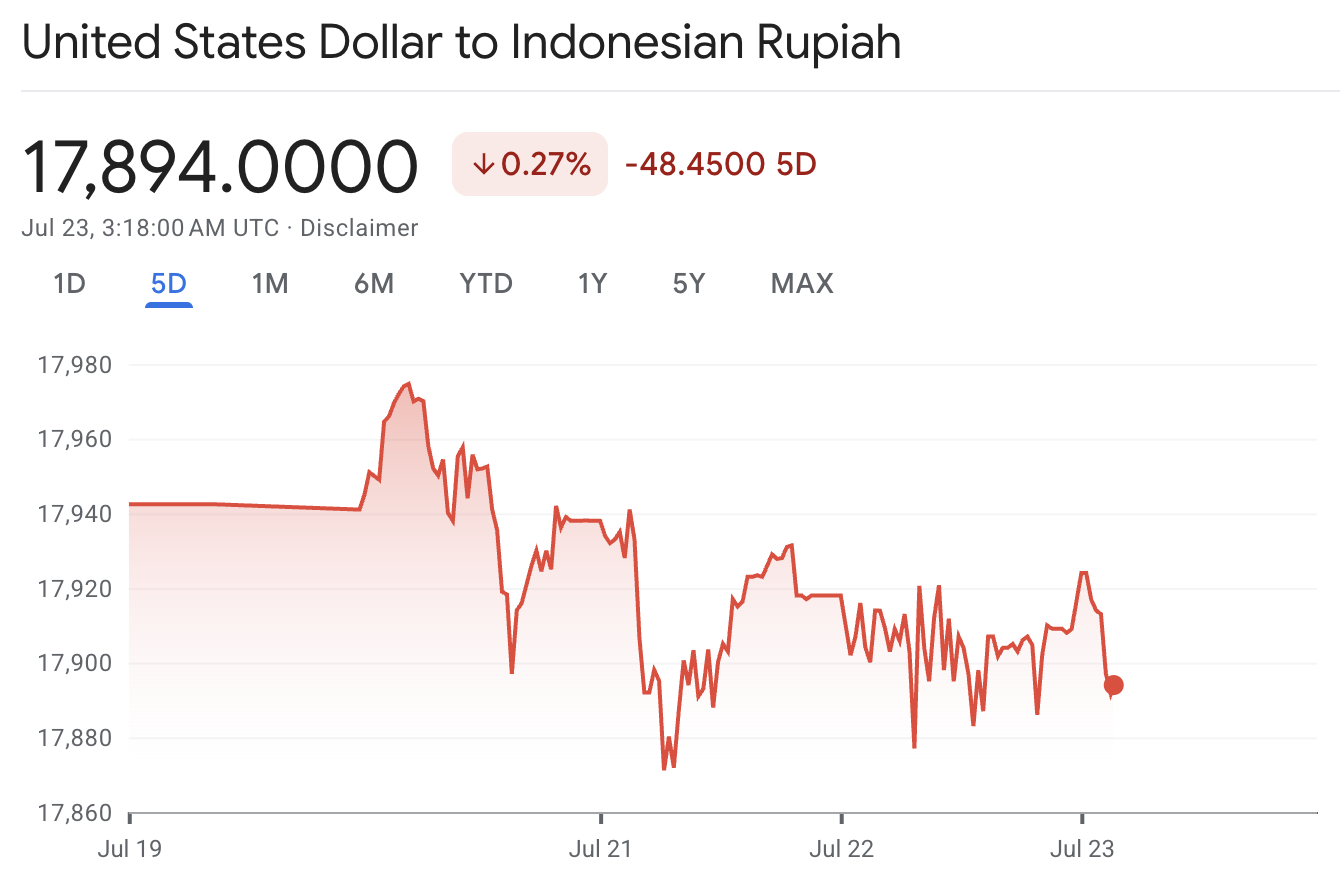
JISDOR was exactly Rp17,909.00 on July 22, against its Rp18,171.00 record on June 8.
BI is using SRBI yields, cheaper hedging and FX intervention to attract foreign capital, with the next move hinging on portfolio flows, oil, the dollar and inflation.
Indicator |
Figure/Decision |
Significance |
|---|---|---|
BI-Rate |
5.75% |
Held, hike expected |
Deposit facility |
4.75% |
Unchanged |
Lending facility |
6.50% |
Unchanged |
Tightening since May |
100bp |
Under review |
JISDOR USD/IDR |
Rp17,909.00 |
July 22 reference |
June inflation |
3.34% |
Near top of target |
BI’s inflation target is 2.5% plus or minus 1 percentage point, a 1.5%-3.5% range. The July hold followed a 50bp increase on May 20, an off-schedule 25bp increase on June 9 and another 25bp move on June 18.
The decision came down to a trade-off: support the rupiah without tightening domestic financing further. A fourth increase would have lifted the yield on rupiah assets, but also raised borrowing costs on top of 100 basis points delivered in under a month.
BI paused while assessing the effects of the earlier increases, which buys time to see how they land. Inflation, at 3.34% in June, sat narrowly inside the target range, just 0.16 percentage points below the 3.5% ceiling.
Governor Perry Warjiyo cast the rate decision and the measures around it as one integrated approach: monetary policy fixed on rupiah stability and inflation, macroprudential and payment-system policy still supporting growth. The pause is conditional, not final. BI can move to 6.00% if the currency weakens again, outflows resume or inflation clears the range.
JISDOR held at Rp17,909.00 on July 22, unchanged from July 21. The rupiah had already recovered from its June 8 record of Rp18,171.00, but this level is still historically weak, sitting exactly Rp262.00 below the record, roughly 1.44% stronger.
Holding when the market expects a hike can knock a currency lower; that it barely moved suggests BI’s incentives and steady FX presence absorbed the reaction.
Bank Indonesia Rupiah Securities, or SRBI, sit at the heart of the new strategy. These rupiah-denominated instruments carry yields designed to compensate foreign investors for part of the currency risk in holding Indonesian assets.
Making SRBI more attractive lets BI compete for foreign capital without raising the policy rate, but it only works if fresh demand outruns outflows from Indonesian bonds and equities.
The early evidence is encouraging: non-resident SRBI holdings rose from Rp238.09 trillion on June 15 to Rp288.65 trillion on July 20, equivalent to 27.11% of total outstanding SRBI.
BI also expanded its hedging incentives, raising the premium reduction for Swap Sell Hedging transactions from 10% to 12.5% and introducing a 15% incentive for DNDF Sell Hedging.
Lower hedging costs lift the risk-adjusted return on Indonesian securities against dollar alternatives. Direct intervention remains available too, through offshore NDFs and domestic spot and DNDF transactions, letting BI lean against disorderly moves while the incentives rebuild inflows.
The clearest and earliest read on whether BI’s gamble is working will come from the portfolio account, and specifically from whether non-residents keep adding to their SRBI and government bond positions rather than trimming them.
The signals worth tracking are non-resident SRBI holdings, weekly bond and equity flows, the bid-to-cover ratios at SRBI auctions and the trajectory of foreign reserves, since a strategy built on yield only holds if that yield is actually pulling capital across the border.
The recent numbers give BI something to work with: net foreign inflows reached $8.5 billion in the second quarter through June 30, a decisive swing from the $0.8 billion of outflows recorded in the first quarter. Sustaining and extending that reversal, rather than watching it stall, is the immediate objective of the July package.
Indonesia’s status as a net oil importer ties the rupiah directly to global crude, and the transmission is mechanical rather than sentiment-driven. When oil rises, the import bill climbs, domestic buyers scramble for dollars to settle it, the trade balance deteriorates and the currency absorbs the strain.
That makes USD/IDR unusually sensitive to supply shocks well beyond Indonesia’s control: a fresh escalation in the Middle East or a disruption to shipping lanes could push the pair higher even if the portfolio account is healing and BI’s incentives are drawing capital back in.
Energy is the channel through which an external shock becomes a domestic currency problem.
The rupiah also competes for capital against the dollar, and that contest is set in Washington as much as in Jakarta.
A broadly stronger dollar or a Federal Reserve that eases more slowly than markets expect narrows the relative appeal of rupiah assets, because the carry that makes SRBI attractive is measured against US yields, not in isolation.
If Treasury yields rise at the same time BI is lifting the return on its own securities, the yield pickup that is supposed to compensate investors for holding rupiah risk can erode even as nominal Indonesian rates stay put. The external rate backdrop can therefore work against BI regardless of what happens domestically.
The final driver is the one BI has the most direct line of sight on. June inflation of 3.34% sat narrowly inside the target range, just 0.16 percentage points below the 3.5% ceiling, leaving little headroom before a breach would force the central bank’s hand.
A further acceleration would compress the room BI has just bought itself to stay on hold, and the risk is partly self-reinforcing: a weaker rupiah raises the local-currency cost of imported fuel and food, feeding straight back into the inflation print that constrains policy in the first place.
Taken together, the portfolio account offers the first and fastest evidence of whether the strategy is landing, while oil and the dollar remain the larger risks sitting outside BI’s control.
Date |
JISDOR Rate |
|---|---|
July 22, 2026 |
Rp17,909.00 |
July 16, 2026 |
Rp18,041.00 |
July 13, 2026 |
Rp18,131.00 |
June 8, 2026 |
Rp18,171.00 |
The table tracks BI’s daily JISDOR fixings since the June 8 record. These are historical observations, not support or resistance; a live read needs a current quote, since JISDOR prints once a business day.
A sustained break below Rp17,909.00 would signal that foreign demand and intervention are easing pressure; a drift back toward Rp18,171.00 would mean the recovery is unwinding.
The drivers above explain what moves the rupiah; the question here is where the tolerance for those moves runs out. A single weak session would probably be insufficient on its own to trigger another hike, so the more likely trigger is a cluster of signals breaching levels at once. The rough thresholds worth watching are these:
JISDOR retesting Rp18,171.00. A return to the June record would erase the recovery the July measures were meant to defend and mark the clearest line in the sand.
The portfolio account flipping negative. The $8.5 billion of second-quarter inflows going back into outflow would signal the yield-and-hedging strategy has stopped paying for itself.
Inflation clearing 3.5%. A print above the ceiling removes the cover that lets BI frame a hold as consistent with the target.
Foreign reserves falling on sustained intervention. If defending the currency is visibly draining the buffer without stabilising it, the cheaper option becomes the rate itself.
A 25bp step to 6.00% moves back into view when several of these fire together rather than in isolation.
The scenario that most plausibly forces BI’s hand is a compounding one: a weakening rupiah that drives outflows, which lift imported inflation, which in turn demands more intervention and thins the reserve cushion further. That feedback loop, not any single miss, is what a rate hike would be meant to break.
The 5.75% hold gives the economy room to absorb earlier increases while shifting more of the currency defence onto SRBI yields, cheaper hedging and intervention. The first evidence will come from portfolio flows and where JISDOR travels next after its July 22 reading of Rp17,909.00.
A sustained move away from the Rp18,171.00 record would back BI’s approach; a return to it would sharpen the pressure for another hike.