Published on: 2026-07-23
Argentina received its third major sovereign credit upgrade in less than three months after Moody’s raised the country to B3 from Caa1 and changed the outlook to positive. The decision followed earlier upgrades from Fitch and S&P and reinforced the view that default risk has fallen as fiscal accounts, inflation and access to foreign currency improve.
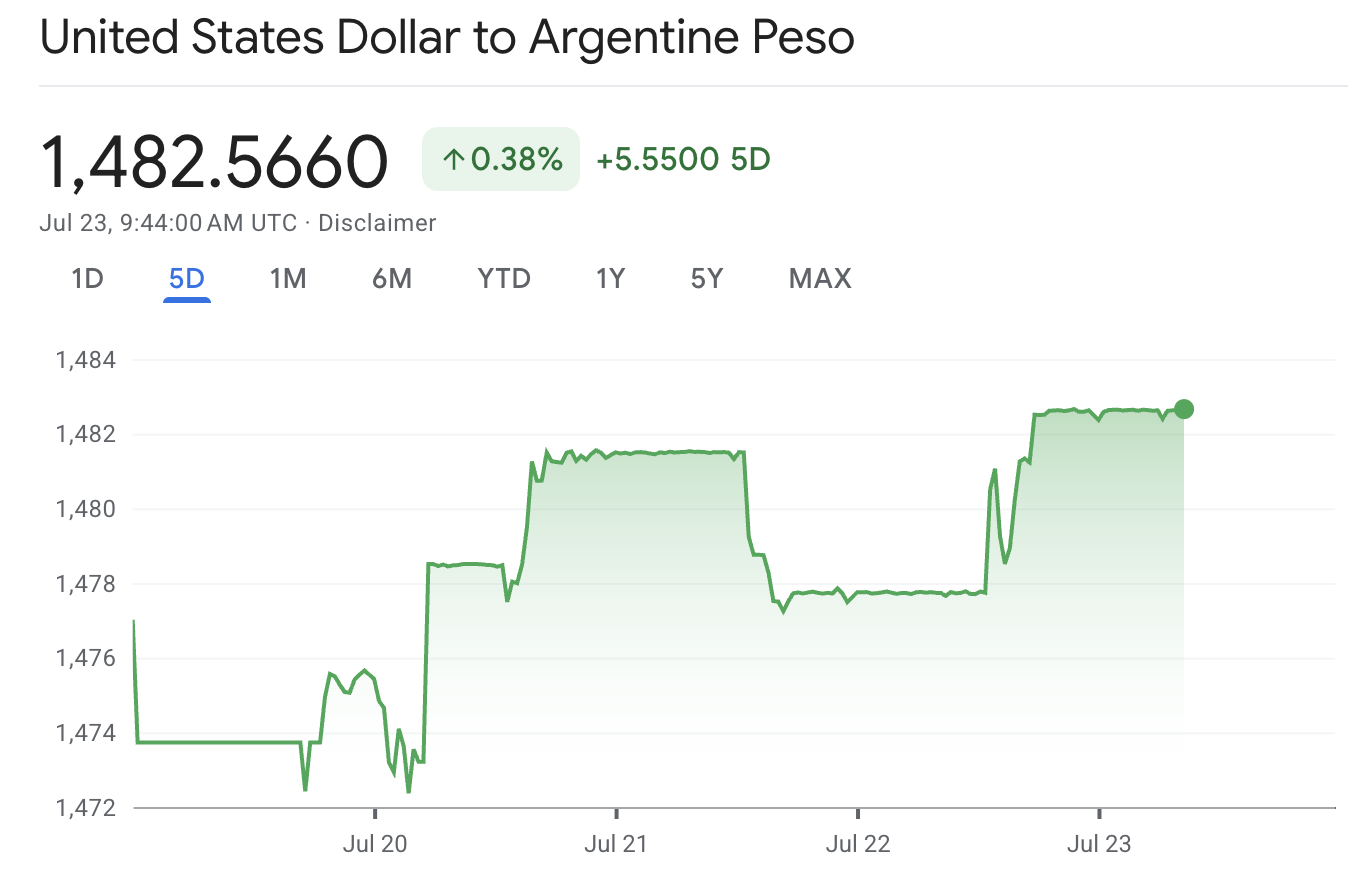
The market reaction was uneven. Argentine dollar bonds edged higher and JPMorgan’s country-risk measure fell to about 410 basis points, while the wholesale peso remained near 1,483 per dollar on 23 July. The latest rating action strengthened the sovereign credit story, but it did little to change the immediate outlook for the currency.
That gap is now the central market question. Bonds are pricing a lower probability of default, while the peso is still being shaped by reserve accumulation, inflation and the central bank’s preference for buying incoming dollars rather than allowing a stronger exchange rate.
Argentina’s sovereign rating rose to B3 from Caa1, with a positive outlook.
The move completed a run of three major upgrades since May.
Country risk fell to about 410 basis points, close to an eight-year low.
The wholesale peso remained near 1,483 per dollar after the announcement.
The BCRA has bought more than $11 billion in foreign currency during 2026, while June inflation slowed to 1.9% month over month.
| Measure | Latest reading |
|---|---|
| Sovereign rating | B3, positive outlook |
| Previous rating | Caa1, stable outlook |
| Major upgrades since May | Three |
| Wholesale USD/ARS | Around 1,483 |
| Country risk | Around 410 basis points |
| BCRA 2026 FX purchases | More than $11 billion |
| June monthly inflation | 1.9% |
| June annual inflation | 33.5% |
The rating agency said Argentina’s default risk had declined as the government’s stabilisation programme became more durable. It cited fiscal surpluses, slower inflation, stronger exports, continued economic liberalisation and rising investment in energy and mining.
Foreign-currency liquidity was another important factor. The BCRA has purchased more than $11 billion in 2026 without triggering a major dislocation in the official exchange rate. That has improved the country’s capacity to meet external obligations and reduced the perceived risk of another near-term funding crisis.
The B3 rating remains firmly below investment grade, so Argentina is still considered a speculative sovereign borrower. The positive outlook, however, leaves room for another upgrade if reserve coverage, policy credibility and debt-payment capacity continue improving.
The action also brought the agency closer to Fitch and S&P, which had already moved Argentina out of their most distressed rating categories. That sequence suggests the improvement is no longer being treated as a one-off policy adjustment. It is increasingly being viewed as a broader shift in the country’s credit profile.
The modest market reaction indicates that much of the improvement had already been reflected in bond prices.
Argentine hard-currency debt gained only slightly after the announcement, while country risk fell 11 basis points to around 410. That level is close to the 402 reached earlier in July, the lowest reading since 2018.
The decline in spreads has been substantial compared with 2023, when Argentine debt traded at roughly 25 percentage points over US Treasuries. By July 2026, that premium had narrowed to around four percentage points.
The government also completed a $4.3 billion payment on foreign-law dollar bonds earlier this month, part of roughly $19 billion in debt obligations due during 2026. Meeting those payments while maintaining fiscal discipline has strengthened confidence in the government’s ability to service debt without returning immediately to crisis financing.
The next important threshold is whether Argentina can regain sustainable access to international capital markets at acceptable borrowing costs. The government has said it can meet obligations through 2027 without issuing new foreign-law debt, but a further decline in spreads would widen its financing options.
The wholesale exchange rate remained near 1,483 pesos per dollar following the announcement. The limited move reflects both the expected nature of the upgrade and the way the central bank is handling fresh dollar inflows.
Rather than allowing export and investment dollars to translate fully into peso appreciation, the BCRA has been purchasing part of that supply. The result is a stronger reserve position with less movement in the official exchange rate.
That policy helps explain why improving capital flows have supported Argentina’s balance sheet more visibly than its currency. The central bank is prioritising a larger foreign-currency buffer ahead of debt payments and potential external shocks.
The peso also had little new information to absorb. Two other major agencies had already upgraded Argentina, while sovereign spreads and bond prices had been improving for months. The latest decision confirmed the trend rather than starting it.
For the currency market, reserve quality now matters more than the headline amount of purchases. Traders will focus on how much of the accumulated foreign currency remains usable after debt servicing and other obligations.
Argentina’s inflation rate has slowed sharply, but it remains high enough to limit the case for outright peso appreciation. Consumer prices rose 1.9% in June, the lowest monthly increase in ten months. Inflation reached 16.8% during the first half of the year and 33.5% from a year earlier.
That still leaves a large inflation gap with the United States. Even if sovereign risk falls and reserves improve, the nominal exchange rate may continue adjusting to reflect the loss of domestic purchasing power.
A rising USD/ARS rate would therefore not automatically invalidate the recovery. The more important questions are how quickly the peso depreciates, whether reserve accumulation continues and whether the gap between official and financial exchange rates remains contained.
An orderly decline in the peso alongside lower inflation and tighter sovereign spreads would be consistent with a more stable macroeconomic framework. A sharp acceleration in depreciation or a widening parallel-market premium would send the opposite signal.
The next phase will depend on a smaller set of financial indicators:
Net reserves: Gross purchases matter less if foreign-currency obligations continue draining the usable reserve position.
Inflation: Monthly readings near or below 2% would reduce pressure on the exchange rate.
Country risk: A sustained move below 400 basis points would strengthen the case for cheaper external financing.
Parallel-market spreads: A narrower CCL or MEP premium would show weaker demand for dollar protection.
Export inflows: Energy, mining and agricultural receipts could provide more durable foreign-currency supply.
Political continuity: The 2027 election remains the largest test of whether the current policy framework can survive beyond the present administration.
The base case remains gradual peso depreciation while the BCRA continues buying dollars. A stronger currency would require inflows to exceed both the central bank’s reserve demand and the pressure created by domestic inflation.
Argentina’s third credit upgrade is therefore a bigger development for sovereign financing than for the exchange rate. Bonds are already reflecting lower default risk. The peso will need stronger net reserves, slower inflation and tighter financial-market spreads before the same improvement becomes visible in the currency.