Published on: 2026-07-20
Chevron enters late July with two stories competing for attention. CVX has risen almost 23% in 2026, while the company has opened negotiations around major Iraqi oilfields and export infrastructure intended to reduce Iraq’s dependence on the Strait of Hormuz.
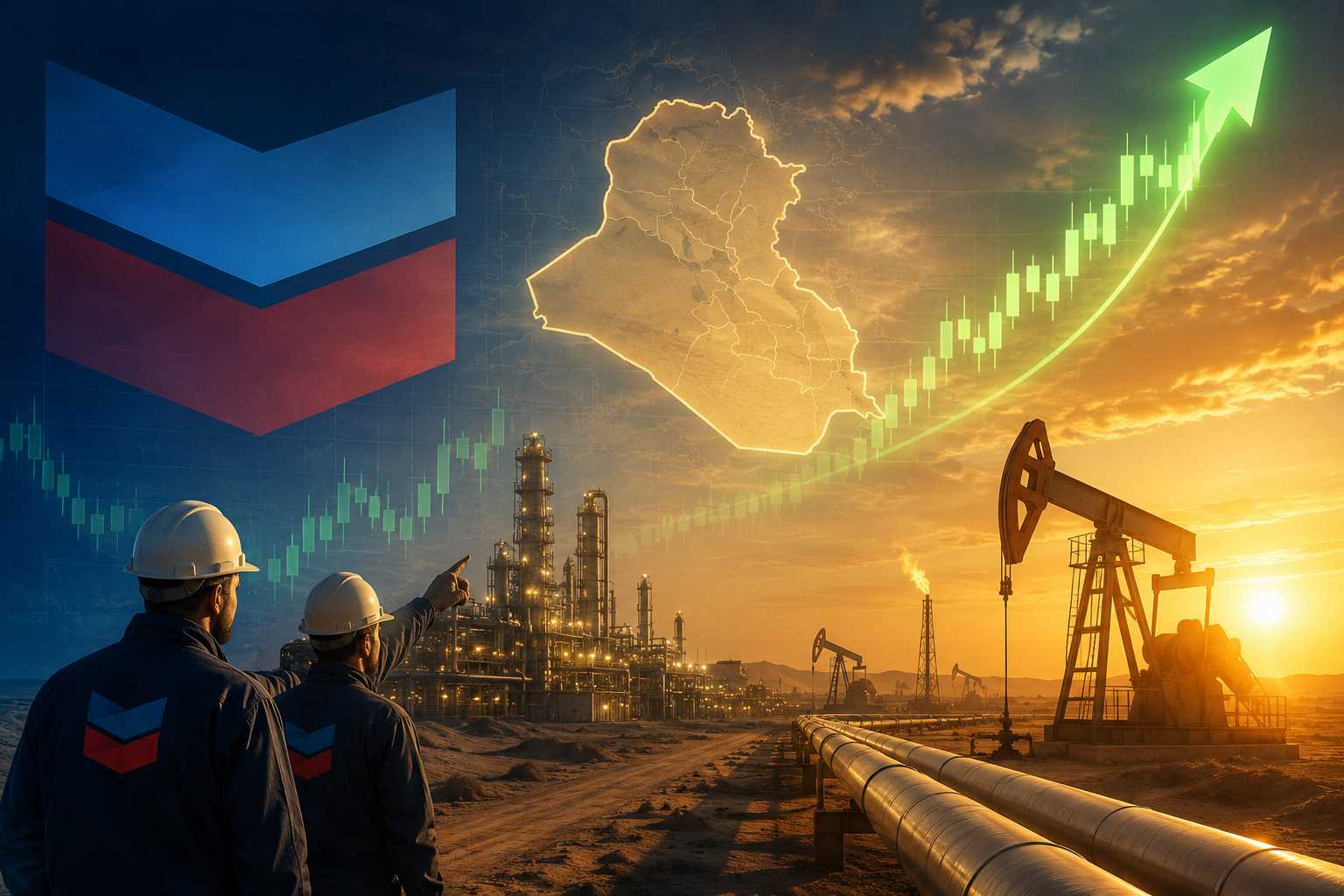
The shares were already enjoying a strong year before the Iraqi projects had contributed any production or cash flow. The question is whether these agreements strengthen the case for further gains in Chevron stock or remain a distant opportunity behind oil prices and Chevron’s existing operations.
Chevron stock closed at $187.38 on 17 July, gaining 1.91% for the session and 22.94% year to date. That percentage reflects share-price appreciation and excludes dividends.
CVX has rebounded approximately 13% from its 1 July closing low but remains about 10% below its record closing high from late March.
Chevron signed preliminary agreements covering West Qurna-2, the Nassiriya project and participation in proposed alternative export routes.
West Qurna-2 offers established production scale, while Nassiriya involves a longer development and exploration timeline.
Contract terms, capital requirements and Chevron’s eventual operating role will determine whether Iraq becomes financially important to CVX.
The latest regular US market close available as of 20 July is Friday, 17 July. Chevron finished at $187.38, up 1.91%, while the S&P 500 fell 1.01%. ExxonMobil gained 0.98% and ConocoPhillips rose 1.66%, showing that the advance extended beyond Chevron.
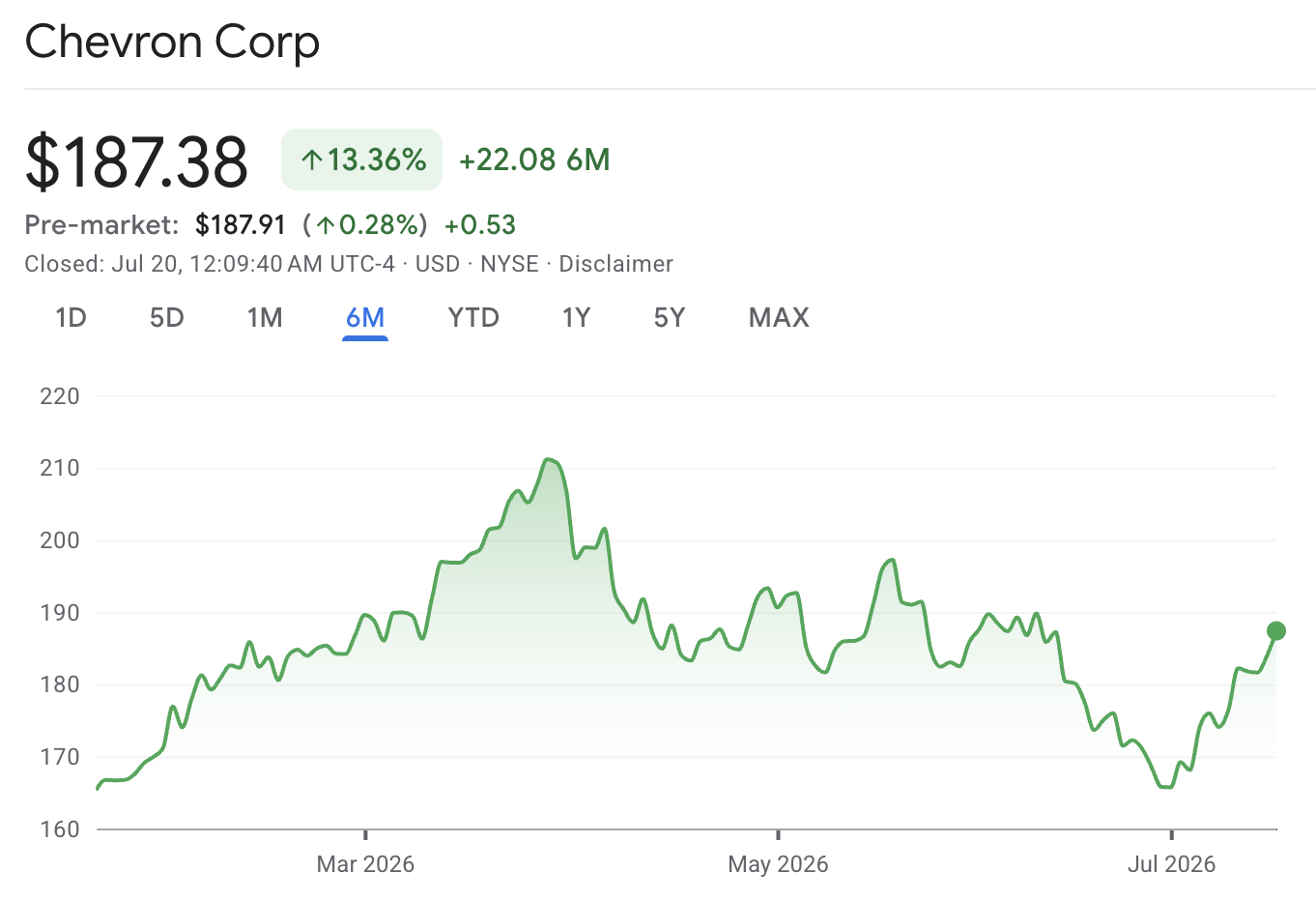
CVX ended 2025 at $152.41, placing its year-to-date price gain at 22.94%. The stock had fallen to a closing low of $165.69 on 1 July before recovering about 13% over the following eleven trading sessions.
| Metric | Reading |
|---|---|
| 17 July closing price | $187.38 |
| One-day move | +1.91% |
| 2026 year-to-date move | +22.94% |
| 1 July closing low | $165.69 |
| Rebound from 1 July | About 13% |
| Record closing high | $209.23 on 27 March |
| Distance below record close | About 10.4% |
| 52-week intraday high | $214.71 on 30 March |
The shares remain below their March records. Chevron reached a record closing price of $209.23 on 27 March and a 52-week intraday high of $214.71 on 30 March. The 17 July close was approximately 10.4% below the closing record and 12.7% below the intraday high.
Chevron’s 17 July gain coincided with the Iraq announcement, but oil majors do not always move in lockstep with crude prices. The wider energy sector also rose as crude prices strengthened.
Chevron signed non-binding agreements intended to advance negotiations over West Qurna-2 and Nassiriya. Technical work and commercial discussions remain necessary before either opportunity becomes a definitive development contract.
The company also joined a consortium with UCC and TI Capital examining alternative export infrastructure. Current proposals include a route connecting southern Iraqi production with the north and a rehabilitated line running west through Syria toward the Mediterranean port of Baniyas. Separate Iraqi pipeline plans involving Turkey have also been discussed.
| Project | Potential Value | Still Unknown |
|---|---|---|
| West Qurna-2 | Operating role in a large producing oilfield | Contract terms, remuneration, cost recovery and capital responsibility |
| Nassiriya | Existing production plus longer-term exploration potential | Development costs, exploration results and project timetable |
| Export infrastructure | Greater flexibility for Iraqi crude exports outside Gulf routes | Final routes, financing, construction timeline and Chevron’s ownership role |
Chevron has secured access to negotiations. It has not disclosed attributable production, an investment budget or expected returns that analysts can include in an earnings model.
West Qurna-2 is one of Iraq’s largest producing oilfields. Its normal operating level has been reported at approximately 460,000 barrels per day, although production has faced temporary curtailments during recent pipeline and export disruptions. The field should therefore be described as a roughly 460,000-bpd asset rather than assumed to be producing that amount continuously.
Basra Oil Company took over management after sanctions disrupted Lukoil’s previous operating role, creating an opening for Chevron to negotiate a longer-term position.
The production number attracts attention, but the entire field’s output would not automatically belong to Chevron. The financial result will depend on the final arrangement: how Chevron is paid, which costs it must fund, how expenses are recovered and whether compensation increases when production improves.
Until those terms are disclosed, assigning West Qurna-2’s full output to Chevron would materially overstate the opportunity.
Nassiriya carries a longer timeline. Iraq’s Dhi Qar Oil Company said field production increased from 52,000 to 90,000 barrels per day in February 2026. The wider Nassiriya project also includes four exploration blocks, creating the possibility of future resource development beyond the existing field.
Chevron could influence drilling plans, reservoir management and infrastructure development. In return, it would accept more uncertainty than at West Qurna-2. Exploration wells, appraisal work and new facilities require capital before additional production reaches the market.
West Qurna-2 is mainly an operating and redevelopment opportunity. Nassiriya combines existing production with longer-term exploration risk. Treating them as one immediate source of Chevron production would distort their different timelines.
Iraq exports most southern crude through Gulf terminals. When tanker movements are disrupted and storage capacity becomes constrained, producers may have to reduce output. Recent conditions demonstrated how quickly export limitations can affect large fields, including West Qurna-2.
Iraq and Syria have agreed to cooperate on rehabilitating a cross-border crude pipeline leading toward Mediterranean markets. The US State Department said the restored system is intended to have an initial transport capacity of 2 million barrels per day.
That figure applies to the proposed Iraq-Syria system. It is not Chevron-owned production, capacity allocated exclusively to West Qurna-2 or guaranteed throughput.
The corridor still needs a legal framework, technical design, financing and operating agreements. Its value lies in giving Iraq another route when Gulf exports face constraints. It would diversify export risk rather than remove it, since a cross-border pipeline creates its own transit, maintenance and regulatory exposures.
The positive case rests on scale. Chevron could secure an operating role in a major producing field, build a longer-term position at Nassiriya and participate in infrastructure that Iraq considers strategically important.
The financial case remains incomplete. Chevron has disclosed no remuneration formula, cost-recovery mechanism, economic interest or expected rate of return. Without those inputs, the projects cannot be added reliably to production or Free-cash-flow forecasts.
Capital discipline will also be important. Chevron has set an organic capital-expenditure budget of $18 billion to $19 billion for 2026, so any major Iraqi commitment would have to compete with established projects elsewhere in the portfolio.
For CVX shareholders, the main scenarios are:
Bullish: Chevron secures attractive terms, a defined operating role and a credible path to competitive returns.
Base case: Studies and negotiations continue without changing Chevron’s near-term production or earnings guidance.
Bearish: High costs, weak contract terms or project delays reduce the commercial appeal.
For now, Iraq expands Chevron’s strategic options without changing its current earnings outlook.
Chevron’s second-quarter earnings call is scheduled for 31 July 2026. Management may face questions about its intended West Qurna-2 role, potential capital exposure and whether Chevron expects to invest directly in export infrastructure.
Useful disclosure would include the proposed contract structure, cost recovery, spending requirements and the earliest realistic production contribution.
For the immediate CVX reaction, oil prices, Chevron’s dividend and buyback outlook, and performance across its existing portfolio are still likely to carry more weight.
Chevron stock rose 22.94% through 17 July, supported by stronger oil prices and confidence in its existing portfolio. The Iraq agreements add long-term potential, particularly at West Qurna-2, but no disclosed economics support a higher valuation yet.
The market now needs a definitive contract. Until Chevron reveals its role, investment requirements and expected returns, Iraq remains an option rather than an earnings catalyst.