Published on: 2026-04-07
Updated on: 2026-04-07
CMS raised the 2027 Medicare Advantage payment update to 2.48%, or more than $13 billion in added payments, versus 0.09% in the advance notice. Including the estimated Medicare Advantage risk score trend, CMS stated the total effect is 4.98%.
HUM has the higher direct Medicare rate torque. Its immediate overnight reaction was larger than UNH's, and management is still targeting approximately 25% growth in individual Medicare Advantage membership in 2026.
UNH has a stronger operating buffer. The company guides to more than $17.75 in 2026 adjusted EPS, more than $439 billion in revenue, and an 88.8% ± 50 bps medical care ratio.
HUM still carries heavier near-term earnings compression. Management expects at least $9.00 in 2026 adjusted EPS, following a 2025 adjusted EPS of $17.14, largely due to the Star Ratings headwind.
Valuation still favors UNH on quality-adjusted terms. Based on the April 6 market snapshot and company guidance, UNH was valued at approximately 15.9 times its adjusted EPS forecast for 2026, compared to about 20.3 times for HUM, despite HUM showing weaker momentum in its 2026 EPS.
On April 6, the Centers for Medicare & Medicaid Services (CMS) significantly revised the 2027 Medicare Advantage payment outlook. The agency has finalized an average payment increase of 2.48% for 2027, compared to the 0.09% in the advance notice. Including the estimated Medicare Advantage risk score trend, the effect rises to 4.98%.
CMS also chose to keep the 2024 Medicare Advantage risk adjustment model for 2027, while finalizing the exclusion of diagnoses from audio-only encounters and from most unlinked chart review records, with an exception for beneficiaries who switch Medicare Advantage organizations.
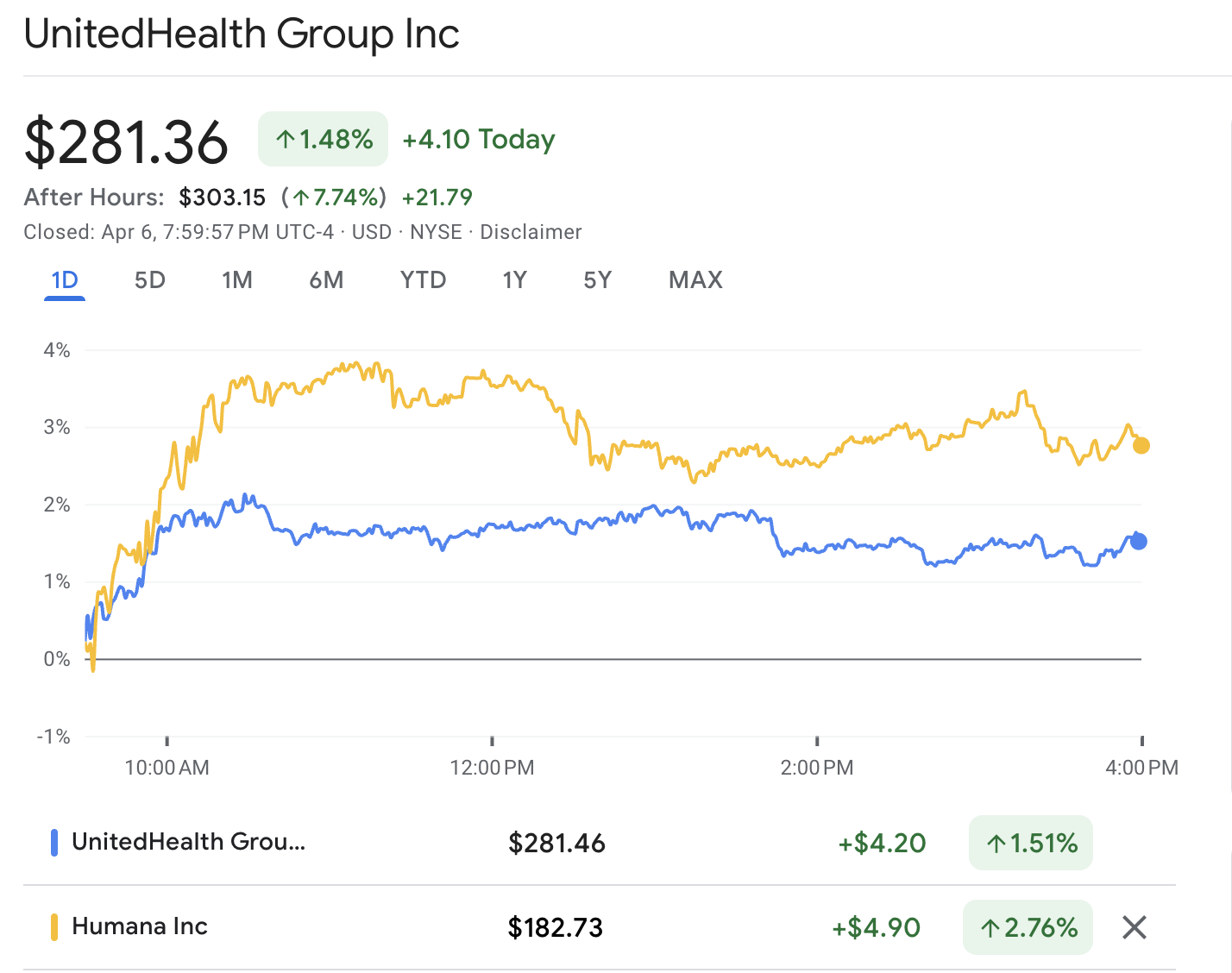
The market immediately treated that as a sector repricing event. In the late April 6 market snapshot used for this article, UNH traded at $281.36 and HUM at $182.65. Yahoo Finance also showed the immediate overnight reaction was larger for HUM than for UNH, which is consistent with investors viewing Humana as the higher-beta Medicare Advantage vehicle.
In our analysis of UNH Stock vs HUM Stock, the question is not which stock rallies more in a single session; it is which company can convert better benchmarks into durable margins without another utilization miss?
| Metric | UNH | HUM | Strategic Lead |
|---|---|---|---|
| Market cap (April 6) | $312.7B | $31.3B | UNH because size supports capital flexibility and earnings absorption. |
| 2025 revenue | $447.6B | $129.7B | UNH because scale funds care delivery, data capabilities, and diversification. |
| 2026 adjusted EPS guide | >$17.75 | ≥$9.00 | UNH because guidance points to recovery, not compression. |
| 2025 medical ratio / benefit ratio | 88.9% adjusted medical care ratio | 90.4% insurance segment GAAP benefit ratio | UNH because lower claims intensity leaves more room for rate pass-through. |
| 2026 Medicare Advantage growth signal | Broad earnings recovery plan, but Medicare Advantage membership is expected to decline | Approximately 25% growth in individual Medicare Advantage membership | HUM for direct rate sensitivity, UNH for diversification. |
| Forward P/E using April 6 price and 2026 adjusted EPS guide | ~15.9x | ~20.3x | UNH because the forward execution bar is lower. |
Methodology: Share price and market cap reflect the April 6 market snapshot used in this article.2025 revenue, medical benefit ratio, and 2026 guidance are taken from each company's latest reported results. Forward P/E is calculated by dividing the April 6 share price by management's 2026 adjusted EPS guide. The earlier EV/EBITDA and sector-weighted-average lines were removed because the in-body methodology did not show the peer set or calculation basis.
UnitedHealth's moat is not just insurance scale. It is vertical integration across UnitedHealthcare and Optum. In 2025, UnitedHealthcare generated $344.9 billion in revenue, while Optum generated $270.6 billion.
For 2026, management projects Optum's operating earnings to exceed $13.2 billion, with approximately 84 million consumers served by Optum Health, around 4.1 million fully accountable patients, and more than 1.52 billion adjusted prescriptions filled at Optum Rx. That is a broader margin engine than Medicare Advantage alone.
Humana's moat is narrower and more senior-focused. The company is improving operationally. CenterWell Senior Primary Care gained 100,600 patients in 2025, an increase of over 25%, and now serves Medicaid patients across 13 states.
However, management's guidance indicates a challenge: Humana anticipates substantial growth in Medicare Advantage membership for 2026, yet still forecasts a year-over-year decline in EPS due to the pressure from Star Ratings, which is overshadowing the benefits of increased volume.
That is the core difference. UNH is managing for margin recovery. HUM is managing for membership restoration. In regulated insurance, recoveries that are driven by margins typically warrant a higher confidence score.
Management guidance makes the contrast even cleaner. UnitedHealth expects a 2026 medical care ratio of 88.8% ± 50 bps, an operating margin of about 5.5%, and cash flow from operations of more than $18 billion.
Humana is still dealing with a headwind from Bonus Year 2026 Star Ratings and only guides to at least $9.00 in adjusted EPS, down from $17.14 in 2025. The strategic advantage lies with the company that can reduce exposure, maintain earnings, and still finance reinvestment.
UNH stock does not screen as distressed, but it does screen cheaper than HUM on management's 2026 earnings framework. Using the April 6 market snapshot and company guidance, UNH traded at roughly 15.9 times its 2026 adjusted EPS guide, versus about 20.3 times for HUM.
The spread is significant because UNH aims to recover margins from a broader base, while HUM continues to forecast a considerable year-over-year adjusted EPS decline, despite policy relief.
In 2025, UnitedHealth absorbed a $2.878 billion pretax hit tied to final cyberattack costs, portfolio divestitures, restructuring, and other items. Humana's challenge is different: management still targets at least $9.00 in 2026 adjusted EPS, versus $17.14 in 2025, largely due to the Star Ratings headwind for Bonus Year 2026. A better rate print helps, but it does not remove the need for execution on margins
That is why UNH still has the cleaner valuation case in this setup. HUM warranted a stronger one-day reaction due to its greater direct sensitivity to the CMS rate surprise; however, a larger policy-beta move does not necessarily yield a better risk-adjusted entry.
In short, HUM stock deserved the bigger one-day pop because it has the highest direct sensitivity to the CMS rate surprise. That does not make it the stock with the better risk-adjusted potential.
If the 2027 rate uplift merely offsets medical-cost inflation and coding pressure, HUM's multiple still has room to compress. UNH needs less perfection because its re-rating case does not depend on one program carrying the entire earnings repair.
The bear case still sits more naturally with HUM, the stock that attracted the sharper rate-driven enthusiasm. A 2.48% headline payment increase is helpful. However, it does not alleviate the pressure from medical-cost trends, Star Ratings, or CMS oversight concerning risk adjustment inputs, such as audio-only diagnoses and unlinked chart review records.
The second problem is a mix. Humana is targeting ~25% individual MA membership growth in 2026 while guiding adjusted EPS down to at least $9.00 from $17.14 in 2025. That is a narrow margin of error.
The counterintuitive risk is that a better rate print encourages a more competitive benefit posture for 2027 before the 2026 utilization problem is fully contained.
If that happens, the stock's sharp reaction becomes a valuation trap rather than a re-rating. UNH and HUM also do not hedge each other. Both are still tied to the same Medicare Advantage funding cycle, Star Ratings regime, and utilization trend. The fact that the same CMS announcement lifted both names at once is the cleanest correlation check available.
Because HUM is more concentrated in Medicare Advantage economics, a better-than-feared 2027 rate print has more direct earnings leverage for Humana than for the more diversified UNH platform.
Yes, but the outperformance case is tactical, not structural. HUM can lead to a pure MA rebound because it is more concentrated and was hit harder.
Yes. Based on the April 6 market snapshot, UNH traded at approximately 15.9 times its forward adjusted EPS, while HUM traded at about 20.3 times. That gap supports the view that UNH requires fewer multiple expansions to work from here.
UNH fits the quality-recovery holder. The stock possesses a strategic advantage as the market currently values UnitedHealth at near-sector levels, despite its broader platform, clearer margin-repair roadmap, and stronger income support.
HUM fits the tactical rate-beta trader. Medicare Advantage sentiment may improve, indicating rebound torque; however, the earnings bridge remains unstable, and the valuation cushion is not as substantial as the headline selloff suggests.
For a definitive relative-value call, UNH has the stronger risk-adjusted potential. HUM can rally harder on policy relief. UNH is still better built to keep the gain.
Disclaimer: This material is for general information purposes only and is not intended as (and should not be considered to be) financial, investment, or other advice on which reliance should be placed. No opinion given in the material constitutes a recommendation by EBC or the author that any particular investment, security, transaction, or investment strategy is suitable for any specific person.