Published on: 2026-03-31
In finance, investors constantly balance opportunity and risk. Two strategies central to this balancing act are arbitrage and hedging. While both involve sophisticated financial tools, they serve very different purposes. Arbitrage aims to profit from price discrepancies, while hedging aims to protect investments from potential losses.
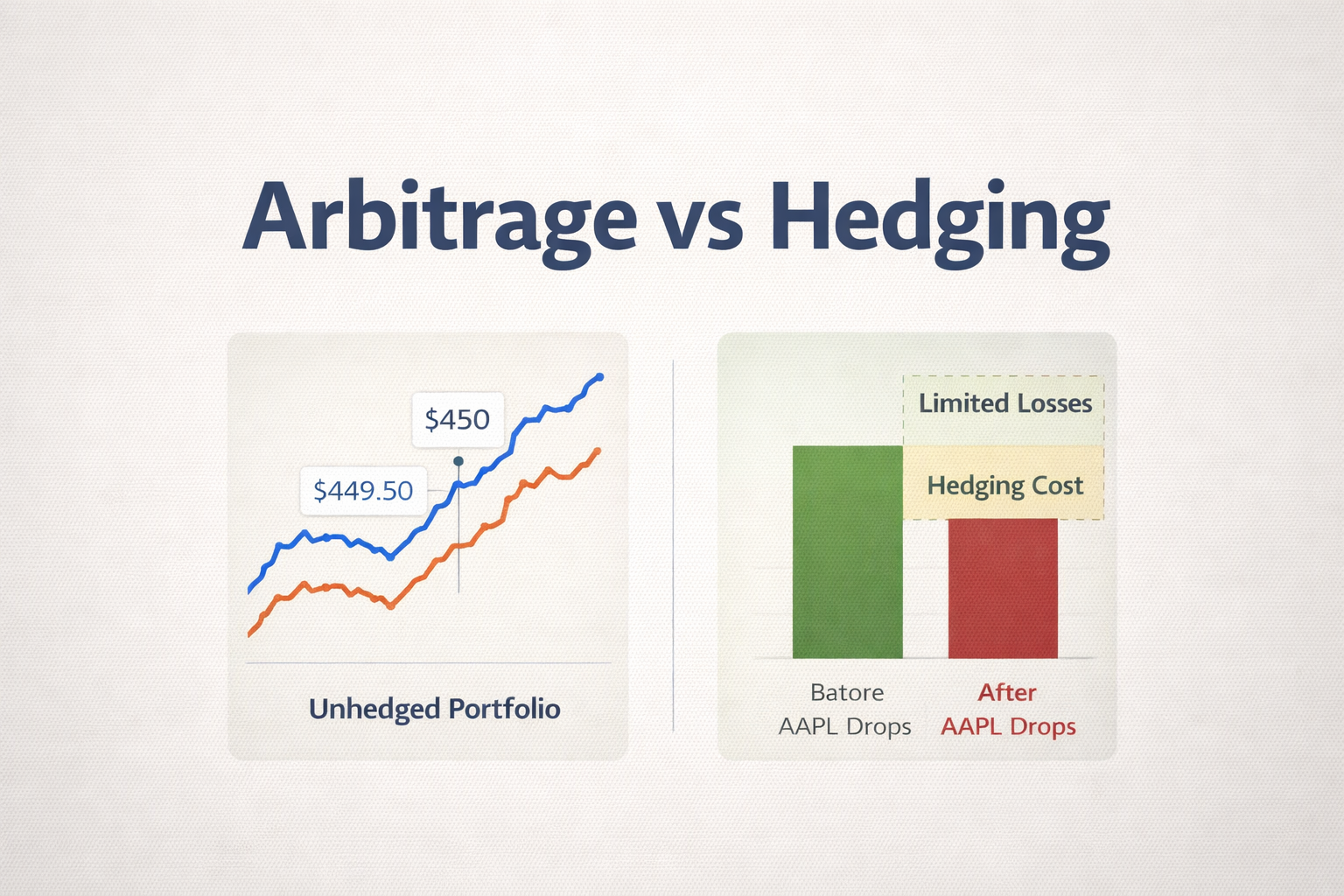
Arbitrage exploits price differences for profit, whereas hedging reduces exposure to risk.
Arbitrage is short-term and opportunistic; hedging is a protective, risk-management approach.
ETFs, stocks, currencies, and commodities are commonly used in both strategies.
Costs, liquidity, and market conditions influence the effectiveness of each strategy.
Combining arbitrage and hedging can optimise returns while managing risk.
Arbitrage involves buying and selling the same or similar assets simultaneously in different markets to profit from price differences. The central idea is that these profits are risk-free if executed correctly.
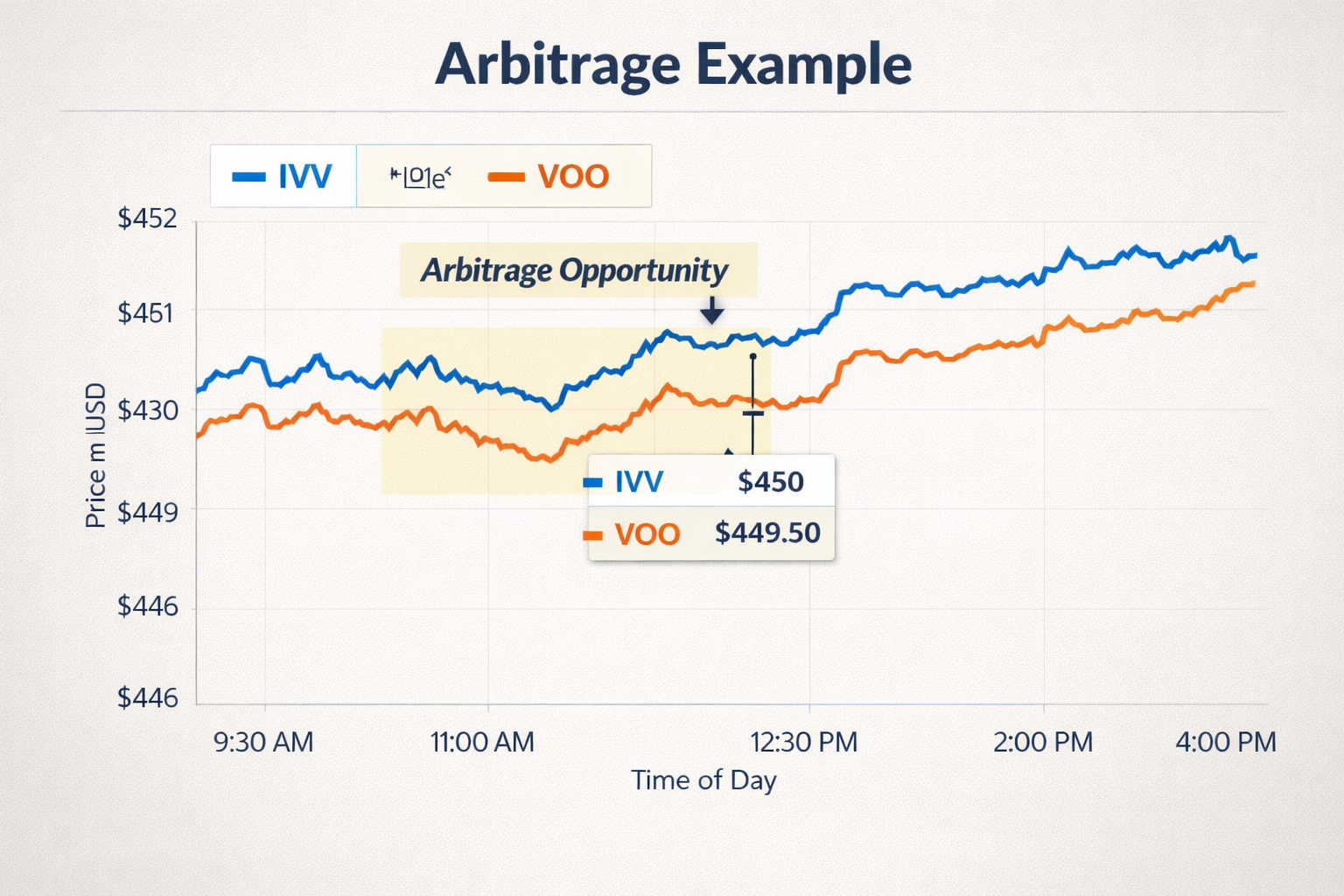
ETF Arbitrage: Consider the S&P 500 ETFs IVV and VOO. If IVV trades at $450 and VOO trades at $449.50, a trader could buy VOO and sell IVV simultaneously, capturing the $0.50 difference. This strategy works best in highly liquid markets where execution is fast and costs are low.
Currency Arbitrage: Forex traders can exploit differences in exchange rates. For example, if 1 USD = 0.90 EUR in one market and 1 USD = 0.91 EUR in another, buying in the cheaper market and selling in the higher-priced market generates a near risk-free profit.
Objective: Profit from price inefficiencies.
Risk: Minimal, though execution and liquidity risk remain.
Time Horizon: Very short-term, often minutes or hours.
Instruments: Stocks, ETFs, currencies, derivatives.
During the first quarter of 2026, traders noticed slight price differences between U.S.-listed and European-listed tech ETFs due to FX fluctuations. Swift arbitrage trades allowed some traders to capture small but consistent profits without taking directional market risk.
Hedging is a risk management strategy used to protect investments against potential losses. Unlike arbitrage, hedging is not primarily profit-focused; its goal is to minimise downside exposure.
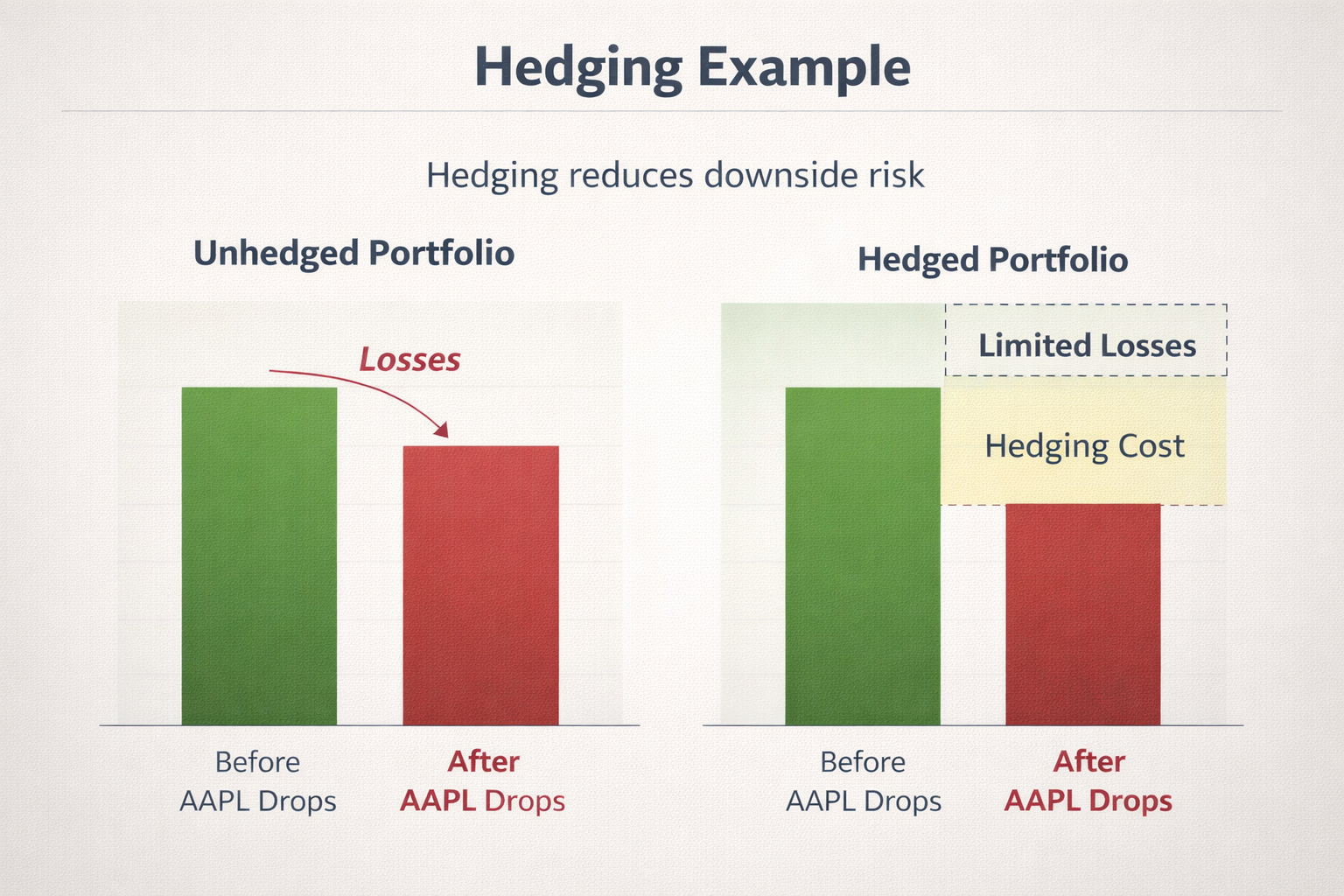
Equity Hedging with Options: An investor holding 100 shares of Apple Inc. (AAPL) may buy a put option to safeguard against a potential decline. This limits downside risk while still allowing gains if the stock rises.
Commodity Hedging: Airlines often hedge fuel prices using futures contracts to stabilise operating costs. With 2026’s geopolitical tensions affecting oil prices, such hedges help companies maintain predictable budgets.
Objective: Reduce potential losses from adverse market movements.
Risk Profile: Protects against downside, but may limit upside gains.
Time Horizon: Medium- to long-term, depending on the exposure.
Instruments: Options, futures, swaps, and insurance contracts.
A U.S. airline anticipated fuel cost spikes in mid-2026 due to tensions in the Middle East. By hedging 50% of its expected fuel needs with futures contracts, it avoided a sudden $500,000 loss, even as spot prices surged.
Transaction Costs: Arbitrage profits can be eroded by commissions, bid-ask spreads, and slippage.
Liquidity: Highly liquid markets, like major ETFs, are ideal for arbitrage; illiquid assets increase execution risk.
Volatility: Hedging strategies must adapt to market volatility. In 2026, fluctuating interest rates and geopolitical tensions affect hedging effectiveness.
Regulation: Some arbitrage strategies, especially derivatives-based, may be restricted in certain jurisdictions.
Combination Strategies: Investors can hedge core positions while performing small arbitrage trades on liquid securities to optimise risk-adjusted returns.
Theoretically, yes, but real-world risks exist. Execution delays, liquidity issues, and market volatility can reduce or eliminate potential profits.
Hedging protects against losses but may reduce gains. For example, buying protective options incurs costs that slightly lower net returns if the market rises.
Yes. Highly liquid ETFs like SPY, IVV, and VOO are commonly used due to tight spreads and frequent price alignment opportunities.
No. Beginner investors can hedge using simple tools, such as stop-loss orders or options on familiar assets, to manage downside risk.
Absolutely. Investors may hedge a portfolio’s core positions while performing arbitrage on liquid assets, generating additional profits without increasing risk exposure.
Arbitrage and hedging are two essential strategies for managing risk and seeking opportunities. Arbitrage focuses on exploiting price differences to make short-term profits, while hedging protects investments from adverse market movements. Understanding their mechanics, benefits, and limitations allows investors to navigate the 2026 market landscape with confidence.
Disclaimer: This material is for general information purposes only and is not intended as (and should not be considered to be) financial, investment or other advice on which reliance should be placed. No opinion given in the material constitutes a recommendation by EBC or the author that any particular investment, security, transaction or investment strategy is suitable for any specific person.