Published on: 2026-05-18
India imported $52.73 billion worth of Russian crude in 2024 and is the world’s third-largest oil importer, with import dependence reaching 88.6%. In 2024, India surpassed China as the world’s largest driver of oil demand growth, and the IEA projects Indian demand will rise by 1.3 million barrels per day by 2030.
Russia’s share of India’s crude imports surged from 2% before 2022 to roughly 40% by mid-2025. During the Hormuz crisis in March 2026, Russian deliveries reached 2.25 million barrels per day, accounting for 50% of India’s total crude intake. In April, Russian volumes dropped 20% under renewed sanctions pressure.
The February 2026 India-U.S. trade deal reduced tariffs from 25% to 18% and included a $500 billion purchase commitment. India has not formally committed to ending Russian crude imports, maintaining that energy security for 1.4 billion people remains the overriding priority.
The UAE exited OPEC on May 1, 2026, freeing 1.6 million barrels per day of spare capacity from quota constraints. Two weeks later, Modi signed a Strategic Petroleum Reserves deal with ADNOC in Abu Dhabi. The competition for India’s crude market is no longer a three-way race. It is four-way, and the newest bidder has the most room to grow.
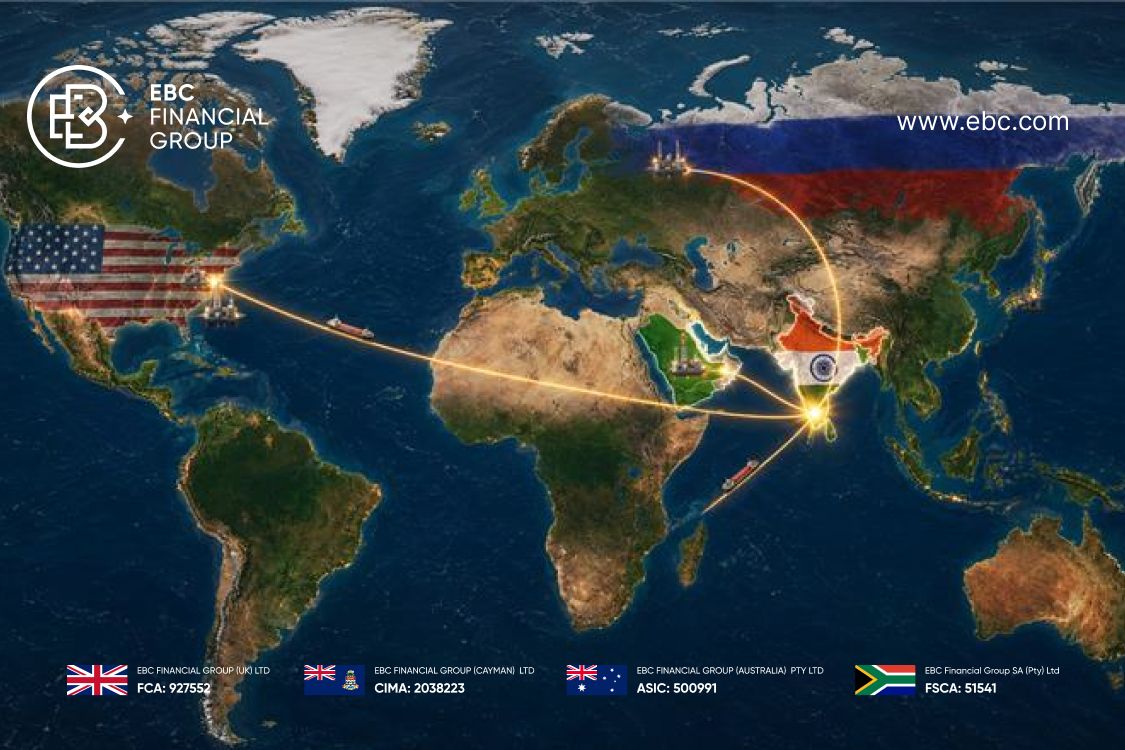
Four economies are now competing for the same customer. Russia, the United States, Saudi Arabia, and a newly independent (from OPEC) UAE are all bidding for India’s crude oil market. Whoever wins the largest share of India’s import bill will shape global crude pricing, OPEC+ cohesion, and the revenue base of one of the world’s largest oil-exporting nations at war.
India imported $52.73 billion worth of Russian crude in 2024 alone, according to UN COMTRADE data. In 2024, India surpassed China as the world’s largest driver of oil demand growth, and the IEA projects India will account for more demand growth than any other country through the end of this decade. With import dependence at 88.6% and rising, India is the buyer whose decisions set the marginal pricing for Russian Urals crude, determine whether Middle Eastern producers gain or lose market share, and define how much American crude flows east.
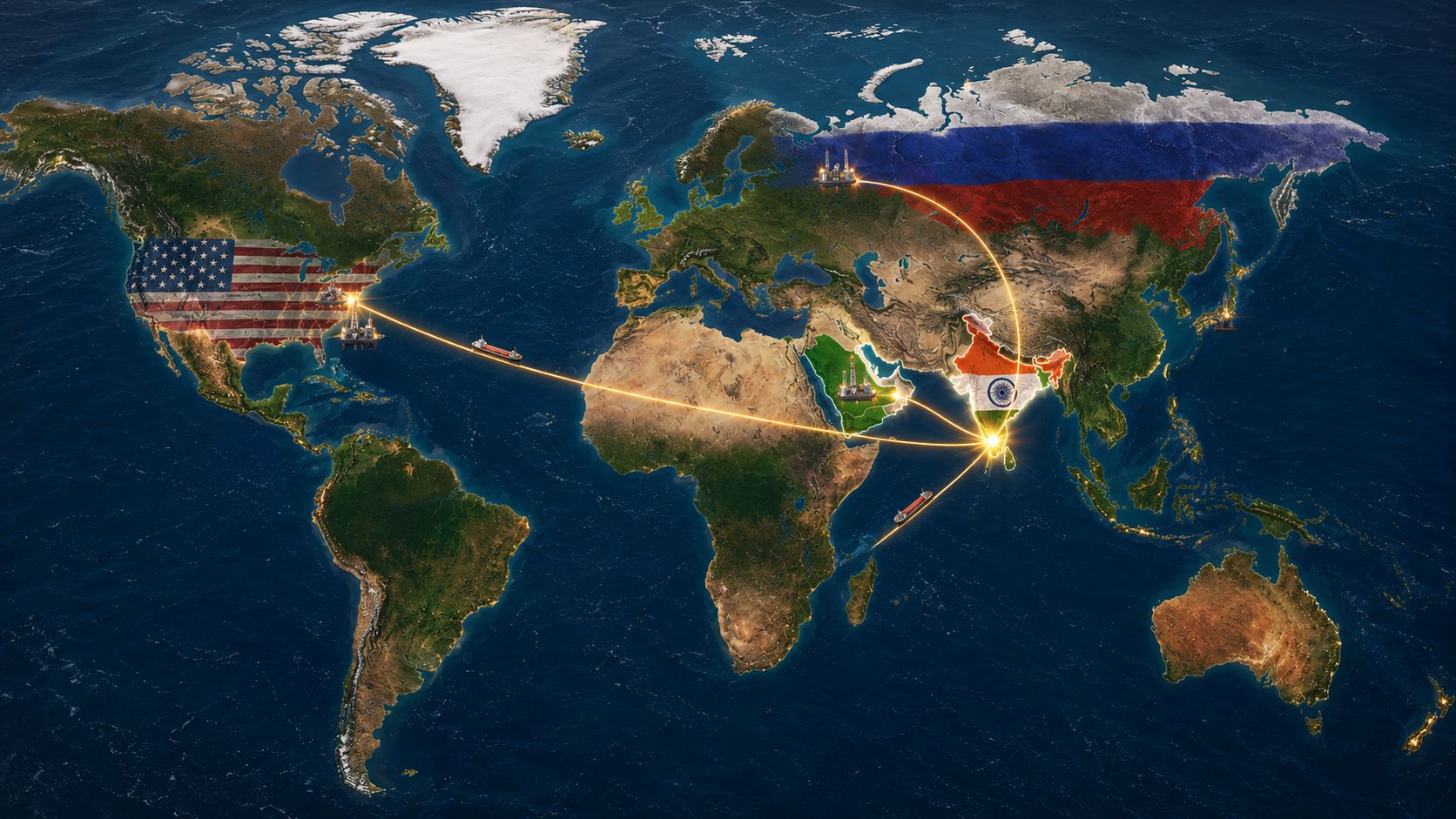
Before Russia’s invasion of Ukraine in February 2022, Russia supplied roughly 2% of India’s crude oil. Indian refiners bought primarily from Iraq, Saudi Arabia, and the UAE.
After Western sanctions cut Russia off from its traditional European customers, Moscow offered steep discounts to redirect volumes eastward. Indian refiners responded. By mid-2025, Russia’s share had surged to roughly 40% of India’s total crude imports, overtaking Iraq and Saudi Arabia to become India’s single largest supplier. India was purchasing over 80% of Russia’s seaborne Urals crude exports, with Reliance Industries and Nayara Energy (partially owned by Russia’s Rosneft) accounting for 45% of total Russian shipments, according to Kpler data.
The Hormuz crisis in March 2026 pushed the dependency even further. When the strait was disrupted, Gulf supply to India fell sharply. Russian deliveries surged to 2.25 million barrels per day, representing 50% of India’s total crude intake that month. Urals crude, which had traded at discounts of $10-$20 below Brent in 2022-2023, briefly commanded premiums of $2 to $8 above the global benchmark during the supply crunch.
In April, the picture reversed. Russian volumes dropped 20%, driven by renewed U.S. sanctions pressure targeting specific Russian exporters and Indian refinery maintenance shutdowns. The swing from 2.25 million barrels per day in March to roughly 1.5 million in April illustrates how rapidly India’s sourcing can shift, and how much that shift moves Russian export revenues.
The India-U.S. trade deal announced on February 2, 2026 was reported as a tariff story. The U.S. reduced its reciprocal tariff on Indian goods from 25% to 18%. India is committed to purchasing $500 billion in U.S. energy, aircraft, technology, and commodities over five years. Prime Minister Modi called it “a step towards restoring stability and momentum in bilateral ties.”
The tariff reduction was the headline. The condition behind it was oil.
Washington had imposed the 25% punitive tariff specifically because India was purchasing Russian crude at volumes that, in the U.S. view, were funding Russia’s wartime economy. The tariff reduction was the reward for India’s implied commitment to reduce those purchases. Late in 2025, India’s state-run refiners signed their first long-term deal to import 2.2 million tons of U.S. liquefied petroleum gas in 2026. Private refiners reportedly reduced their purchases of Russian crude in January 2026.
India, however, has not formally confirmed any explicit commitment to stop buying Russian oil. The Ministry of External Affairs has consistently maintained that ensuring the energy security of 1.4 billion Indians is the supreme priority, and that sourcing decisions will be driven by “objective market conditions.” The Carnegie Endowment’s Evan Feigenbaum expected New Delhi to refrain from making any “explicit” Russian oil commitment.
That ambiguity is deliberate. It gives India maximum flexibility to play all four suppliers against each other, buying Russian crude when prices or supply conditions favor it, buying American crude to maintain the trade relationship, and buying Gulf crude when proximity and contract terms make it the best option.
Russia needs India. After losing most of its European crude market, India became Russia’s financial lifeline. At $52.73 billion in 2024, India’s crude purchases represented a significant share of Russia’s total export revenue. Russia’s budget requires roughly $59 per barrel to balance. When India buys heavily, Russian revenues hold above that threshold. When India cuts back, Urals crude trades at levels that threaten Russia’s fiscal stability.
Russia’s ambassador to India has repeatedly reaffirmed Moscow’s commitment to supply India “regardless of wartime uncertainties.” Russia is offering long-term supply contracts, flexible payment terms, and crude grades tailored to Indian refinery configurations. For Moscow, the competition for India is existential in a way it is not for the other three bidders.
The U.S. is India’s fifth-largest crude supplier, with volumes running at roughly 300,000-370,000 barrels per day. The February 2026 trade deal’s $500 billion purchase commitment over five years is designed to scale that up dramatically.
Washington’s strategy goes beyond crude volumes. The U.S. wants India integrated into American energy supply chains across oil, LNG, and defense technology, creating a level of economic interdependence that makes the relationship structurally durable.
The IEA’s May 2026 Oil Market Report shows that Atlantic Basin crude exports to Asian markets have increased by 3.5 million barrels per day since February, with the United States, Brazil, Canada, Kazakhstan, and Venezuela all increasing eastward shipments to replace the disrupted Gulf supply.
Iraq remains India’s second-largest crude supplier. Saudi Arabia, which held roughly 12% of India’s import share in mid-2025, has seen that share decline as Russian volumes crowded it out, falling as low as 9% in some months.
Both producers want that share back. Every barrel of Russian crude that India does not buy is a barrel that Iraq or Saudi Arabia can supply at market rates rather than the discounted prices Russia used to capture the market.
For Saudi Arabia in particular, winning back Indian market share supports the OPEC+ pricing structure: when India buys discounted Russian crude, it suppresses the effective global price. When India buys Saudi crude at market rates, it reinforces the pricing discipline that Riyadh needs to maintain its fiscal balance.
The competitive landscape shifted on May 1 when the UAE formally exited OPEC and OPEC+, ending nearly six decades of coordinated production policy. The UAE’s production capacity of 4.8 million barrels per day had been constrained to 3.2 million under OPEC quotas. It now plans to expand to 5 million barrels per day by 2027, with no output restrictions.
Two weeks after that exit, Modi landed in Abu Dhabi. On May 15, India and the UAE signed a Strategic Petroleum Reserves MoU aimed at strengthening India’s energy security against supply disruptions. ADNOC is already the only foreign entity storing crude oil in India’s underground strategic reserves, a level of physical integration that no other supplier has achieved. The visit also produced a $5 billion investment deal, an LPG supply agreement, and a strategic defense partnership framework.
The UAE is no longer bidding for India’s market as part of a coordinated Gulf bloc. It is bidding independently, with 1.6 million barrels per day of spare capacity it can deploy without OPEC approval, and an existing physical presence inside India’s own strategic infrastructure. UAE Energy Minister Suhail Al Mazrouei was direct about the logic: the decision to operate “outside any constraint” ensures the UAE can respond to “market conditions, at the right time and at the right pace.”
For India, a newly independent UAE with spare capacity and a willingness to compete on price and terms is exactly the kind of supplier diversification that strengthens its negotiating hand against all three other bidders simultaneously.
India’s position in global oil markets has structural characteristics that no other buyer matches.
The IEA projects India’s oil demand will rise from 5.5 million barrels per day in 2023 to 6.6-6.7 million by 2030, an increase of 1.3 million barrels per day that will account for more than one-third of total global demand growth this decade. India’s refining capacity is expanding from 5.8 million to 6.8 million barrels per day by 2030, more capacity additions than any country outside China. Domestic production covers just 11-13% of needs and is declining, meaning import dependence will keep rising.
That combination, rising demand, expanding refining capacity, and declining domestic production, makes India the most consequential marginal buyer in crude markets for the rest of this decade. India’s purchasing decisions do not just affect its own energy costs. They determine whether Russia can sustain wartime fiscal stability, whether Saudi Arabia and Iraq can defend OPEC pricing, whether the UAE can monetize its newly freed capacity, and whether American crude finds a growing Asian market.
During the Hormuz crisis, the U.S. was forced to grant India a specific 30-day waiver allowing the resumption of Russian crude purchases, acknowledging that India’s energy needs override Washington’s sanctions architecture when supply conditions require it. That waiver was the clearest signal of India’s leverage: even the country imposing the sanctions recognized it could not afford to cut India off from the supply it needed.
The competition for India’s oil market will intensify through 2026 and beyond.
Russia will continue offering competitive pricing and flexible terms to maintain its position as India’s largest supplier. Moscow cannot afford to lose this market. The U.S. will push for deeper integration through the $500 billion framework and increased LNG and crude exports. Saudi Arabia and Iraq will use OPEC+ pricing strategy and long-standing refinery relationships to reclaim share. And the UAE, now free from quota constraints and already embedded in India’s strategic reserve infrastructure, will compete on volume, price, and speed in ways it could not while inside OPEC.
India will play all four against each other. That is the rational position for a country importing 89% of its crude for 1.4 billion people. Every percentage point of India’s import share that shifts from one supplier to another moves billions of dollars in annual revenue, adjusts the effective global crude price, and reshapes the fiscal position of the exporting nation.
Four economies are bidding for the same $52 billion annual crude market. Russia needs India’s purchases to fund its wartime economy. The United States needs India’s alignment to demonstrate that its sanctions architecture carries strategic weight. Saudi Arabia needs India’s market share back to sustain OPEC pricing discipline.
And the UAE, 18 days into its post-OPEC independence and freshly armed with a strategic reserves agreement signed in Abu Dhabi three days ago, is positioning itself as the supplier with the most capacity, the most flexibility, and the deepest physical integration with India’s energy infrastructure. India needs all four competing for its business, because that competition is what delivers the best price, the most reliable supply, and the greatest energy security for the world’s fastest-growing major oil market.
The country that wins the largest share of India’s crude imports wins the pricing cycle. The data suggests that India has structured things so that no single country ever does