Published on: 2026-09-01
Updated on: 2026-09-01
The global semiconductor market has expanded rapidly over the past few years. Chip sales reached $630.5 billion in 2024 and $795.6 billion in 2025, then hit $702 billion in the first half of 2026 alone.
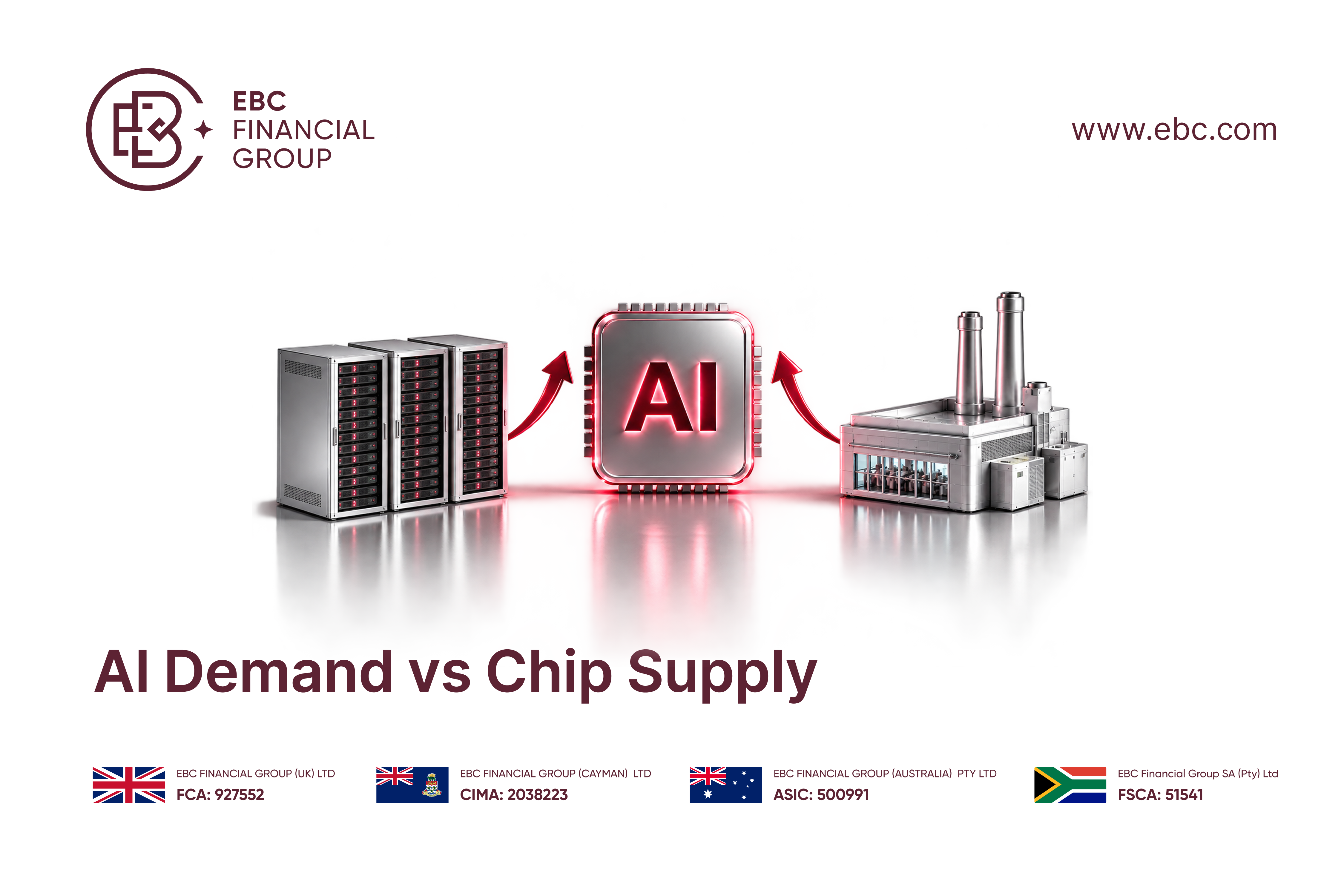
According to World Semiconductor Trade Statistics, memory led the first-half surge with 305% growth compared to 45% for logic, as demand from AI infrastructure, high-performance computing and advanced memory kept building
But every boom carries a cautionary side: the bust.
Semiconductor manufacturers and equipment suppliers are committing billions of dollars to new capacity, with much of the supply expected to arrive over the next few years. But how much new capacity is too much?
Where is all the AI infrastructure spending going? Follow the money and the scale of chip demand comes into focus.
Alphabet's Q2 2026 earnings call reported $44.9 billion of capital expenditure in the quarter alone, most of it going to the technical infrastructure behind AI. Around 60% went to servers and 40% to data centres and networking equipment. Alphabet also lifted its full-year capex guidance from $180–190 billion to $195–205 billion, mainly to bring capacity online faster as demand grows.
Spending also extends beyond general-purpose AI processors. Broadcom's Q2 FY2026 results reported $10.8 billion in AI semiconductor revenue, up 143% year on year, driven by custom AI accelerators and AI networking.
Put together, the figures tell one demand story. Building AI infrastructure takes more than the chips that do the computing. It also takes the servers, networking, and other semiconductor capacity around them.
Strong demand is now driving a strong supply response across the semiconductor chain.
TSMC, a major maker of advanced chips, raised its 2026 capital budget to $60–64 billion. Around 70–80% of that will go to the advanced manufacturing used to produce chips with smaller features and higher performance.
Even at that scale, new leading-edge capacity takes years to arrive. In its Q2 2026 earnings call, TSMC said that developing the technology and products, preparing capacity, and ramping up to large volumes can take more than five years.
TSMC is careful about reading that demand. Rather than adding up every forecast it receives, it talks to its customers and their customers, including cloud providers, and checks how AI data-centre construction is progressing: where the sites are, what demand is expected, and how many server racks are planned. The same call hinted at some uncertainty about whether the boom can be met in full. Management noted that any one customer's forecast may look reasonable on its own, but adding them all together could overstate the demand that reaches the market.
The equipment industry is preparing for the expansion as well.
ASML is the industry's largest supplier and the only producer of the EUV machines needed to make the most advanced chips. It plans to raise its 2027 production capacity for two of its main equipment lines by 30% from 2026 levels, and it is weighing a further 30% increase in both for 2028, according to its Q2 2026 results. It is also considering another capacity increase of roughly 30% in both categories for 2028, according to its second-quarter 2026 results.
That expansion could help chipmakers add capacity over the next several years, but the timing and mix will matter as much as the amount: which chips, and whether the capacity comes online where and when the demand is.
The semiconductor market could take three broad paths as chipmakers expand production:
| Possible Path | What It Would Look Like |
|---|---|
| Demand Remains Ahead of Supply | AI infrastructure spending continues rising, memory prices remain firm, chip sales grow, and factories continue operating close to full capacity. |
| Supply and Demand Move Closer | Chip availability improves, prices stabilise, and factory utilisation moderates without a large increase in inventories or major production cuts. |
| Supply Exceeds Demand | Inventories rise, chip prices fall, factory utilisation weakens, equipment orders are delayed, and manufacturers begin reducing production. |
The summary table below then further breaks down how each player can affect the overall semiconductor chip chain:
| Company | What It Could Reveal |
|---|---|
| Nvidia / Broadcom | AI computing and networking demand |
| Micron | Memory pricing and inventory conditions |
| TSMC | Advanced-node utilisation and foundry demand |
| ASML | Long-term capacity commitments |
What happens next depends on which moves faster from here: demand for AI computing power, or the chip capacity being built to supply it.
The first signs will likely show up in pricing, inventories, and factory use before they reach headline chip sales. Rising inventories, softer pricing, or falling utilisation would suggest supply is starting to catch up with demand. Firm pricing and high utilisation would point the other way, to capacity still running tight.
Semiconductor exchange-traded funds (ETFs) spread investment across several companies, but not with equal influence. Each holding's weight decides how strongly its share-price moves feed through to the fund, so an ETF gives you exposure to shifts across the whole industry rather than a bet on one name.
Each major holding maps to a different part of the chain. Nvidia sits closest to AI accelerator demand, Broadcom adds custom accelerators and networking, Micron is the memory play, TSMC stands for advanced manufacturing, and ASML sits nearest the capacity build-out.
Two well-known funds show how much a single stock can shape a semiconductor ETF:
The VanEck Semiconductor ETF (SMH) held Nvidia, TSMC, Broadcom, Advanced Micro Devices (AMD), ASML, and Micron among its ten largest positions as of 31 July 2026. Nvidia alone made up 21.38% of the fund. On that weighting, a 10% rise in Nvidia shares would lift SMH's underlying portfolio value by around 2.1%, assuming every other holding stayed put and setting aside fees and tracking differences.
The iShares Semiconductor ETF (SOXX) spread its top positions more evenly as of 30 June 2026. Micron was its largest holding at 8.54%, followed by AMD at 8.09% and Nvidia at 6.81%. On that weighting, the same 10% rise in Nvidia would lift SOXX's underlying portfolio value by around 0.7%, under the same assumptions.
Neither fund is automatically the better one to hold. They are simply driven by different things. SMH was more sensitive to Nvidia's share price on those dates, while SOXX leaned less on any single top holding. Either way, both would feel an industry-wide slide in demand, pricing, or factory use.
As the market moves through H2, the semiconductor chain still turns on two tensions: how fast demand grows, and how much new capacity arrives to meet it.
Eligible US semiconductor stock and ETF CFDs are currently available on EBC with zero commission and zero swap fees until 11 September 2026, subject to campaign terms, product eligibility, platform conditions and regional availability.