Published on: 2026-08-10
Arabica has climbed roughly a third from its June low even as the USDA forecasts record global production. El Niño has restored a weather premium, but depleted ICE inventories and unhurried Brazilian selling are doing much of the work.
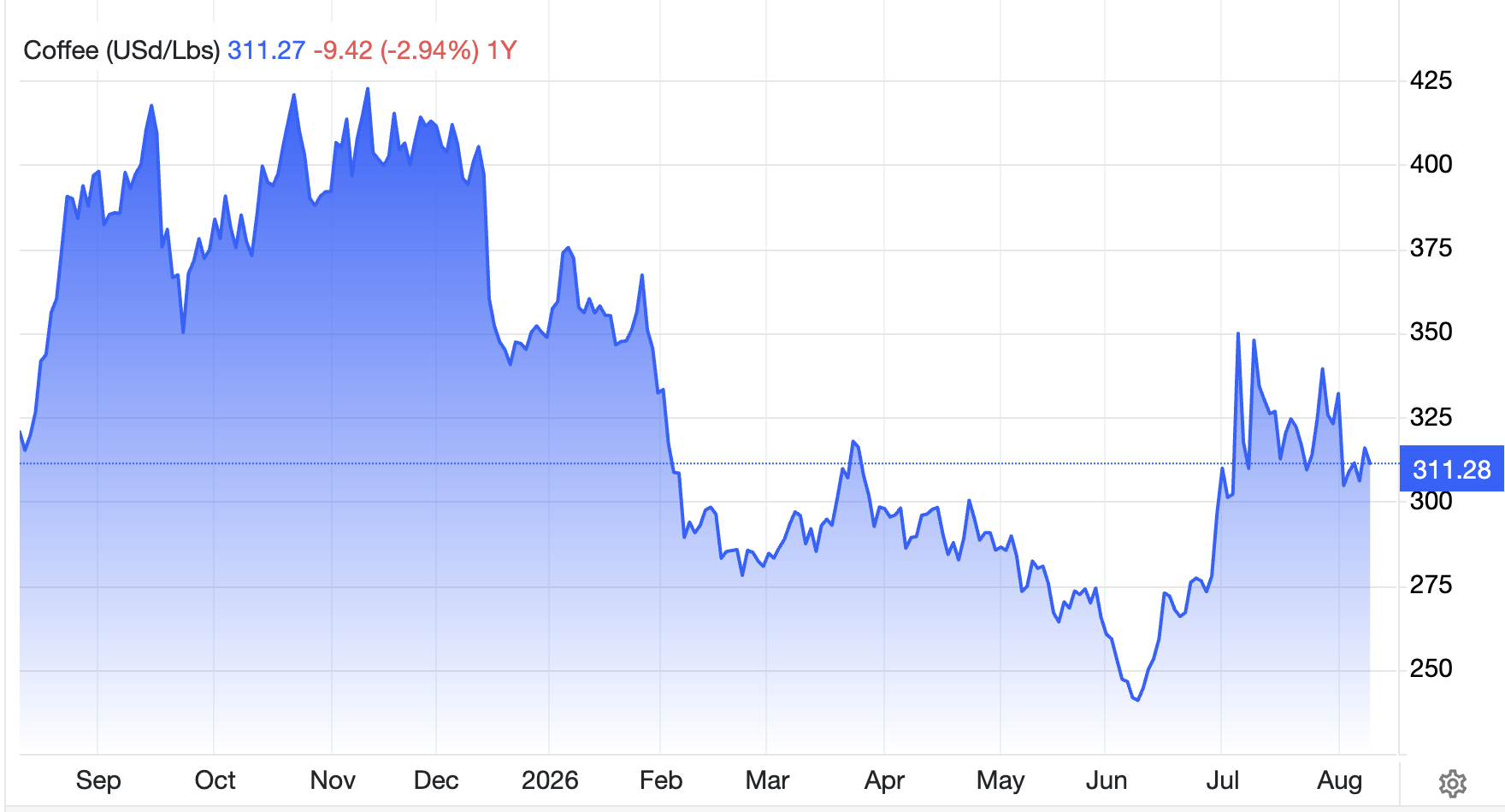
Benchmark arabica coffee was at 315.90 US cents a pound on 7 August, up 3.2% on the day and about 32% above the 238.85 cents low set on 9 June. El Niño has taken most of the headlines, with forecasters raising the odds of a strong Pacific warming event running into early 2027.

Weather is not carrying the rally on its own. ICE-certified arabica stocks had fallen to 244,172 bags by 7 August, a two-and-a-half-year low and roughly a third of the 754,516 bags held a year earlier. Brazilian growers are selling slowly, and the market has started looking past the record crop now coming off the trees.
The rally therefore poses a narrower question: is El Niño driving this market, or did it arrive when the market had unusually little inventory available to absorb a scare?
Benchmark arabica was at 315.90 cents a pound on 7 August, around 32% above its 9 June low, as traders priced weather risk back into agricultural commodities.
El Niño is not acting alone. ICE-certified arabica inventories fell to 244,172 bags on 7 August, a two-and-a-half-year low, leaving less deliverable coffee to absorb any supply scare.
Forecast supply remains historically strong. The USDA sees record 2026/27 world output of 189.7 million bags, with Brazil alone at 71.9 million.
The larger weather risk lies beyond the current harvest, in Brazil’s September to October flowering window and in rainfall across Vietnam’s Central Highlands.
Coffee entered June with a bearish consensus and left it carrying a weather premium. The reversal owed as much to what was held in exchange warehouses as to the forecast itself.
The turn was abrupt. The International Coffee Organization noted in its June market report that growing confidence the event would develop into a strong El Niño by late 2026 halted the decline in prices on 9 June, ending six consecutive weeks of losses in New York.
The harvest has also been late. Cooxupé, Brazil’s largest coffee cooperative, reported its members were 67.3% through the 2026 crop by 31 July against 74.2% a year earlier. Safras & Mercado put national progress at 64% by 15 July, behind both last year’s 77% and the five-year average of 70%.
Brazilian growers have compounded the effect, selling gradually rather than clearing the crop into a soft market, so a record forecast has not translated into freely available coffee.
El Niño supplied the trigger. Thin inventories supplied the leverage.
On paper, the global production outlook is the strongest in years. The USDA’s July biannual report set records across almost every line of the 2026/27 season.
| Market | Bags (mn) | YoY change |
|---|---|---|
| World production | 189.7 | +6.0% |
| World arabica | 105.9 | +12.1% |
| World robusta | 83.8 | -0.7% |
| Brazil total | 71.9 | +14.1% |
| Brazil arabica | 47.5 | +25.0% |
| Vietnam total | 32.5 | +2.5% |
| World ending stocks | 26.3 | +7.8% |
The USDA’s Brazil number nevertheless runs well above Conab’s official 66.7 million bags. A gap of more than five million between the two most closely watched estimates leaves the size of this crop contested, and the resolution cuts both ways.
If the USDA proves closer, the weight of that supply should eventually press prices lower. If Conab is nearer the mark, the cushion standing between the market and El Niño is already thinner than the headline global forecast implies.
The deeper issue is that the table and the exchange measure different things. A 189.7 million bag forecast describes production across a marketing year. The 244,172 bags at ICE describe coffee already graded, warehoused and immediately deliverable against the benchmark contract. One says world supply should eventually be ample. The other says the buffer behind the futures price is unusually thin.
Record production, in other words, does not mean record available inventory.
Brazil’s bumper arabica crop was made by rainfall during the September and October 2025 flowering, which the USDA credits for near-record yields in Minas Gerais. El Niño arriving in mid-2026 does not undo beans already on the tree.
The beans lifting supply today were grown under last year’s weather. The futures market has begun pricing the weather that will grow next year’s.
That places the next flowering window, September and October 2026, at the centre of the trade. Traders have flagged the risk that El Niño delays those rains, and the market is already watching for dryness: Somar Meteorologia recorded no rainfall in Minas Gerais in the week ended 2 August.
Past El Niño episodes have coincided with both higher and lower Brazilian output, which casts the Brazilian exposure as a question of rainfall timing and heat stress rather than of automatic drought-driven shortfall.
Vietnam sits at the other end of that exposure. Of its record 32.5 million bag forecast, 31.4 million is robusta, and Central Highlands rainfall has a long record of responding to El Niño. The 2015/16 event cut Vietnamese output sharply. For now that market looks better cushioned: ICE robusta stocks reached a four-and-a-half-month high of 4,261 lots on 7 August, the mirror image of arabica.
Arabica’s weather premium is landing in a market with very little certified coffee behind the futures contract. ICE hosts the benchmark Coffee C contract, and certified stocks are exchange-grade beans graded, warehoused and made deliverable against it. The decline has been steep:
7 August 2026: 244,172 bags
One year earlier: 754,516 bags
That is a drop of roughly two-thirds in twelve months.
When certified stocks are plentiful, a weather headline runs into visible physical supply and the price response is dampened. When stocks sit near a two-and-a-half-year low, the same headline meets a much smaller buffer, and minor frictions such as a late harvest or reluctant selling can carry a disproportionate price effect. Low inventories do not create the story; they amplify whatever story arrives.
El Niño owns a share of the rally rather than the whole of it. It explains why traders are suddenly willing to pay for protection against damage to crops that do not yet exist, but not why a weather forecast alone can lift a market by roughly a third in eight weeks.
That required certified stocks at a two-and-a-half-year low, gradual Brazilian selling, a harvest running behind schedule all season and unresolved disagreement over the crop’s final size, each compounding the others.
Each of those supports can reverse. Should Brazilian selling accelerate, certified stocks rebuild and the September rains arrive on schedule, the premium can unwind as quickly as it was assembled. Coffee demonstrated the point in the second quarter, when a run of bullish supply forecasts drove arabica to a 19-month low inside a few weeks.
El Niño is helping send coffee prices higher again, though it is one input rather than the whole explanation. The current market combines a rebuilt weather premium with certified arabica stocks at a two-and-a-half-year low, unhurried Brazilian selling and a harvest that has lagged all season.
The record 2026/27 forecast remains a genuine cushion. The open question is whether Brazil and Vietnam can convert that paper surplus into certified inventory before El Niño begins working on the production cycle that follows.