Published on: 2026-08-11
BSE’s Nifty 50 inclusion takes effect on September 30 and could pull in close to ₹7,000 crore of passive buying. This year the flow lands in a closing auction that did not exist at the last rebalance.
BSE Ltd will join the Nifty 50 on September 30, replacing Wipro in India’s benchmark equity index. The operator of one exchange is about to become a constituent of the other’s flagship gauge. Nuvama Institutional Equities puts the passive buying that follows at roughly $741 million, against about $246 million of selling in Wipro.
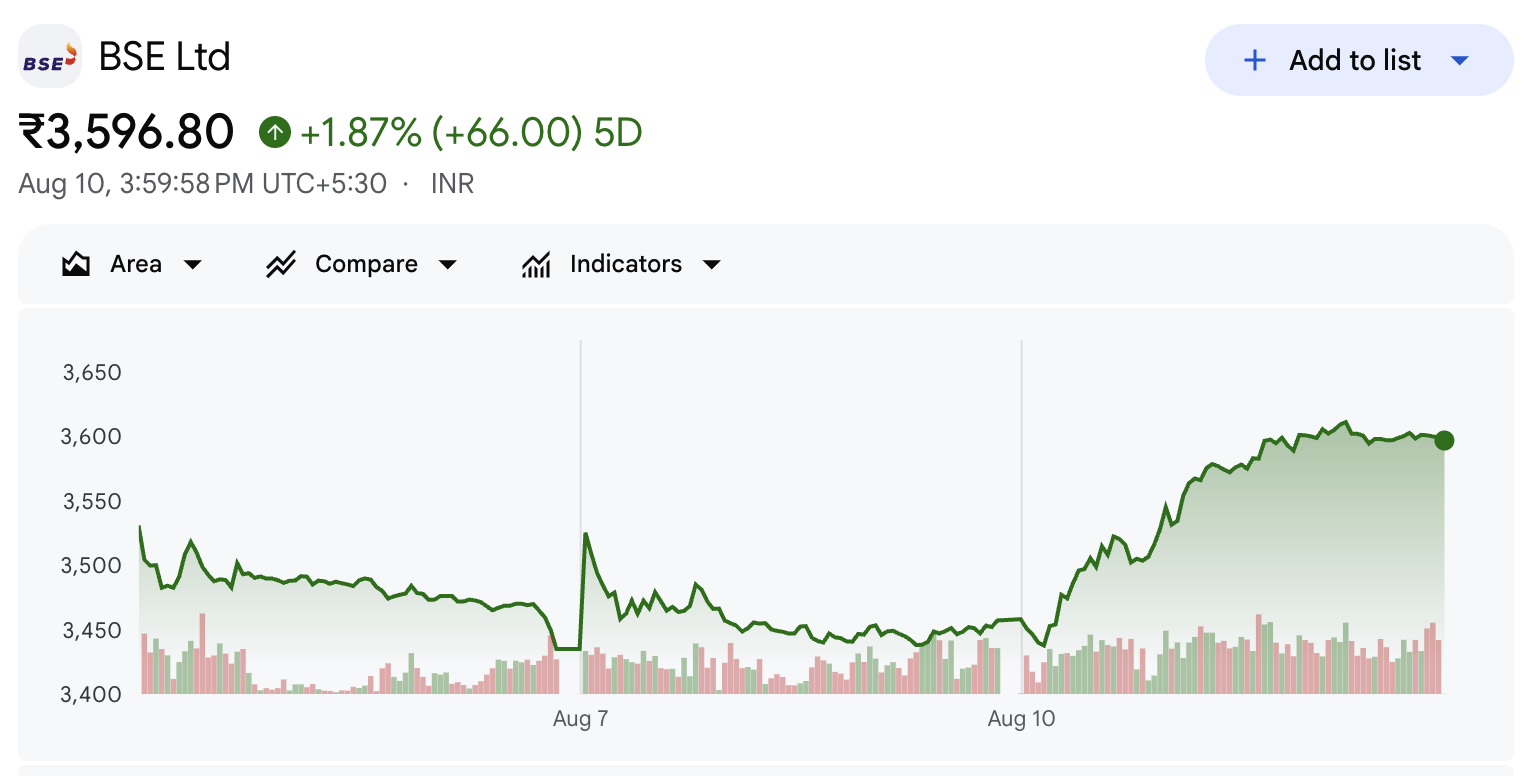
The stock moved first: BSE closed 4% higher at ₹3,596 on Monday, hours before the announcement landed after the bell. The question facing the BSE share price is not whether the buying arrives. It is how much of it has already been paid for.
The $741 million works out at close to ₹7,000 crore. Across the 20 sessions to August 7, the last full day before the announcement, BSE’s average daily traded value on the NSE was about ₹982 crore. The requirement is worth roughly seven ordinary sessions of turnover, executed in one.
Treat that as an order of magnitude. Turnover in that window ranged from about ₹490 crore to ₹2,430 crore, so absorption depends on which kind of session September 29 turns out to be.
NSE Indices confirmed the change on August 10, and BSE simultaneously enters the Nifty50 Equal Weight index and moves from the Nifty Midcap 150 into the Nifty 100, pulling further tracked assets into the calculation.
A fund that promises to track the Nifty 50 has to hold the Nifty 50. Once BSE receives a benchmark weight, replicating portfolios need matching exposure, sized by index rules rather than by any view on earnings or multiple. Wipro’s weight goes to zero, so those portfolios clear it.
Passive managers are not indifferent to price. Slippage feeds straight into tracking error. What they do not have is a choice about whether to own BSE. The choice they keep is how: how early to begin, whether to hold futures through the transition, and how much to leave to the closing auction.
In May, when this outcome was first flagged as likely, the figure in circulation was closer to $639 million. Three months later it is $741 million. None of the index rules changed. The inputs did.
The estimate moves with the assets benchmarked to the Nifty 50, BSE’s final weight, the price at which funds transact, and the free-float factor at the cut-off. A higher BSE price lifts both the weight and the rupee value of the buying; redemptions from trackers cut it. This is a forecast of a future requirement, not a booked order.
Predictable demand attracts earlier demand. Event-driven desks, arbitrageurs and active managers can position ahead of a flow they can size themselves, and they have seven weeks. Monday’s 4% gain came before any official confirmation, which is consistent with anticipatory positioning, though the move alone does not prove it. May’s record high, when inclusion was still speculation, points the same way.
The event runs in three phases: announcement, when positioning begins; anticipation, when flow estimates circulate and the requirement is absorbed into the price; and execution, on September 29.
That third phase looks different this year. India’s Closing Auction Session went live on August 3, and September’s reconstitution will be the first Nifty 50 semi-annual reshuffle to settle under it.
For cash-market stocks with derivatives contracts, BSE among them, the close is no longer the volume-weighted average of the last half hour of continuous trading.
It is set in a separate session from 3:15pm to 3:35pm, in which orders collect and the equilibrium price, the level at which the largest volume can be executed, becomes the official close. That is the price a tracker’s performance is struck against, so it is the price the tracker wants.
One constraint is worth noting. Auction prices are banded at plus or minus 3% from a reference level, itself the volume-weighted average of trades between 3:00pm and 3:15pm. However large the order, the close cannot travel more than 3% from where the stock was trading beforehand.
The September 2025 review is the closest comparison, though it ran under the old closing mechanism.
Elara Capital sized that rebalance at ₹4,347 crore of passive buying in IndiGo and ₹3,281 crore in Max Healthcare, more than ₹7,600 crore combined. It also noted that active funds were already overweight IndiGo, while Max Healthcare was the one name where big buying met big underweight positioning.
The session delivered a windfall in neither. IndiGo closed September 29 up 0.18%. Max Healthcare finished 1.64% lower.
The longer record is similarly mixed. Value Research examined 40 stocks added to the Nifty 50 over 15 years to February 2024 and found only 57% were higher a year later.
Wipro’s exit is the mirror image, and a smaller one. The estimated $246 million of selling, about ₹2,340 crore, lands on a company capitalised near ₹1.86 lakh crore, and part of it is offset by entry into the Nifty Next 50, though a net figure needs same-model estimates for both legs.
The reason for deletion is narrow. Wipro’s six-month average free-float market capitalisation, at ₹55,930 crore, was the smallest in the index, and an eligible outsider cleared the 1.5 times threshold against it.
The shares are down roughly 30% in 2026 against weak discretionary technology spending, and that decline is what pushed the free-float figure to the bottom of the table. September’s selling follows from index rules, not from a fresh verdict on the business.
The Nifty 50 selects on eligibility, not corporate symbolism: presence in futures and options, liquidity, and six-month average free-float market capitalisation of at least 1.5 times the smallest constituent. BSE cleared it at ₹1,40,879 crore.
The free-float test also explains how a smaller company displaced a larger one. Wipro’s full market capitalisation exceeds BSE’s, but the promoter group holds most of it. BSE has no promoter, so almost its entire market value counts as float. On the index’s measure, BSE sits comfortably clear.
The forced flow has an end date. Once the auction clears, BSE loses its captive buyer and trades on what drove the re-rating: cash and derivatives volumes, market share, the regulatory backdrop for expiry-day contracts, and a valuation that already discounts a great deal.
June-quarter net profit of ₹874 crore, up 62% year on year, is the sort of delivery that multiple assumes. Index membership adds no revenue.
September 30, 2026. Index funds implement the switch after the close on September 29, which is the session in which the passive flow is executed.
Nuvama Institutional Equities estimates about $741 million, close to ₹7,000 crore, or roughly seven times BSE’s average daily traded value. It is a forecast, not a fixed amount, and moves with the share price and the final index weight. The May estimate was $639 million.
Wipro had the index’s smallest six-month average free-float market capitalisation at ₹55,930 crore, and BSE cleared the required 1.5 times threshold against it at ₹1,40,879 crore. Wipro moves to the Nifty Next 50. This is free-float arithmetic, not a judgement on the business.
No. Predictable buying attracts earlier buyers, so part of the effect can show up weeks before the rebalance. In September 2025, with over ₹7,600 crore of estimated buying across two additions, one stock closed the session up 0.18% and the other fell 1.64%. Only 57% of 40 past additions were higher a year later.
No. The fund manager executes the switch inside the portfolio. The only cost to unitholders is indirect, through tracking error and the transaction costs of rebalancing.
BSE gains a large, predictable and temporary buyer. Wipro gets a smaller, partly offset seller. Neither changes what either company earns. The $741 million is real money, but it moves with prices, and a market that has known about this since May has had time to work on it.
The easiest part of the price move may already have happened. The largest mechanical flow is still ahead.