Published on: 2026-06-01
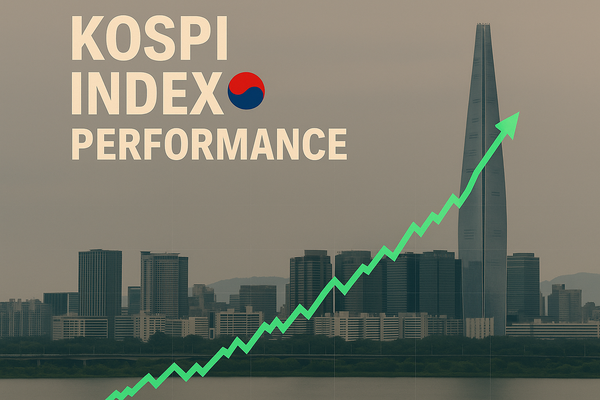
South Korea's stock market is tearing up the financial history books right now. In a massive display of market momentum, the country's benchmark index, the KOSPI, has smashed through generational barriers, setting fresh milestones that have global investors glued to their screens. Driven by the relentless global arms race in artificial intelligence, South Korean tech stocks have seen a total valuation re-rating, pushing prices to levels nobody in East Asian finance has ever seen before.
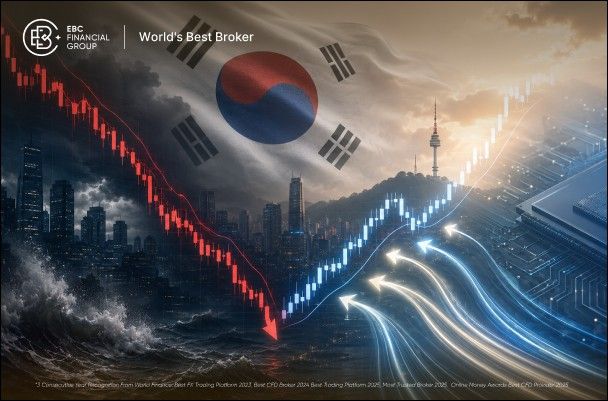
But this incredible ride hasn't been smooth sailing. The sheer volume of automated institutional cash and eager everyday retail investors has created a double-edged sword: jaw-dropping returns paired with dizzying, stomach-churning daily swings. As the KOSPI hits record highs, the stock exchange's backend infrastructure is being pushed to its absolute limits, leading to dramatic trading halts that show just how wild things can get when everyone tries to pile into the same trade at once.
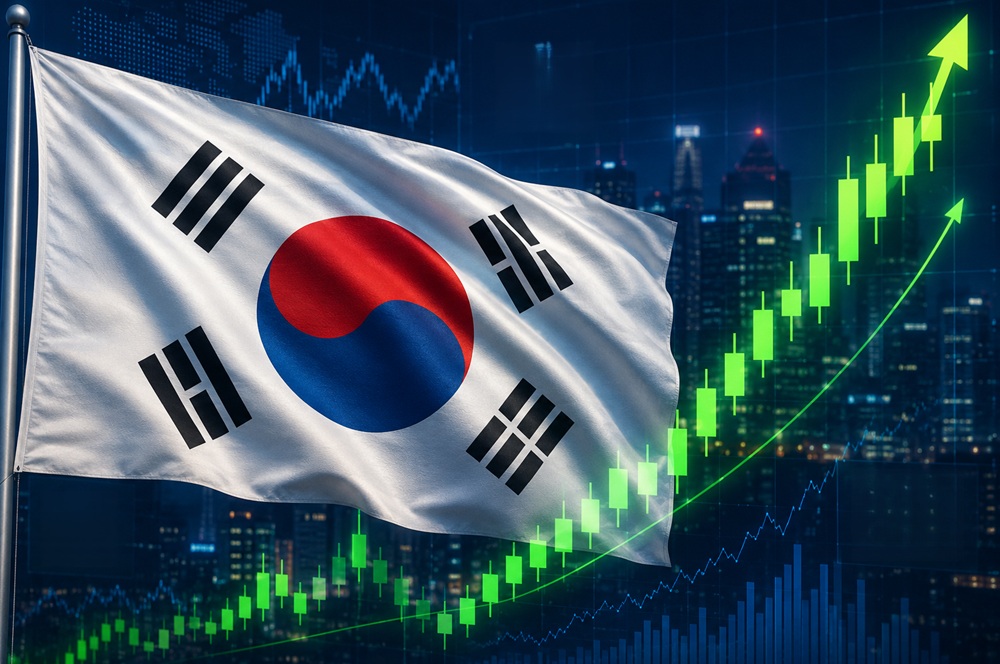
The momentum behind South Korea's biggest companies finally boiled over when the index comfortably cleared the psychological 8,000-point barrier. It didn't stop there, either—stretching its intraday gains to post a stunning all-time high of 8,874.16 points. To put this into perspective, the benchmark index has gained more than 100% since the start of 2026, making South Korea the single best-performing stock market on the planet right now.
This massive bull run is completely separating South Korea from the sluggish growth seen in neighboring Asian markets. The rally has added hundreds of billions of dollars in equity value, almost entirely fueled by the world's insatiable appetite for high-bandwidth memory (HBM) chips and high-end hardware. Because the underlying business is so strong, every time foreign investors try to lock in profits, local retail investors and domestic institutions immediately buy the dip, keeping a solid floor under stock prices as the KOSPI hits record highs.
Just how crazy is the trading right now? During a today's session right after the index broke its historical peak, a sudden wave of automated sell orders and big fund rebalancing sent shockwaves through the derivatives market.
When the KOSPI 200 futures contracts suddenly took a sharp rise, it triggered an automatic circuit breaker, temporarily freezing program trading to let everyone catch their breath. This isn't a sign of a broken market; it's a built-in safety feature designed by regulators to keep algorithmic trading from causing a total flash crash.
The 5% Rule Explained: According to the Korea Exchange rules, if the main futures contract moves up or down by more than 5% from the previous day's close and stays there for over a minute, an automatic "sidecar"—or temporary circuit breaker—kicks in. It doesn't matter if a stock or index tracking tool experiences a 5% gain or a 5% loss; the rule triggers exactly the same way.
What Happens During the Halt: The moment that 5% line is crossed, all automated program trading orders are frozen solid for five minutes. This short pause gives human traders and institutional desks a quick window to adjust their risk, fix mistakes, and stop computer algorithms from feeding on each other and wiping out market liquidity.
Triggering a circuit breaker right as the KOSPI hits record highs shows just how much power computer algorithms wield in today's markets. Instead of panicking, most seasoned analysts view the halt as a healthy safety valve—it stops a localized computer glitch or rapid sell-off from turning into a full-scale panic.
If you want to know why South Korean stocks are soaring, you only need to look at a handful of massive tech exporters. South Korea has essentially locked down a near-monopoly on the incredibly complex memory chips needed to run large language models and next-generation AI networks. The earnings numbers dropping out of Seoul make it obvious why the KOSPI hits record highs.
The undisputed king of the index, Samsung Electronics, officially crossed the $1 trillion market cap threshold earlier this year. Riding an absolute wave of high prices for corporate memory chips and massive enterprise hard drives, Samsung's semiconductor wing reported quarterly revenues that literally tripled. The stock itself is up a breathtaking 163% this year alone.
The award for the most dramatic corporate turnaround of the decade has to go to SK Hynix. By becoming the go-to supplier for the world's biggest AI chip designers, their stock has skyrocketed by nearly 1000% over the last 12 months. Their first-quarter revenue shot up 198% year-over-year to 52.58 trillion won—proving they are making an absolute fortune on every chip out the door.
This AI hype is leaking into other sectors, too. LG Electronics watched its stock price go completely vertical, hitting a record 293,000 won after signing a massive enterprise deal with Google. At the same time, specialized software and industrial firms like Hyundai Autoever, LG CNS, and Doosan have notched triple-digit gains, showing that the wave of cash is lifting almost every boat in the supply chain.
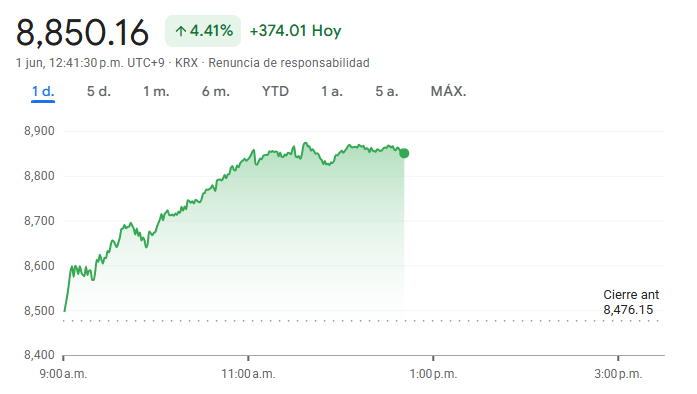
If you look at the charts, this isn't just random hype. The breakout is backed by massive trading volume, showing real institutional conviction. Looking at the long-term view, the index has broken out of a multi-year slumber, transitioning from a cyclical market into a true long-term growth engine.
Now that the index has blown past its old highs, the psychological 8,000 mark has turned into a major line of defense. Trading desks note that if things do pull back, there is another massive floor between 8,200 and 8,400 points where big funds are waiting to buy more. On the upside, because the index is in uncharted territory, technical analysts are eyeing 9,000 and 9,500 as the next targets.
The charts look incredibly clean right now. The 50-day moving average is running hot well above the 200-day moving average, which is a classic sign of a strong, healthy uptrend. While the 14-day Relative Strength Index (RSI) is sitting deep in "overbought" territory (above 75), quick breathers—like today's session that triggered the circuit breaker—help cool things down without ruining the broader rally.
| Technical Indicator | Current Level / Status | What It Means for Traders |
| KOSPI Spot Level | 8,850.16 Points | Sitting at historic highs |
| 14-Day RSI | 74.2 | Overbought (expect some choppy days) |
| 50-Day Moving Average | 7,920.00 Points | Strong immediate floor on a pullback |
| 200-Day Moving Average | 6,450.00 Points | Confirms a long-term bull market |
| 12-Month Target | 9,000 - 10,500 | Wall Street targets (Goldman Sachs / KB) |
Whenever a major stock index doubles in six months, people immediately start throwing around the word "bubble." It's natural to worry and draw parallels to the dot-com crash of 2000. But if you talk to top global macro strategists, they'll tell you the math this time around is totally different.
According to research notes from Goldman Sachs—which just bumped its target for the index to 9,000—corporate earnings growth for South Korean companies is on track to hit an unbelievable 300% for the year. That is the most explosive profit growth seen in Asia since the late '90s recovery.
Because actual company profits are growing even faster than the stock prices, the market isn't actually as expensive as it looks. Trading at a forward price-to-earnings (P/E) ratio of just 8.6x, South Korean stocks are a absolute steal compared to the US S&P 500, which trades at a rich 21x. Investors aren't buying dreams here; they're buying companies that are generating actual mountains of cold, hard cash.
The reality of 2026 is that the global AI boom cannot move forward without South Korea's factories. As the KOSPI hits record highs, the index has become a real-time scoreboard for the global tech revolution. Yes, the occasional circuit breaker halt reminds us that fast money causes choppy waters. But with real corporate earnings backing up the price action, a passionate base of local investors, and incredibly reasonable valuations, South Korea's historic run looks less like a speculative bubble and more like a market finally getting the respect—and the price tag—it deserves.