Published on: 2026-06-08
Updated on: 2026-06-08
The KOSPI Index Crash turned Seoul’s 8% trading halt into a live test of global AI risk after Samsung, SK Hynix, KOSPI200 futures, and the won all broke in the same session. Samsung and SK Hynix remain central to the memory boom, yet both were sold as if AI exposure had become a liability rather than a strength.
The question now is whether Korea suffered a local liquidity break or exposed the first global crack in the AI trade.
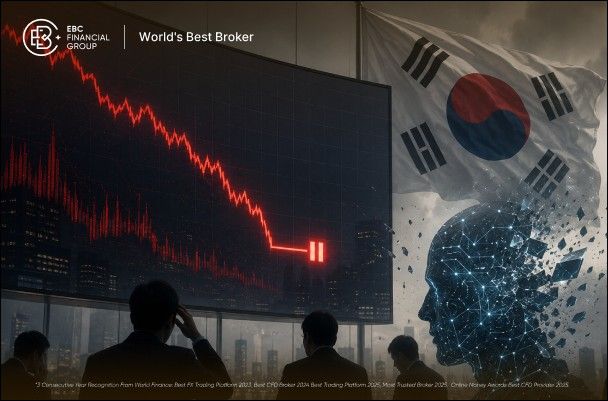
The KOSPI’s 8.37% intraday fall triggered a 20-minute circuit breaker, marking the point where selling outran normal trading conditions.
Samsung and SK Hynix turned Korea’s AI leadership into index risk as semiconductor selling moved from Wall Street into Seoul.
KOSPI200 futures and sidecar activity indicated that the decline was driven not only by emotional selling but also by mechanical deleveraging.
The won near the 1,560 per US Dollar zone is the cross-asset signal that determines whether foreign selling deepens.
The crash becomes a buying opportunity only if chips, futures and the won stabilise together, not if the index merely rebounds once.
The fastest way to judge the crash is to look beyond the KOSPI. The pressure appeared at the same time in spot stocks, futures, currency and global semiconductors.
| Break Point | Latest Signal |
|---|---|
| KOSPI spot index | Down 8.37% to 7,477.46, crossing Korea’s formal halt threshold |
| Trading halt | 20-minute circuit breaker after prices fell too fast for orderly trading |
| Samsung Electronics | Down 8.51%, turning Korea’s largest chip stock into an index drag |
| SK Hynix | Down 7.29%, as AI memory exposure shifted from leadership to liquidation |
| KOSPI200 futures | Down 6.26% at the sidecar trigger, showing mechanical selling pressure |
| Korean won | Near 1,560 per US Dollar, raising the cost of foreign exposure |
| Philadelphia Semiconductor Index | Down 10.26%, confirming a wider global chip reset |
The key row is KOSPI200 futures. A falling index shows fear; a futures-led sidecar shows forced selling moving through the market structure.
A market does not trigger an 8% circuit breaker because investors are merely cautious. It does so when selling overwhelms the market’s ability to set orderly prices.
The Korea Exchange activates a Phase 1 circuit breaker when the KOSPI falls more than 8% from the previous close for one minute. The halt lasts 20 minutes and also affects related futures and options trading, which matters because pressure was already visible in KOSPI200 futures.
The point is simple. The halt did not cause the crash. It confirmed that selling had moved beyond normal valuation debate and into liquidity stress.
Samsung and SK Hynix did not fall because memory chips stopped mattering. They fell because they mattered too much to the same trade at the same time.
Samsung Electronics dropped 8.51%, while SK Hynix fell 7.29% in early Seoul trading. TradingKey reported both chip leaders falling about 10% intraday, with the two stocks together accounting for roughly half of the KOSPI market capitalisation.
That concentration changes the meaning of the KOSPI. In calm markets, Korea looks like a national equity benchmark with strong technology exposure. In stressed markets, it behaves as a high-beta proxy for AI memory, global chip valuations, and foreign risk appetite.
The danger is not that Samsung and SK Hynix have stopped mattering to AI. The danger is that they mattered too much to everyone at once.
Korea opened after Wall Street had already repriced the semiconductor complex.
The prior US session saw the Nasdaq fall 4.18%, the S&P 500 lose 2.64%, and the Dow Jones Industrial Average drop 1.35%. Nvidia fell 6.2%, Broadcom lost 7.92%, and Micron Technology slid 13.25%.
The warning reached Asia before Seoul opened. AI earnings expectations had become harder to satisfy, while stronger US labour data revived pressure on long-duration growth valuations.
Korea absorbed the shock first because its market is liquid, semiconductor-heavy and globally owned. When global funds cut AI exposure in Asia, Samsung and SK Hynix are among the fastest exits.
Korea did not create the AI selloff. It revealed how quickly the trade can spread across stocks, futures, and currencies when positioning is crowded.
The stock losses showed the damage. The futures move explained why the selling became harder to stop.
A sell-sidecar was triggered at around 9:34 a.m. after KOSPI200 futures fell 6.26% to 1,216.85. The mechanism temporarily suspends program sell orders for five minutes when futures fall by at least 5% and remain there for one minute.
Once futures broke, the KOSPI stopped trading like a collection of company stories. It traded like one crowded risk position being cut at speed.
The Korean won turned the KOSPI crash into a cross-asset stress test.
The won weakened to 1,554.6 per US Dollar, down 15.5 won from the previous session, while the currency also traded near the 1,560 zone as volatility persisted.
For foreign capital, the loss is the stock price multiplied by the currency move.
A bounce in Samsung or SK Hynix can follow a pause in forced selling. A stabilising won would carry a stronger message: foreign capital is no longer demanding a wider exit premium to hold Korean risk.
If the won continues to weaken while chip stocks rebound, the recovery remains fragile. If the won steadies while futures calm, the market has a cleaner path to repair.
The first rebound after a circuit breaker is not proof of value. It is often proof that forced selling has paused.
Samsung and SK Hynix may still benefit from AI memory demand, but strong fundamentals do not protect a stock from liquidation pressure. When leverage, valuation and currency risk move together, even market leaders can keep falling.
Retail margin debt stood at 37.74 trillion won as of June 4, leaving leveraged accounts exposed to margin calls and forced liquidation. A low-leverage selloff can clear through valuation; a high-leverage selloff must clear through positioning first.
The dip becomes more investable only when the pressure points start confirming each other:
The won stops weakening near the 1,560 per US Dollar zone.
KOSPI200 futures avoid another sidecar-level decline.
Samsung and SK Hynix close above their opening lows, not merely rebound intraday.
The Philadelphia Semiconductor Index stabilises after its 10.26% fall.
Foreign selling slows enough for the rebound to come from cash buying rather than short-covering.
Until then, the crash is less a valuation opportunity than a test of deleveraging.
The KOSPI crashed because semiconductor selling, futures pressure, won weakness, and leverage risk hit at the same time. Samsung and SK Hynix carried the heaviest weight because Korea’s index is highly exposed to global chip sentiment.
Trading was halted after the KOSPI crossed the Korea Exchange’s 8% circuit-breaker threshold. The 20-minute pause slowed order flow, but it did not remove the selling pressure behind the move.
Samsung and SK Hynix fell as exposure to AI chips became a source of liquidity risk. Their fundamentals did not collapse overnight; their size, index weight, and global ownership made them obvious targets for exit during the semiconductor selloff.
The crash is a warning for AI stocks with crowded positioning and high sensitivity to valuation. It does not prove the AI cycle is broken, but it shows how quickly optimism can turn into forced selling when rates, currency and chip sentiment move against the trade.
Only after stabilisation. A cleaner setup requires the won to steady, KOSPI200 futures to calm, Samsung and SK Hynix to close above their lows, and foreign selling to slow. A single rebound after a trading halt is not enough.
The next test comes with the US Consumer Price Index for May 2026, scheduled for Wednesday, June 10, 2026, at 8:30 a.m. ET. A softer inflation print would ease pressure on long-duration AI valuations, while another rate shock would test whether Korea’s halt was only the first forced exit.
The signal is simple: if the won steadies and chip shares stop falling, Korea looks like it is deleveraging; if both break again, the AI trade will look far less safe than investors believed.