Published on: 2026-07-22
Updated on: 2026-07-22
Brent crude settled at $91.01 on 21 July, its first close above $90 in more than a month, as Indian equities extended their decline and the rupee tracked oil and capital-flow headlines.
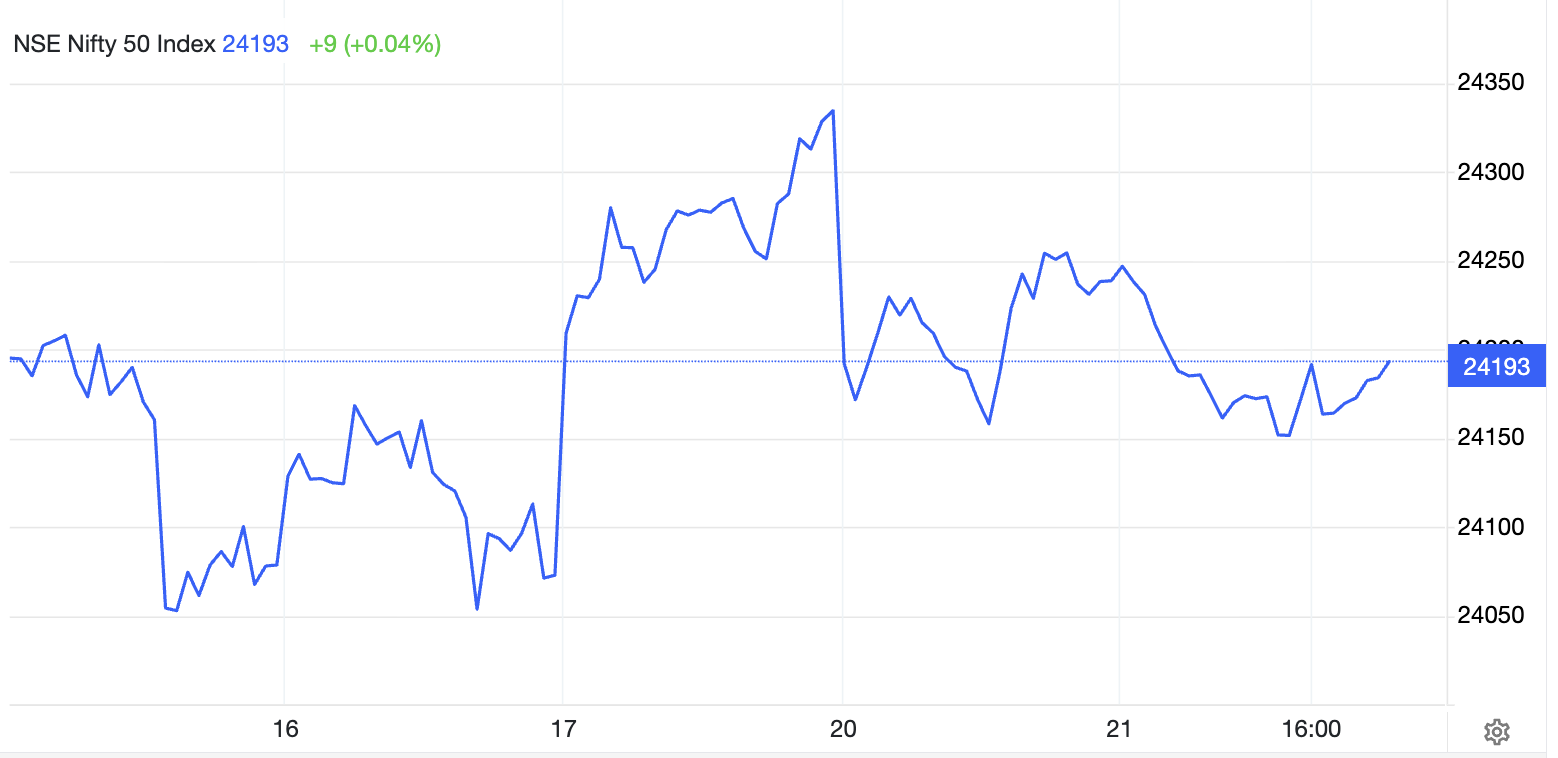
The Nifty 50 ended at 24,187.70 after a second consecutive decline, while the rupee firmed to around 96.24 per dollar as crude briefly eased. US-listed India ETFs face both local equity risk and currency translation.
The test is whether oil above $90 will deepen rupee pressure and foreign selling.
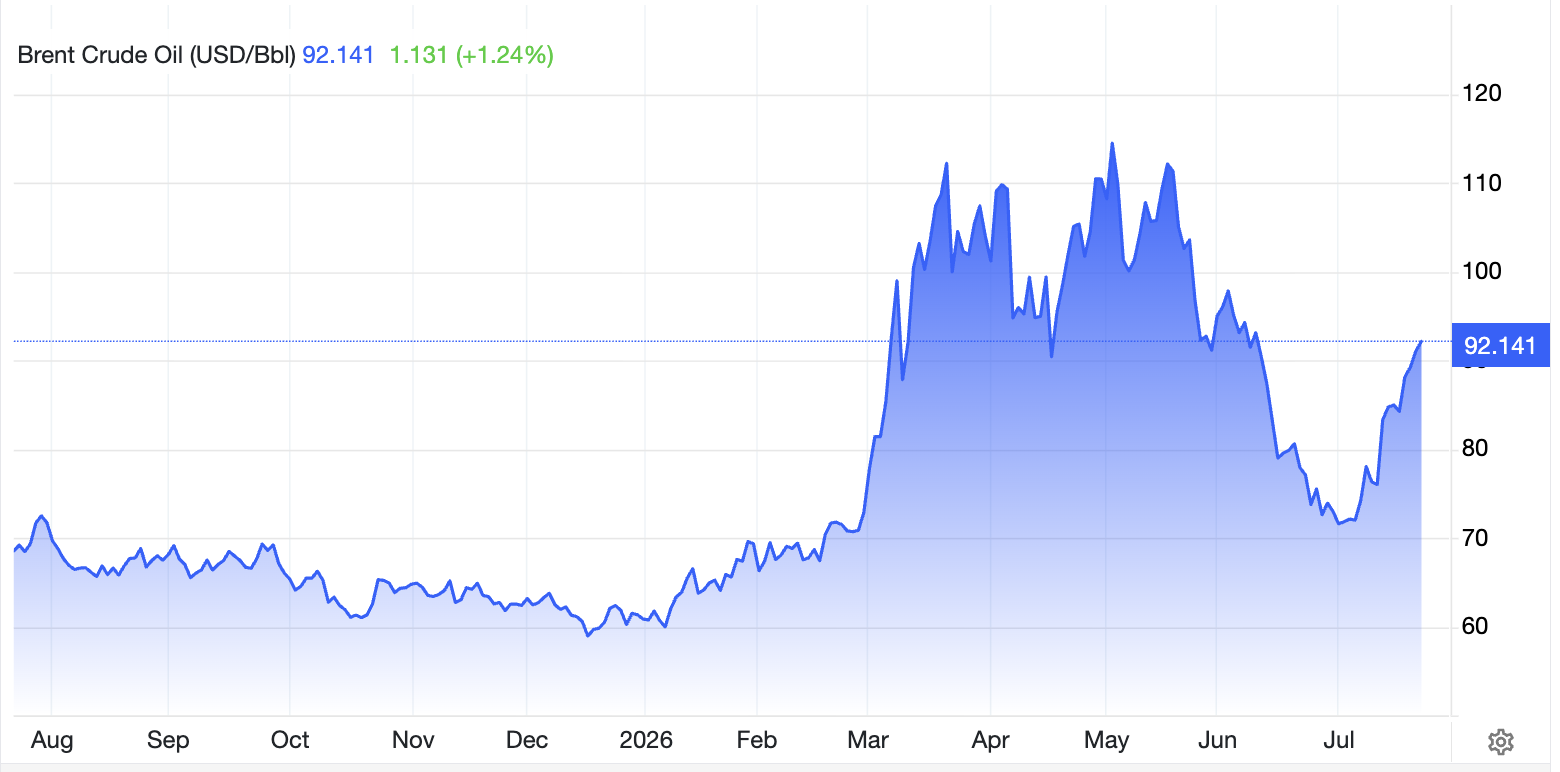
Brent settled at $91.01 on 21 July, its first close above $90 in more than a month, then rose to $91.51 early on 22 July as US strikes on Iran entered an 11th night.
The Nifty 50 closed at 24,187.70, extending its decline to a second session.
The rupee firmed to around 96.24 per dollar as crude temporarily eased.
India’s finance minister linked rupee pressure to higher crude prices and reduced capital-account support.
INDA, INDY and EPI posted small positive NAV gains on 21 July, showing the initial response was mixed.
The relationship between India ETFs and oil prices has become more immediate because equities, the rupee and foreign flows are now reacting to the same geopolitical shock.
Brent’s first settlement above $90 in more than a month gave the move more weight than the prior session’s brief intraday break, and it extended into a second session: Brent added another 0.55%, or 50 cents, to $91.51 in early 22 July trade as US strikes on Iran entered an 11th night and Kuwait reported Iranian drone attacks. WTI rose 0.36% to $84.64.
Indian markets were already soft. The Nifty 50 fell 50.80 points, or 0.21%, to 24,187.70, with HDFC Bank down about 2% and Reliance Industries around 1.4%, both a major drag on the index.
The rupee strengthened to around 96.24 per dollar as crude retreated and inflows improved, a same-session reversal that showed sensitivity to both oil and capital flows.
Finance Minister Nirmala Sitharaman told Parliament on 21 July that recent depreciation reflected higher crude prices and weaker capital-account support, and cautioned that a softer currency raises import costs.
The chain runs from higher Brent to greater dollar demand for energy imports, then to rupee pressure and weaker dollar returns. US-listed India ETFs hold shares priced in rupees while their own units trade in dollars, so a weaker rupee cuts the translated value of those holdings even when the local index is flat.
For an unhedged fund, that is the most direct route from an oil headline to a dollar-based statement.
Higher oil also compresses margins across fuel-intensive sectors, with pricing power deciding how much each company can pass on. Persistent energy inflation can push out rate-cut expectations, weighing on the financials that dominate most India benchmarks.
Foreign flows amplify all of this: higher oil and a weaker currency can reduce India’s relative appeal against commodity-exporting markets that benefit from stronger energy prices, and overseas selling adds pressure when equity proceeds are converted back into dollars.
Foreign institutional investors bought about ₹15,559 crore of Indian equities in the first half of July, helped by improved valuations, easing US-Iran tensions, cooler crude and positioning near multi-year lows.
The flows since have been choppy: FIIs sold roughly ₹1,121 crore on 20 July, then returned as net buyers of ₹1,650 crore on 21 July, while domestic institutions turned net sellers of about ₹657 crore.
Even on a buying day, the currency translation overseas funds face is unaffected by who is on the other side of the trade.
The open question is whether July’s buying marks a durable reallocation or a tactical trade that relies on calmer geopolitics and contained oil. Positioning near multi-year lows leaves room to rebuild exposure, but the day-to-day swings show how quickly sentiment turns when the oil premium returns.
Sensitivity comes down to weighting. INDA tracks the MSCI India Index, roughly 85% of the investable universe, and carried about 31% in financials as of 20 July; FLIN, on the FTSE India RIC Capped Index, sat close behind near 30%.
Currency translation hits the whole rupee-denominated book, not just those sectors, but consumer and fuel-intensive names carry the added margin exposure while financials feel oil more indirectly, through inflation, rates and flows.
INDY’s Nifty 50 mandate pushes financials to about 37%, concentrating the same risk into its top banks. EPI’s earnings weighting lifts energy to about 16% of the book, against roughly 8% for INDA and 10% for INDY, so higher crude cuts both ways: upstream producers may benefit while refiners and industrial users face mixed effects and greater margin uncertainty.
The immediate reaction was mixed, not bearish. On 21 July, INDA’s NAV rose 0.73%, INDY gained 0.55% and EPI added 0.21%, even as the Nifty closed down 0.21%.
The divergence may reflect systematic fair-value adjustments, later foreign-exchange rates, different benchmarks and portfolio composition, since only INDY tracks the Nifty 50.
Oil begins the shock, but the rupee decides how much of it reaches a dollar-based return. If Indian equities fall 1% and the rupee weakens 1% against the dollar, an unhedged dollar-based fund would lose approximately 1.99% before fees, though tracking, valuation timing and fund-specific differences could alter the final result either way.
This is an illustration, not a forecast. A rupee recovery can soften a weak local session, and strong equity gains can outrun moderate depreciation. For a US-listed India ETF, USD/INR can provide a more direct indication of the currency effect than crude alone.
The $90 level is a monitoring threshold, not a mechanical sell signal. With Brent holding above it into a second session, the rupee and foreign flows are what determine how much of the pressure bites.
| Scenario | Oil and rupee signal | Likely India ETF implication |
|---|---|---|
| Bullish relief | Brent falls below $90 and the rupee stabilises | Currency pressure eases and foreign inflows may recover |
| Base case | Brent holds around $90 to $93 | Returns depend more on earnings and domestic buying |
| Bearish risk | Brent approaches $95 while the rupee weakens | Greater pressure on dollar returns, margins and foreign flows |
A stretch near $90 to $93 leaves the market weighing expensive energy against earnings and domestic demand. A move toward $95 with fresh rupee weakness would be more serious, because equities, currency and flows could deteriorate together.
The main signals are whether Brent holds above $90 across several sessions and how USD/INR behaves near recent highs, alongside daily institutional flow data and Q1 FY2027 earnings commentary on fuel, freight and raw-material costs.
For the Nifty 50, market analysts place immediate resistance around 24,300 to 24,400, with support near 24,100 and a break potentially exposing 24,000. Developments affecting Gulf oil shipments through the Strait of Hormuz remain a major external catalyst.
Brent’s return above $90 has created a credible test for India ETFs, arriving while the rupee sits near recent lows, the Nifty has declined for two sessions and foreign flows have stayed volatile, with FIIs turning net buyers on 21 July after four sessions of selling.
The decisive signal will come from currency and capital flows, not the oil price alone. A stable rupee and steady inflows could contain the shock, while sustained crude near $95 and weaker foreign demand could develop into a broader valuation problem for dollar-based India exposure.