Published on: 2026-03-26
Updated on: 2026-03-26
Volatility skew is an essential concept for options traders and financial market participants. While many investors focus primarily on price movements, understanding volatility skew provides deeper insight into market sentiment, risk management, and pricing anomalies in options markets.
At its core, volatility skew refers to the difference in implied volatility among options with the same underlying asset but different strike prices or expirations. It reveals how traders are pricing risk in relation to future price movements. Volatility skew has significant implications for risk strategists, institutional portfolio managers, and retail traders alike.
Volatility skew is the variation of implied volatility across options with different strike prices or expirations.
Traders use skew to gauge market sentiment and asymmetric price risk.
Volatility skew often reflects fear, uncertainty, and demand for downside protection.
Different markets, asset classes, and expirations display unique skew patterns.
Understanding volatility skew can enhance the accuracy of options pricing and risk management.
Volatility skew refers to the pattern in which implied volatility varies across options for the same underlying asset.
In the Black‑Scholes model, implied volatility is assumed to be constant across all strike prices and expirations. In reality, the market frequently prices certain options with higher implied volatility due to demand imbalances and uncertainty.
Rather than calculating a single implied volatility for an entire options chain, traders observe that implied volatility varies with strike price, time to expiration, and recent market activity.
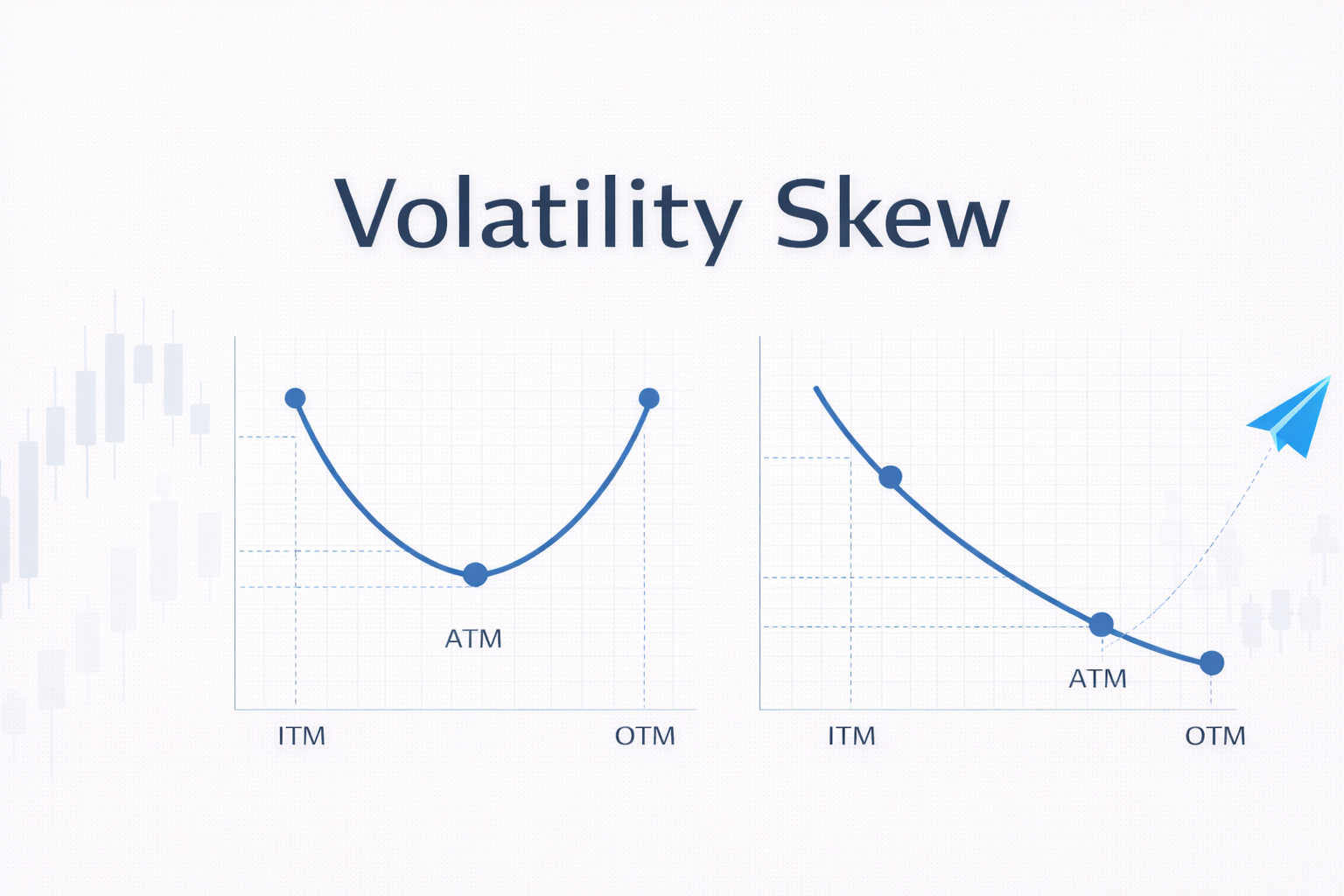
For example, in equity markets, out‑of‑the‑money (OTM) put options often exhibit higher implied volatility than at‑the‑money (ATM) or out‑of‑the‑money call options. This relationship creates the volatility skew.
Volatility skew arises for several reasons. Understanding the causes can help traders interpret skew patterns and make more informed decisions.
Market participants often seek downside protection, especially during periods of heightened uncertainty or anticipated market declines. This demand increases implied volatility for OTM put options relative to OTM calls, leading to negative skew.
Pessimistic sentiment typically increases demand for protective puts, while optimistic sentiment may increase demand for calls. This imbalance creates a skewed pattern of implied volatilities.
Market makers may charge higher implied volatility for certain strike prices where demand is strong and supply is limited. This can arise during earnings announcements, economic data releases, or geopolitical events.
Major shocks, such as sudden economic surprises, natural disasters, or geopolitical tensions, often prompt traders to bid up implied volatility for protective options, thereby steepening the skew.
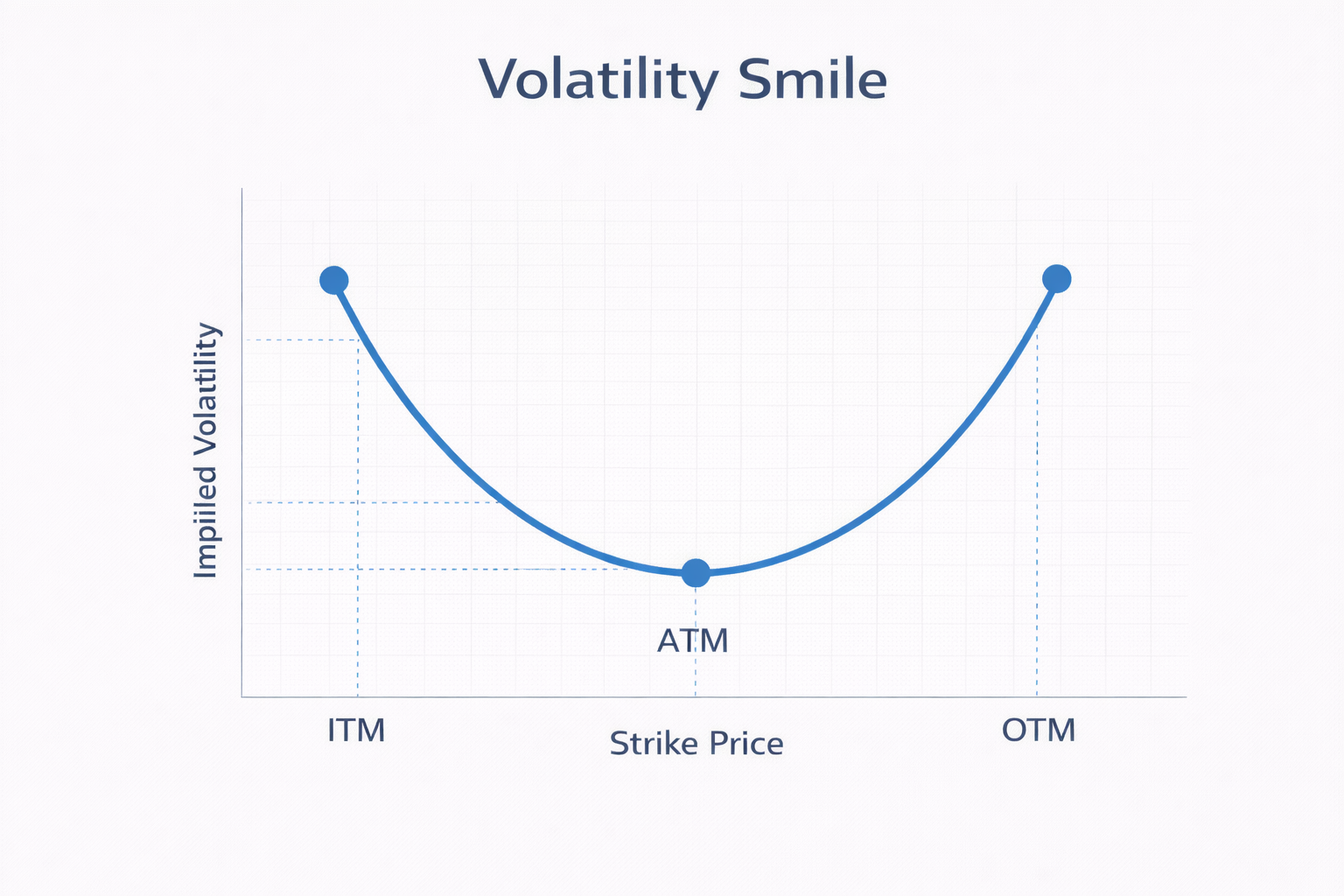
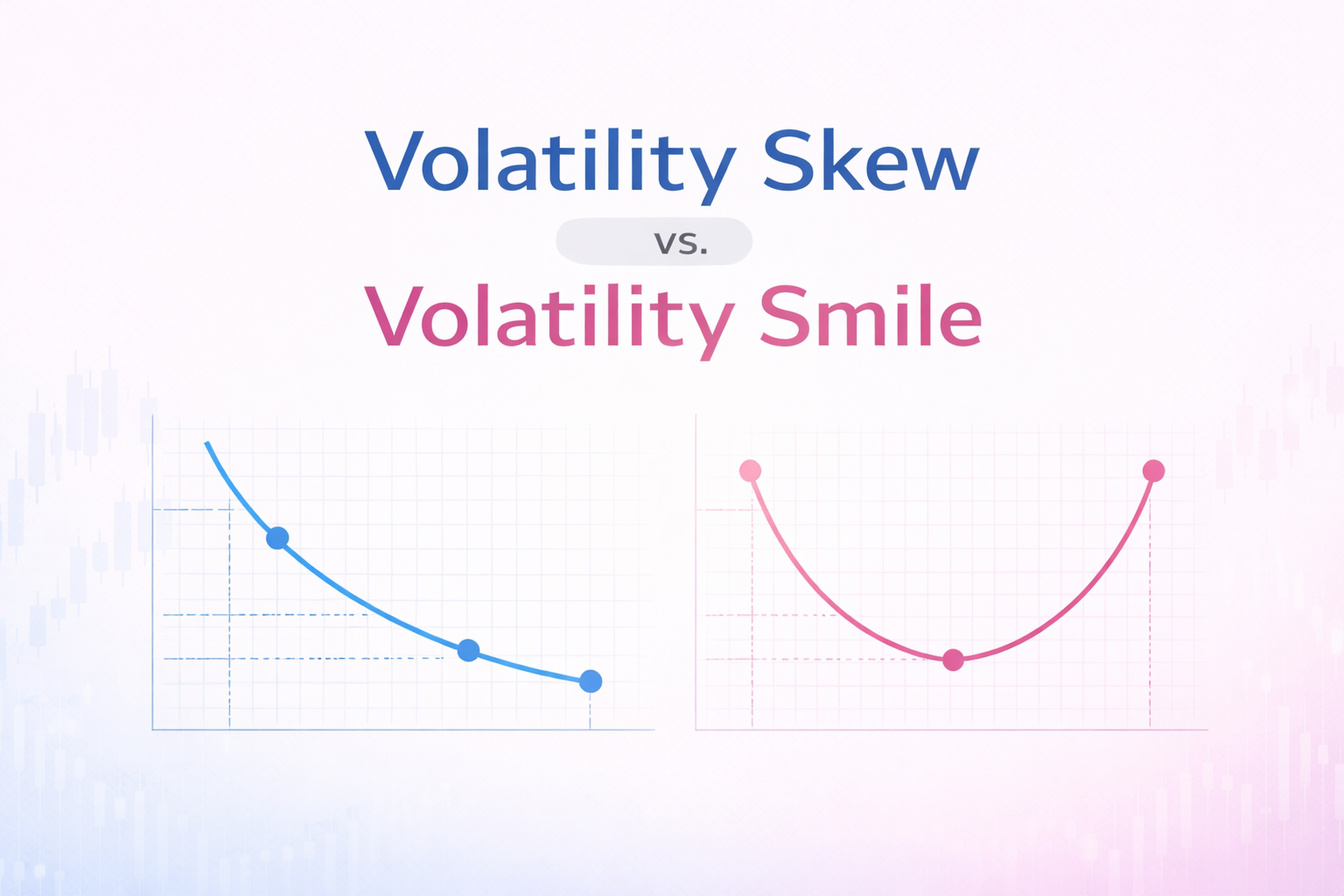
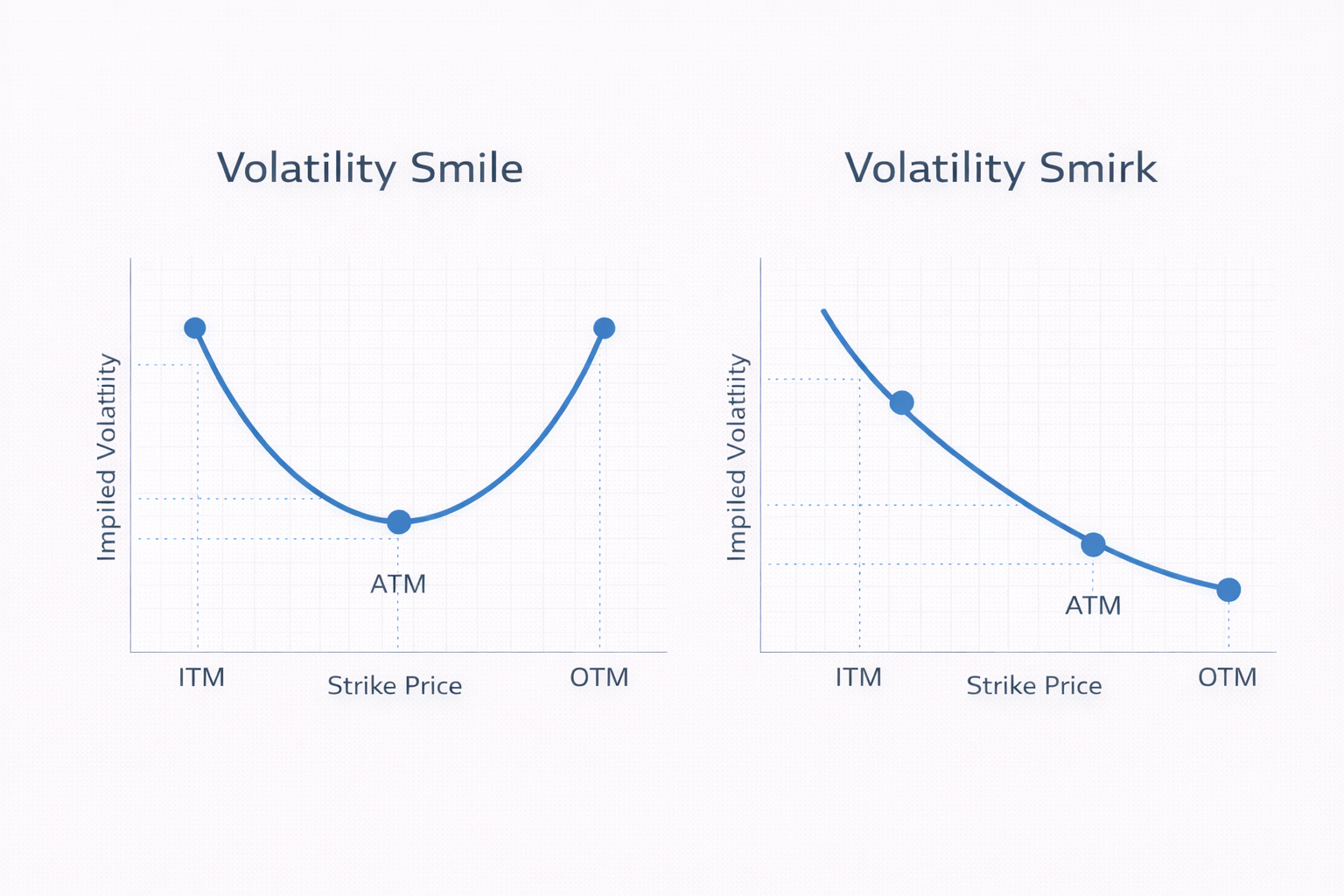
A volatility smile occurs when implied volatility is higher for both deep in‑the‑money and deep out‑of‑the‑money options relative to ATM options. This shape was historically more common in foreign exchange markets.
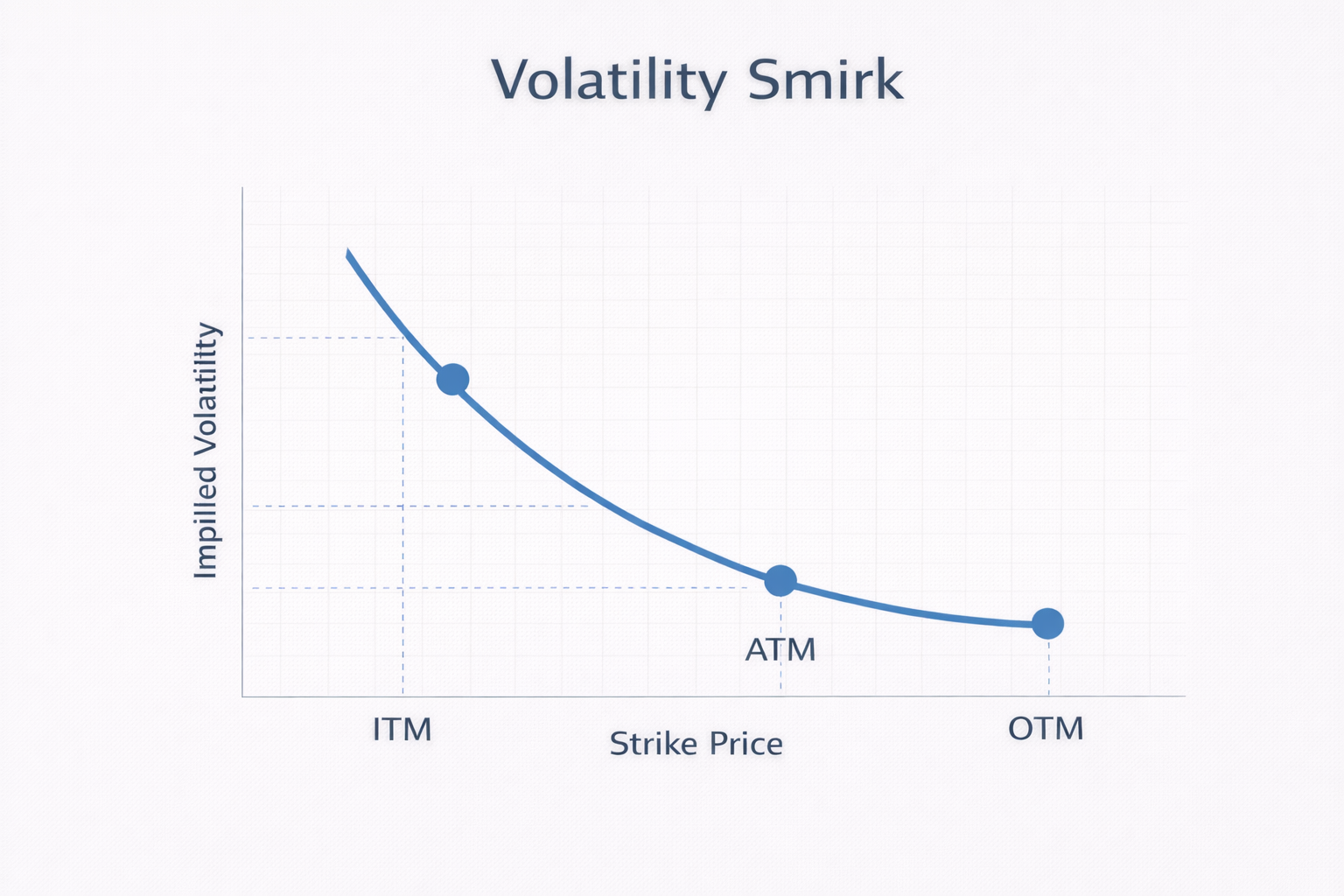
A volatility smirk is the most common pattern in equity markets. It occurs when implied volatility rises as strike prices fall, indicating that traders are pricing in greater downside risk than upside risk.
Term structure skew relates to how implied volatility varies not only by strike price but also by expiration date. For instance, short‑dated options may have very different implied volatilities than long‑dated options depending on upcoming events such as earnings, regulatory decisions, or macroeconomic data releases.
Volatility skew is more than a theoretical concept. It has direct applications in risk management, strategy design, and pricing.
Implied volatility is a key input in options pricing models. Traders adjust pricing based on skew rather than relying on a constant volatility assumption.
Correctly interpreting skew ensures that options are neither overpriced nor underpriced relative to market expectations.
Institutional investors and fund managers use skew to assess the cost of hedging. For example, high implied volatility on protective puts signals expensive downside insurance. Knowing this cost helps firms determine when and how to hedge equity exposure.
Certain options strategies, such as straddles, strangles, and butterflies, depend heavily on the shape of the skew. Traders may select one strategy over another based on skew patterns and the relative cost of premiums.
Volatility skew is also a powerful sentiment indicator. When implied volatility for downside options increases, it suggests that traders expect higher future market stress or a greater probability of negative price moves.
For example, ahead of major central bank announcements or employment data releases, skew patterns often widen as participants hedge against adverse outcomes. This can offer insight into market expectations that go beyond price trends alone.
In major equity indices such as the S&P 500, implied volatility for out‑of‑the‑money put options often remains elevated relative to that for call options. This reflects a persistent preference for protective downside hedges.
During market downturns, the skew steepens as traders rush to buy protective puts, increasing their implied volatility. Conversely, in stable or rising markets, skew may flatten as demand for downside protection subsides.
Volatility skew is not limited to stock options. It also appears in other markets:
Currency Options: Foreign exchange markets exhibit skews driven by global risk factors.
Commodity Options: Oil and agricultural commodities often show skew related to supply shocks and seasonality.
Interest Rate Options: Skew can arise from expectations of central bank policy.
Understanding skew across asset classes allows investors to better allocate risk and diversify portfolios.
Many traders believe that volatility skew contains predictive information about future market movements. While skew does not tell traders exactly how prices will move, it does indicate where risk is perceived to lie.
A steep skew is often interpreted as an elevated fear of downside risk, while a flat skew suggests more balanced expectations.
Options traders use various tools to analyse volatility skew, including:
Implied Volatility Charts
Skew Indices
Volatility Surfaces
Options Chain Analysis Software
These tools allow traders to visualise how implied volatility changes across strike prices and expiration dates, aiding in more precise pricing and strategy design.
Volatility skew shows how implied volatility varies across strike prices and expirations, revealing market expectations about risk and the asymmetry in potential price movements.
No, implied volatility refers to the market’s expectation of future volatility for a specific option, while volatility skew refers to differences in implied volatility across an option chain.
Equity markets often show a smirk because investors value downside protection more than upside speculation, leading to higher implied volatility for out-of-the-money put options.
Yes, volatility skew can be profitable for traders who correctly interpret the skew pattern and implement strategies that capitalise on pricing inefficiencies or sentiment shifts.
Yes, volatility skew affects all derivatives markets where implied volatility can vary by strike or expiration, including equities, commodities, currencies, and interest rate derivatives.
Volatility skew is a key concept in trading that describes how implied volatility varies across options with different strike prices or expiration dates. It reflects market sentiment, risk preferences, and pricing imbalances. Its relevance spans multiple asset classes and is essential knowledge for both professional and retail options traders.
Disclaimer: This material is for general information purposes only and is not intended as (and should not be considered to be) financial, investment or other advice on which reliance should be placed. No opinion given in the material constitutes a recommendation by EBC or the author that any particular investment, security, transaction or investment strategy is suitable for any specific person.