Published on: 2026-04-03
Updated on: 2026-04-03
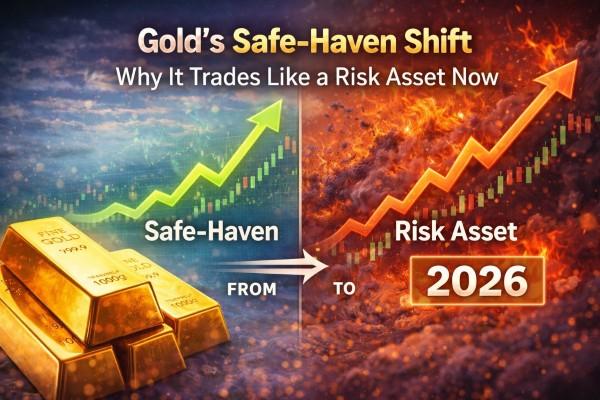
Gold is trading in a macro-beta regime, not a pure fear regime: from the late-January peak near $5,626 to around $4,650 to $4,700 this week, the price has behaved like a crowded liquid position being de-risked.
Rates remain a headwind. The 10-year Treasury yield is around 4.3%, and the 10-year real yield is around 2.0%, which keeps the carry disadvantage of bullion elevated.
The competing haven is still the US dollar. The WSJ Dollar Index has risen 2.4% since the Iran conflict began, which shows that stress capital is favoring dollar liquidity over bullion.
Structural support still exists. US-listed gold ETFs added 437 tonnes in 2025, lifting holdings to a record 2,019 tonnes and US$280 billion in AUM, supporting medium-term demand even as short-term positioning stays unstable.
Gold's investor base is far more financialized than in prior cycles. In 2025, global gold demand totaled 5,002.3 tonnes. Investment demand surged by 84% to reach 2,175.3 tonnes, and ETF inflows contributed an additional 801.2 tonnes year on year.

A traditional safe-haven rally needs falling real yields, a softer dollar, or both. The current backdrop has delivered neither consistently. Energy shock risk has pushed inflation anxiety back into the market, with WTI crude jumping to nearly $110 on April 2, while the Treasury curve repriced higher.
That combination matters because gold performs best when fear suppresses yields. It performs far less well when fear lifts oil, lifts inflation expectations, and keeps policy restrictive.
That is why gold has been trading more like a risk asset. In a funding squeeze, investors sell what is liquid and what still carries embedded gains. Gold now fits both categories.
The market is not rejecting bullion's long-run role in reserve diversification. It discounts the short-run cost of owning a non-yielding asset when the 10-year real interest rate is above 2%, and the dollar is receiving safe-haven flows.
The deeper reason for gold's shift in safe-haven behavior is market structure. According to the World Gold Council, total gold demand in 2025 exceeded 5,000 tonnes, while annual investment demand rose to a record 2,175.3 tonnes. That matters because a larger share of the market is now driven by portfolio flows, other than traditional defensive buying.
Notably, gold ETF demand increased by 801.2 tonnes. US-listed ETFs added 437 tonnes, pushing holdings to 2,019 tonnes. That is a larger, faster, and more portfolio-driven demand base than the one that defined earlier safe-haven cycles.
The strategic advantage of that shift is depth and institutional adoption. The drawback is that gold is now embedded in the same cross-asset plumbing as equities, credit, and rates. When macro funds cut gross exposure, gold can be sold alongside risk. That is why a metal that still enjoys central-bank accumulation and strong ETF sponsorship can nonetheless post equity-like drawdowns over short windows.
World Gold Council still expects another year of strong ETF inflows in 2026, but that is a quarterly support mechanism, not an intraday shock absorber.
| Timeframe | Gold/S&P 500 Correlation | Context |
|---|---|---|
| Long-run average since 1969 | +0.004 | Structural non-correlation |
| 12-month reading (early 2026) | +0.897 | Near long-run extreme |
| Top 1% of all 365-day readings | Yes | Rare regime event |
| 2008 financial crisis | Negative | Safe-haven mode |
| March 2020 pandemic shock | Briefly negative | Liquidity-crisis mode |
In the long-run series presented in the table above, the 12-month correlation between gold and the S&P 500 has averaged near zero at +0.004 since 1969. The early-2026 reading of +0.897 is therefore a regime event, not a normal state, and it sits in the top 1% of 365-day readings in this dataset.
The underlying explanation is as follows: In a market characterized by high liquidity and momentum, where the S&P 500 is nearing valuations seen during the dot-com era and gold is experiencing sustained structural demand over several years, both assets are affected by the same macroeconomic factors.
Rate cut expectations, dollar weakness, and global reflation narratives lift equities and gold simultaneously. When those narratives reverse, both sell off together.

The first condition is a cleaner bond signal. Gold's risk-adjusted potential improves materially if the 10-year real yield falls below the recent 2.0% area and nominal yields stop repricing higher.
The second is dollar fatigue. As long as the dollar remains the market's preferred liquidity shelter, bullion will struggle to regain its old crisis premium.
The third condition is macro data that weakens growth without reigniting inflation. On the Bureau of Labor Statistics calendar, the March employment report is due on April 3, and the March CPI report is due on April 10. A softer payroll report or lower inflation numbers would reduce rate pressure more quickly than a fear-driven market reaction.
A softer payrolls print or cooler inflation number would reduce rate pressure faster than any headline-driven fear bid.
| Institution | 2026 View | Key Catalyst |
|---|---|---|
| J.P. Morgan | $6,300/oz by end-2026 | Central-bank and investor demand, reserve diversification into gold |
| UBS Global Wealth Management | $6,200/oz for Mar, Jun, and Sep 2026; $5,900/oz by end-2026 | Investment demand, central-bank buying, diversification into real assets |
| Deutsche Bank | $6,000/oz in 2026 | Persistent investment demand and higher allocations to non-dollar and real assets. |
Yes. The correlation spike is a regime event, not a structural reversal. Five forces continue to define gold's medium-term outlook:
Central bank buying reaccelerated in Q3 2025 to about 220 tonnes of net purchases. That keeps official-sector demand structurally supportive, even if quarterly buying remains uneven.
Poland recently raised its gold reserve target from 550 to 700 metric tons. China's central bank extended gold purchases for 15 consecutive months through January 2026. Price-inelastic sovereign buyers place a structural floor beneath spot.
Gold's importance in official reserves is growing stronger. The European Central Bank reports that by the end of 2024, gold is expected to account for approximately 20% of total official reserves at market prices, positioning it as the second-largest global reserve asset, behind the US dollar.
That is a structural reserve-diversification story, not a short-term trade.
Gold ETF holders spent nearly four years redeeming shares after the 2020 recession, which released physical gold back into the market. That reversed in 2025, when global ETF holdings grew by 801.2 tonnes.
The World Gold Council also expects strong ETF inflows to continue in 2026, which keeps this support mechanism intact.
US stock/bond correlations soared to 30-year highs during the post-COVID inflation spike and Fed tightening cycle.
If those correlations remain historically elevated, gold's role as a portfolio diversifier and left-tail hedge becomes even more important as investors seek alternatives to traditional 60/40 portfolios.
Stretched US equity valuations amplify the asymmetry of gold's downside-protection role.
When risk assets are expensive, investors have a stronger reason to keep some exposure to assets that can diversify portfolio stress.
Because the current shock is lifting oil and preserving real-rate pressure rather than crushing yields, when inflation risk rises with conflict, the dollar and Treasury yields can outperform bullion as the market's preferred defensive channel.
Yes, but more selectively. Gold is gaining from reserve diversification, ETF demand, and medium-term geopolitical risks. It is less reliable now as an immediate crisis hedge when real yields and the dollar are rising simultaneously.
The near-term pivot is $4,650 to $4,700. A break below that zone could expose the late-March low near $4,376. On the upside, a reclaim of $4,813 would suggest the immediate liquidation phase is losing force.
Gold has not lost its strategic role. It has lost its automatic status as the first destination for fear capital. That is the essence of gold's safe-haven shift.
In a market defined by nominal Treasury yields around 4.3%, real yields around 2.0%, a firmer dollar, and a highly financialized investor base, bullion is trading as a liquid macro instrument first and a defensive store of value second.
A lower-yield, weaker-dollar environment would restore the traditional hierarchy. Until then, gold will continue to look less like a sanctuary and more like a position.
Disclaimer: This material is for general information purposes only and is not intended as (and should not be considered to be) financial, investment or other advice on which reliance should be placed. No opinion given in the material constitutes a recommendation by EBC or the author that any particular investment, security, transaction or investment strategy is suitable for any specific person.