The Dow Jones in 2026 remains one of the most powerful market signals in global finance, but its headline moves require more interpretation than the daily point change suggests. A 500-point swing still carries psychological force, yet the number itself does not always capture the true condition of the broader U.S. equity market.
That is important in a market shaped by artificial intelligence, industrial reshoring, elevated interest rates, geopolitical risk, and renewed small-cap participation.
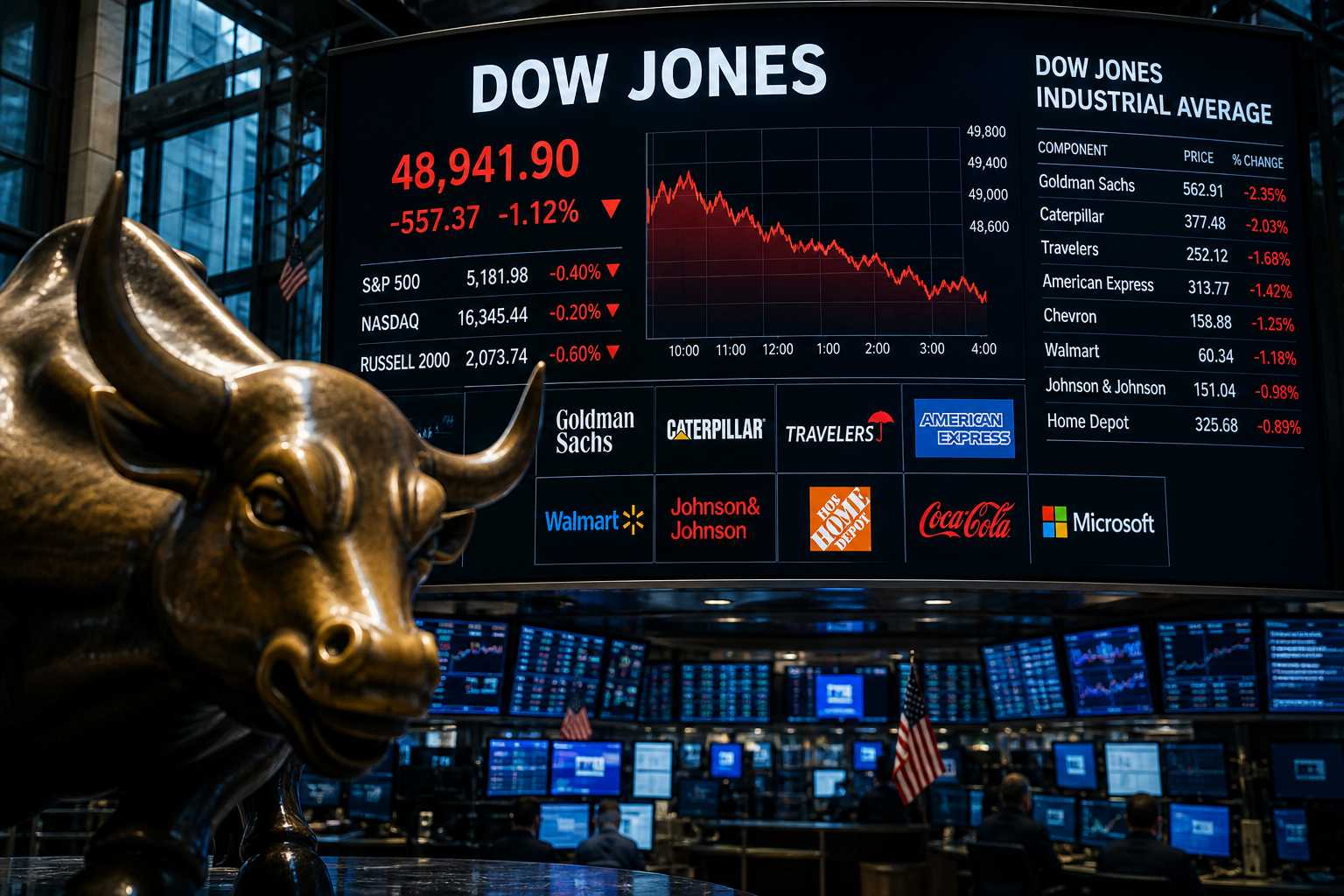
On May 4, 2026, the Dow Jones Industrial Average fell 557.37 points, or 1.1%, to 48,941.90. The S&P 500 declined 0.4%, the Nasdaq slipped 0.2%, and the Russell 2000 lost 0.6%. The Dow headline looked dramatic. The broader market signal was more selective.
The Dow Jones Industrial Average is a 30-stock, price-weighted index, so high-priced shares can carry outsized influence over daily moves.
The S&P 500 is broader, with around 500 companies and roughly 80% coverage of available U.S. market capitalization.
A Dow point move can overstate or understate the broader market signal when component concentration dominates the session.
Goldman Sachs and Caterpillar held some of the largest Dow weights in early May 2026, giving financials and industrials substantial mechanical influence.
The Dow remains useful as a blue-chip barometer, but its message is strongest when confirmed by breadth, sector leadership, and broader benchmark alignment.
The Dow Jones Industrial Average was built for clarity. It compresses 30 established U.S. companies into one widely followed market number. That simplicity gives the index its influence, but it can also make the daily point move look more conclusive than it really is.
The main issue is methodology. The Dow is price-weighted, which means a company with a higher share price has more influence on the index than a company with a lower share price. This is different from the S&P 500, where company weight is based on float-adjusted market capitalization.
A large Dow move may reflect:
pressure in a few high-priced components;
weakness in one sector, such as financials or industrials;
a mechanical index effect rather than broad market stress;
or a genuine risk-off move if broader benchmarks confirm it.
A 500-point Dow decline should therefore not be treated as a full-market verdict on its own. If the S&P 500, Nasdaq, Russell 2000, and sector breadth are also weak, the signal is stronger. If they diverge, the move may say more about the Dow’s structure than the wider market.
The Dow remains useful as a blue-chip barometer. But in 2026, with market leadership split across AI, mega-cap technology, industrials, healthcare, financials, and small caps, its point move needs confirmation before it can be treated as a broad market signal.
The Dow and the S&P 500 are often quoted together, but they measure different versions of the U.S. stock market.
The Dow is a curated blue-chip index. It tracks 30 established companies selected for their economic relevance, reputation, and sector representation. Its value lies in showing how mature corporate America is performing across financials, industrials, healthcare, consumer stocks, technology, and other major areas of the economy.
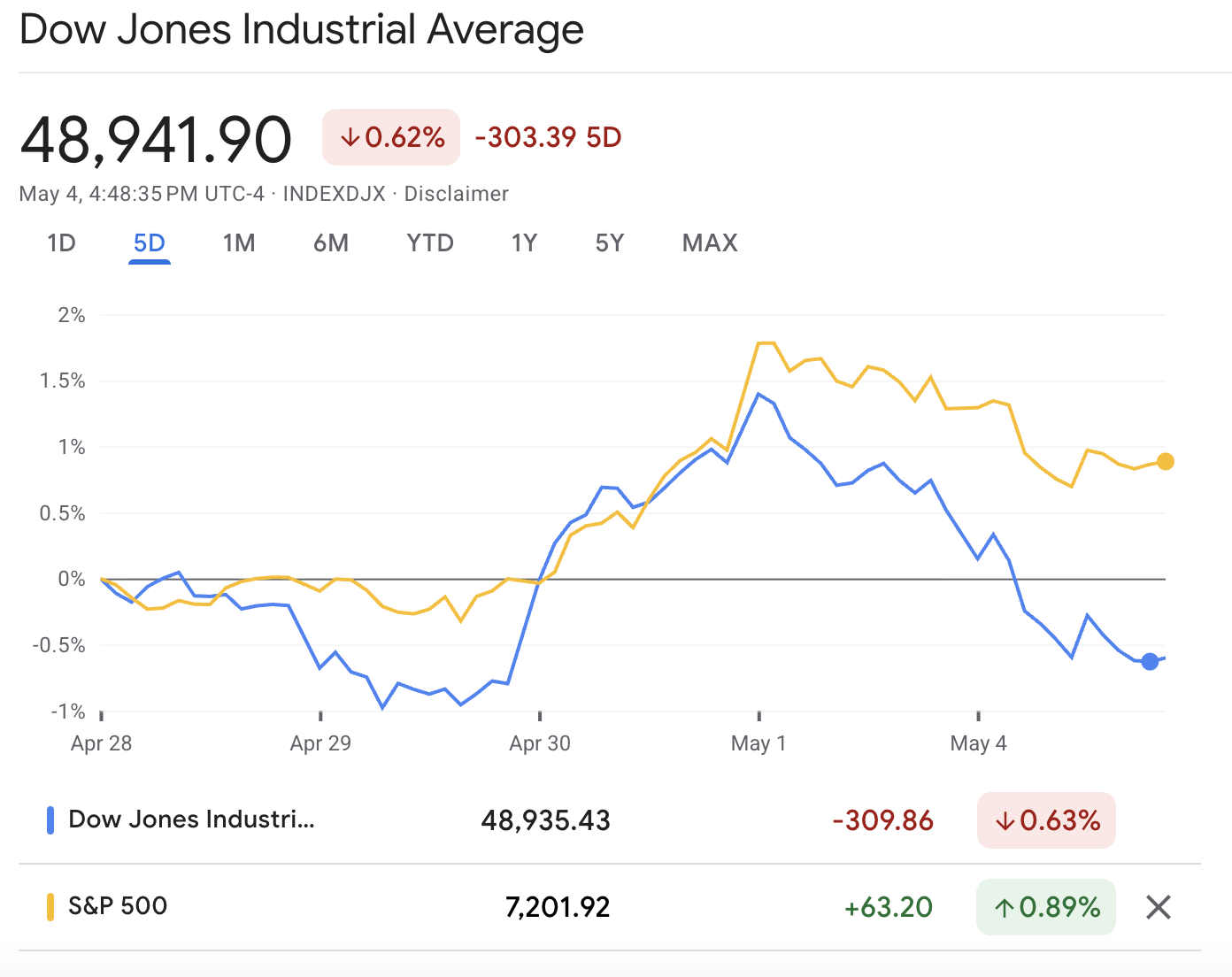
The S&P 500 is broader and more market-driven. It includes around 500 leading companies and covers roughly 80% of available U.S. market capitalization. Its weightings are based on company size, which makes it a more comprehensive gauge of large-cap U.S. equity performance.
| Feature | Dow Jones Industrial Average | S&P 500 |
|---|---|---|
| Number of companies | 30 | Around 500 |
| Weighting method | Price-weighted | Float-adjusted market-cap weighted |
| Core signal | Blue-chip performance | Broad U.S. large-cap performance |
| Sector scope | Broad, excluding transportation and utilities | Broad U.S. large-cap equities |
| Main analytical risk | High-priced stocks can dominate moves | Mega-cap concentration can dominate moves |
The weighting difference is not a technical footnote. It changes how each index should be interpreted. In the Dow, a $1 move in any component has the same point impact before adjustment through the Dow divisor. A high-priced stock can therefore carry greater mechanical influence than a lower-priced company with a larger market value.
That structure makes component-level attribution essential. A broad Dow decline across 25 or more components carries a stronger signal about blue-chip risk appetite. A decline driven by five high-priced stocks may reflect index mechanics, sector-specific pressure, or earnings weakness concentrated in a narrow part of the market.
The Dow captures an important slice of the market. The S&P 500 captures the wider large-cap structure. Treating both as identical signals can blur the real source of market movement.
The May 4 trading session showed why the Dow needs context. The index fell 1.1%, while the S&P 500 lost 0.4% and the Nasdaq slipped only 0.2%. The Dow headline pointed to a sharper sell-off, but the broader benchmark picture showed a more selective decline.
The year-to-date gap told a similar story. At that point in 2026, the Dow was up 1.8%, trailing the S&P 500’s 5.2%, the Nasdaq’s 7.9%, and the Russell 2000’s 12.7%. The divergence did not weaken the Dow’s relevance. It showed that market leadership was sitting elsewhere.
Each index carries a different signal:
Dow weakness may reflect pressure in financials, industrials, healthcare, or other blue-chip sectors.
Nasdaq resilience may point to continued support for technology and growth stocks.
S&P 500 outperformance may suggest broader large-cap strength.
Russell 2000 strength may signal improving appetite for domestic cyclicals and smaller companies.
The sharpest index move is not always the broadest market signal. In 2026, divergence across the Dow, S&P 500, Nasdaq, and Russell 2000 says more about leadership rotation than simple risk-on or risk-off sentiment.
Nvidia’s addition to the Dow in 2024 improved the index’s semiconductor exposure, while Sherwin-Williams strengthened its materials representation. The changes made the Dow more aligned with modern market leadership, especially as AI infrastructure, data centers, and industrial supply chains became central to U.S. equity performance.
But the methodology did not change. The Dow remained price-weighted, meaning Nvidia’s broader importance to global equities cannot be measured only by its Dow contribution. A high-priced financial or industrial stock can still exert greater mechanical influence on the index than a company with deeper thematic relevance to AI, cloud infrastructure, or long-term capital expenditure.
The Dow has evolved, but its legacy structure remains intact. Its composition is more modern. Its signal still requires context.
The Dow’s signal is strongest when four conditions align:
Breadth: most Dow components move in the same direction.
Confirmation: the S&P 500, Nasdaq, and Russell 2000 support the move.
Sector logic: the move aligns with identifiable macro, earnings, or policy drivers.
Component balance: no single high-priced stock dominates the point change.
This framework gives the Dow its proper role. It can reveal stress in mature, economically sensitive blue-chip companies. It can flag pressure in financial conditions, industrial demand, healthcare margins, or defensive sectors. It can also show when established U.S. companies are confirming a broader rally.
But the Dow works best as one signal inside a wider framework, not as a standalone verdict on U.S. equities.
Yes. The Dow remains a widely followed blue-chip equity indicator. Its value comes from history, visibility, and the quality of its constituents. Its limitation is structural: it tracks only 30 companies and uses price weighting.
The Dow is price-weighted, while the S&P 500 is market-cap weighted. A high-priced Dow stock can therefore have more influence than a larger company with a lower share price. This can create differences in daily performance.
Not always. A Dow decline needs confirmation from the S&P 500, Nasdaq, Russell 2000, sector breadth, and component performance. Without that confirmation, the move may reflect Dow-specific pressure rather than broad market weakness.
Its main limitation is representation. Thirty stocks cannot fully capture the U.S. equity market, especially when price weighting gives high-priced components outsized influence. The Dow is useful, but not a complete market proxy.
The Dow Jones in 2026 remains influential because it compresses a complex market into a familiar number. That strength is also its weakness. A single point move can attract attention while concealing the component concentration, sector rotation, and methodology effects beneath the surface.
The index still matters. It reflects a durable slice of U.S. corporate strength and continues to serve as a blue-chip barometer. But its signal needs context. In a market shaped by AI leadership, financial conditions, industrial cycles, geopolitical shocks, and small-cap rotation, the Dow’s message is strongest when confirmed by broader benchmarks and internal breadth.
The Dow should not be dismissed. It should be decoded.