Published on: 2026-06-23
The DuPont stock split will make DD trade roughly three times higher after June 24, but shareholders will not become richer from the split itself. Every three DD shares become one, with fractional shares paid in cash, while the ticker remains unchanged.
The real test begins on June 24: will investors see DD as a cleaner post-Qnity business, or focus on the fact that DuPont’s fastest-growing segment now trades elsewhere?
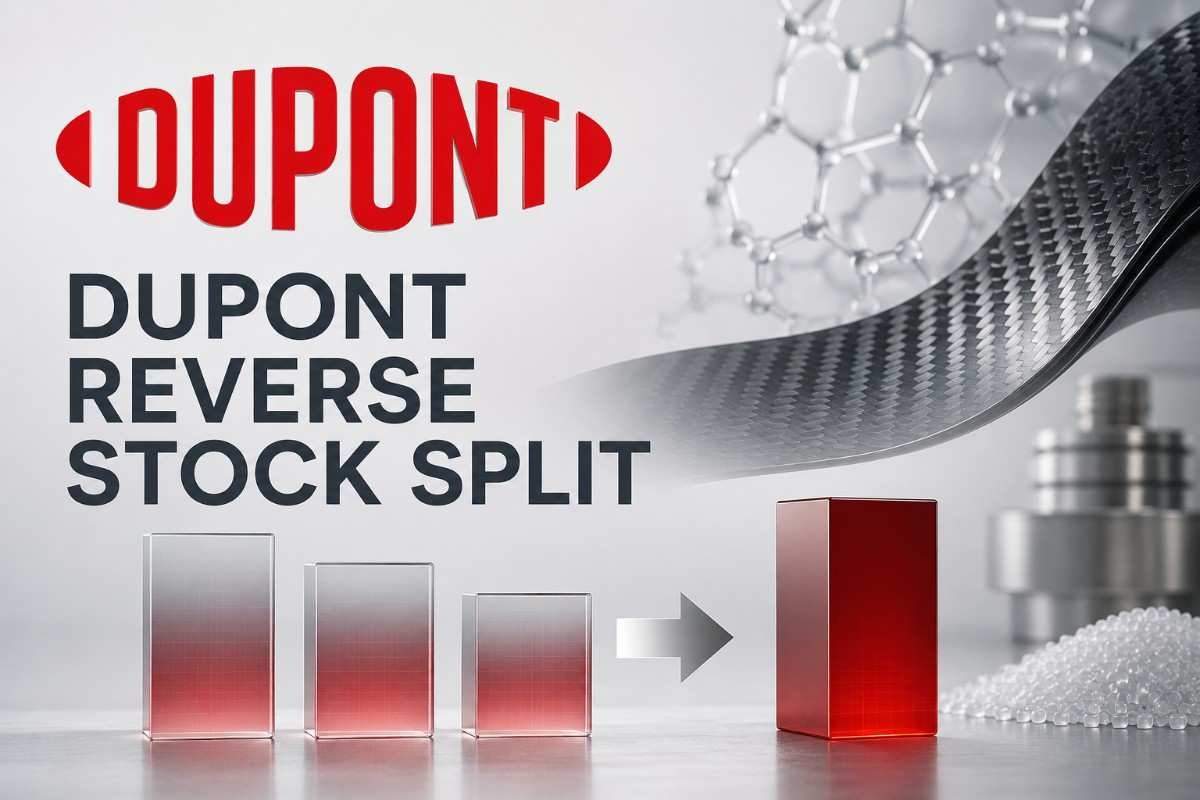
DuPont’s 1-for-3 reverse split takes effect at 12:01 a.m. ET on June 24, 2026, with DD expected to trade split-adjusted that day.
Every three DD shares become one, while fractional shares are paid in cash instead of being issued.
DD keeps its ticker, while the share count falls from about 405.1 million to 135.0 million, changing per-share optics rather than ownership economics.
The split follows the Qnity separation, making June 24 a test of whether investors accept DuPont’s cleaner post-spin profile.
The fastest way to read the split is to separate what changes on June 24 from what does not.
| Detail | Shareholder Impact |
|---|---|
| Ratio | 1-for-3 reverse stock split |
| Effective time | 12:01 a.m. ET, June 24, 2026 |
| First trading day | Split-adjusted DD trading expected June 24 |
| Ticker | DD stays the same |
| New CUSIP | 26614N 201 |
| Shares | Every 3 DD shares become 1 |
| Fractions | Paid in cash |
| Share count | About 405.1 million to about 135.0 million |
| Value | No automatic increase |
The final row is the key: the split changes the share math before it changes the market’s opinion.
No. The split changes DD’s share count and quoted price, not the value of a shareholder’s stake.
A holder of 300 DD shares before the split will own 100 DD shares after the split. DD most recently traded at $48.19 before the split adjustment, implying a theoretical post-split price of about $144.57 before normal market movement.
The split only changes the math. DD creates value after June 24 only if investors pay more for the same post-Qnity business.
Every three DD shares will automatically become one DD share when the reverse split takes effect at 12:01 a.m. ET on June 24, 2026. DD is expected to trade on a split-adjusted basis when the NYSE opens that day.
Most shareholders should see the adjustment handled automatically through their broker. The ticker remains DD, while the CUSIP changes to 26614N 201.
Fractional shares will be paid in cash. A holder with 10 DD shares, for example, would receive 3 whole shares after the split plus cash for the remaining one-third share.

DuPont chose a reverse split to reset DD’s per-share profile after the Qnity separation, not because the company is trying to create value through the split itself.
A normal stock split lowers the quoted share price after a strong rally. DuPont’s 1-for-3 reverse split does the opposite: it reduces the share count, lifts the quoted price and makes per-share figures look cleaner.
The risk sits in perception. Reverse splits often carry weak-stock stigma, so DuPont needs investors to see this as a post-Qnity reset rather than a cosmetic move.
DuPont is resetting DD after separating Qnity, the electronics business that gave the old company much of its growth profile.
Shareholders received one Qnity share for every two DuPont shares in the separation. Afterwards, DD became a smaller company centred on healthcare, water, construction and industrial materials.
The market comparison is hard to ignore. Qnity now trades separately under ticker Q, while DD is being repositioned with a smaller share count and higher quoted price.
Investors now have to decide whether the remaining DD warrants a stronger standalone valuation without the electronics business.
DD’s higher post-split price will come from arithmetic, not a sudden wave of buying.
That is why a move from roughly $48 to roughly $145 would not represent a sudden rally. It would reflect the 1-for-3 share consolidation.
A higher DD price may look dramatic on a trading screen, but the real signal will be whether investors assign a stronger valuation to the post-Qnity business.
The bull case starts with timing: DuPont is making the move while reaffirming its 2026 outlook.
DuPont reported $1.7 billion in first-quarter 2026 net sales, 2% organic sales growth, $414 million in operating EBITDA and $0.55 in adjusted EPS before the reverse split adjustment. Those numbers give management a cleaner argument than a weak company using a reverse split to repair optics.
The split also makes DD easier to compare on a per-share basis with higher-priced industrial peers. That only helps if investors believe the remaining DuPont can deliver steadier earnings and cash flow after Qnity.
Reverse splits make investors cautious because weak companies often use them after prolonged share-price declines. DuPont’s setup is different, but the stigma does not disappear just because the company frames the move as a post-Qnity reset.
The risk after June 24 is simple: a cleaner share structure will not matter unless DD proves that the remaining business can attract investor confidence without Qnity.
Yes. DuPont is conducting a 1-for-3 reverse stock split effective 12:01 a.m. ET on June 24, 2026. DD is expected to keep trading on the NYSE under the same ticker after the adjustment.
The split ratio is 1-for-3. Every three existing DD shares become one share, reducing the share count by roughly two-thirds and lifting the theoretical share price by about three times before market movement.
DuPont will not issue fractional shares. A shareholder with fewer than three shares, or a position that does not divide evenly by three, will receive cash for the fractional portion.
No. The split changes the share count and quoted price, not the value of the investment. Shareholders only gain or lose value if DD moves higher or lower after split-adjusted trading begins.
Not automatically. Reverse splits often make investors cautious, but DuPont’s move follows the Qnity separation and reaffirmed 2026 guidance. The risk is that investors still treat the move as cosmetic unless DD proves stronger post-spin earnings power.
DD’s first split-adjusted session will show whether investors treat the reverse split as a reset or a cosmetic change.
The higher share price alone means little. The stronger signal would be steady trading volume, renewed focus on post-Qnity earnings and a valuation that reflects DuPont’s reaffirmed 2026 outlook rather than reverse-split suspicion.
DuPont’s split changes the stock’s appearance overnight. The market will decide whether it changes the stock’s standing.