Published on: 2026-08-26
Updated on: 2026-08-26
Australia’s annual inflation rate fell to 3.5% in July from 3.8% in June. Economists had expected 3.3%. The decline is real, but it flatters the underlying picture.
Prices rose 1.0% during the month itself. Trimmed mean inflation held at 3.6% for a third consecutive month. Neither figure gives the Reserve Bank of Australia much room to relax.

The Board already weighed a 25 basis point increase in August. The July data keep that option alive. The September decision now sits between stubborn price pressure and a labour market that has started to bend.
Australia’s annual CPI eased to 3.5% in July from 3.8%, but the Reuters median forecast was 3.3%, so inflation ran hotter than expected.
The annual fall owes much to base effects, since July 2025’s 1.3% monthly jump dropped out while prices rose another 1.0% during July 2026.
Underlying inflation did not budge, with the trimmed mean steady at 3.6% and up 0.5% on the month, its sharpest monthly gain in a year.
August minutes show the Board debated tightening again before holding at 4.35%, with several members judging further increases quite possible.
September remains a two-sided decision, because unemployment has risen to 4.5% and earlier increases are still restraining housing and domestic demand.
The Australian Bureau of Statistics reported that the Consumer Price Index rose 3.5% in the 12 months to July 2026, down from 3.8% in the year to June. Housing was the largest contributor at 5.0%, then food and non-alcoholic beverages at 3.2% and recreation and culture at 2.6%.
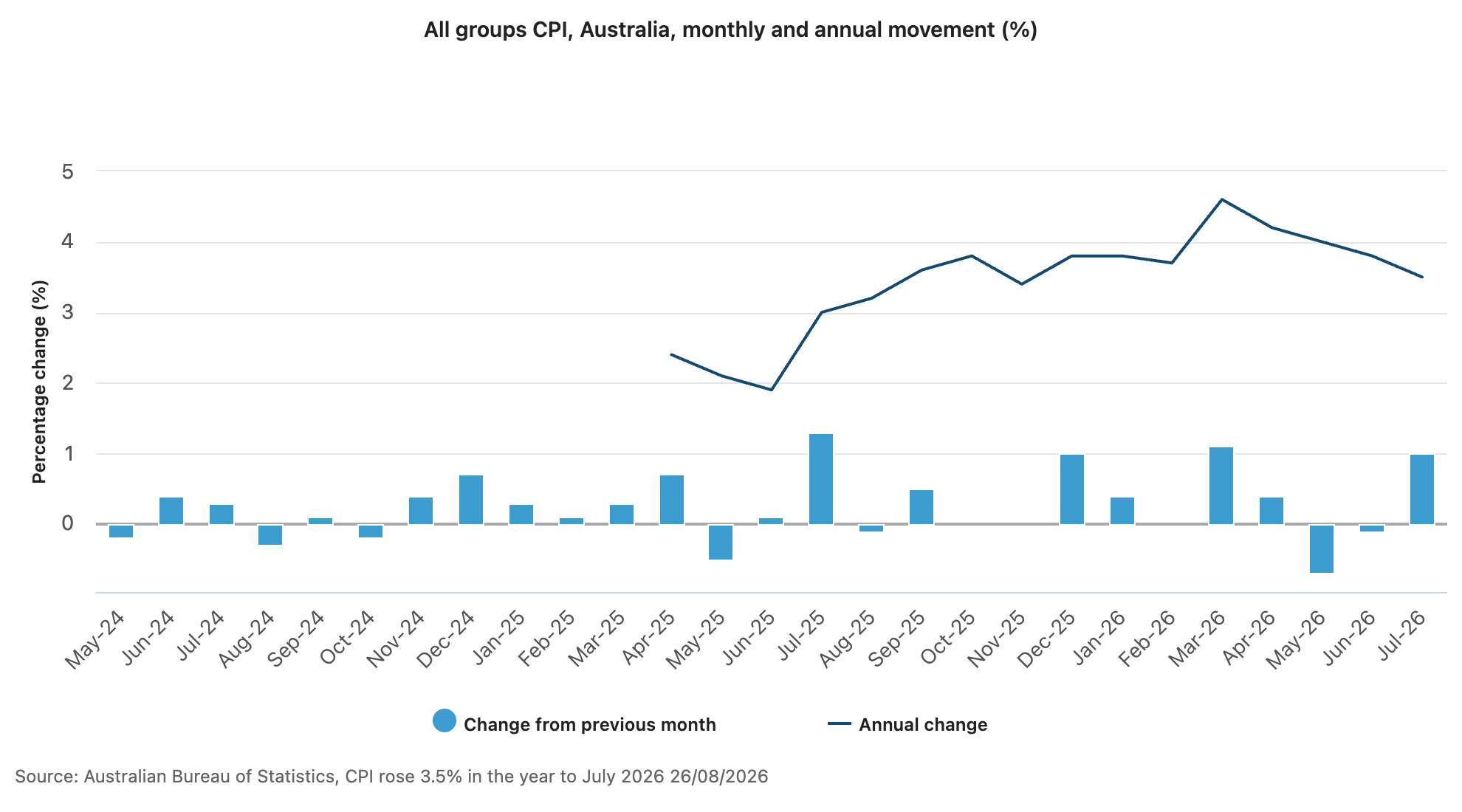
The median forecast in the Reuters survey of economists was 3.3%, so a print of 3.5% cleared it comfortably. Every headline and underlying measure released on the day came in above what markets had priced.
| Measure | July 2026 | Consensus | June 2026 |
|---|---|---|---|
| Headline CPI, annual | 3.5% | 3.3% | 3.8% |
| Headline CPI, monthly | +1.0% | +0.8% | -0.1% |
| Trimmed mean, annual | 3.6% | 3.5% | 3.6% |
| Trimmed mean, monthly | +0.5% | +0.3% | n/a |
In the month itself, CPI also rose 0.6% in seasonally adjusted terms. June had recorded a 0.1% fall on both measures.
The move from 3.8% to 3.5% is largely arithmetic. In July 2025, monthly CPI jumped 1.3%, one of the sharpest single-month increases of the cycle. That reading has now dropped out of the 12-month window and been replaced by July 2026’s 1.0%.
Annual inflation therefore fell by roughly the gap between those two months, even as the price level climbed sharply in the most recent one. Currency desks had flagged the base effect well ahead of the release, and attention moved quickly from the softer annual headline to the stronger monthly and underlying readings.
Australian prices did not go backwards in July. Only the rate of change did.
The trimmed mean sat at 3.6% over the year to July, unchanged from June and from May before it. On a monthly basis it climbed 0.5%, its largest monthly increase in a year and well clear of the 0.3% pace markets had pencilled in.
Since Australia moved to a complete monthly CPI, the RBA has kept placing particular weight on the established quarterly underlying measures while it assesses how the newer monthly series behaves, so the July trimmed mean is not the final word on anything. It is still the cleanest read currently available, and it points sideways rather than down.
Non-tradables inflation, the part of the basket least exposed to global prices, ran at 4.4% against 1.7% for tradables. Services inflation was 3.7%.
Fuel did most of the visible work in July. Automotive fuel prices jumped 7.5% during the month after three consecutive monthly falls, driven by higher world oil prices and the partial unwinding of federal fuel excise relief. Transport inflation lifted to 1.6% annually from 0.1% in June.
Strip the volatile components out, though, and the monthly increase still lands close to 0.9%. This is broader than a petrol spike.
Housing remains the single largest contributor at 5.0%. New dwelling prices rose 5.7% in annual terms, with the ABS pointing to builders passing on higher materials and labour costs. Meals out and takeaway lifted 4.5%, the main driver of food inflation.
Construction and hospitality are both labour-intensive, and the ABS has tied the dwelling figure directly to labour and materials costs. Sustained increases in categories like these fit the cost pass-through the RBA has been watching for, and are harder for policy to look through than a fuel spike.
The Board left the cash rate at 4.35% on 11 August, following increases in February, March and May that added 75 basis points. The decision was unanimous, but minutes published on 25 August showed the hold was a contest rather than a formality. Members explicitly weighed a pre-emptive 25 basis point increase against leaving policy where it was.
The case for moving rested on a prolonged Middle East conflict lifting oil prices, fuller pass-through of reported cost pressures into consumer prices, and a larger than expected boost to activity from artificial intelligence and data centre investment.
Several members judged it quite possible that upside inflation risks would materialise and require further tightening.
Members also noted they would have fresh readings on employment, inflation and the national accounts by the 28 and 29 September meeting, which is a fairly direct way of saying the meeting is live.
The counterweight is the labour market, and it has weakened.
Unemployment climbed to 4.5% in July, the highest since late 2021 and above the 4.4% expected. Employment fell by 15,800 after a revised 80,200 gain in June. The participation rate and the employment-to-population ratio each slipped 0.2 percentage points, to 66.9% and 63.9%. Hours worked declined 0.6%.
Wage growth is cooling alongside it. The Wage Price Index rose 0.8% in the June quarter and 3.2% over the year, down from 3.4% twelve months earlier. That takes some heat out of the second-round pressure the Board has been watching for.
The RBA itself describes financial conditions as somewhat restrictive, with the cash rate at the upper end of neutral estimates. Housing momentum has turned, new lending has fallen, and this year’s three increases have not yet worked fully through household budgets.
Cash rate futures priced roughly a 17% chance of a September move before the release. Within hours they had it at 36%, and a hike by February next year moved to about 94%. The Australian dollar rose 0.2% to 0.7176 against the US dollar, and three-year bond futures surrendered an earlier rally.
At least one major global bank switched its call to a September hike on the figures. That is a reassessment rather than a consensus: 36% still describes a market that expects the Board to wait.
The Board meets on 28 and 29 September with two significant readings still to come: June quarter national accounts on 2 September, and the August labour force survey in mid-September. The August CPI is not among them.
On the current schedule, it lands on 30 September, the day after the decision, so whatever the Board concludes about inflation, it concludes on the print delivered today.
That makes July the last inflation reading the Board will see, which loads a single monthly report with far more weight than it usually carries. A trimmed mean stuck at 3.6%, rising 0.5% in the month with non-tradables above 4%, is a poor argument for waiting. A weak GDP print and a second straight fall in employment would be a good one.
The Board is left choosing between two errors it would rather avoid: tightening into a slowdown already under way, or letting above-target inflation harden into expectations. July’s figures took neither risk off the table.
Mostly because of a base effect. Prices jumped 1.3% in July 2025, and that unusually large month dropped out of the annual calculation. Prices still rose 1.0% during July 2026, so the price level increased even as the annual rate declined.
It is possible but not expected. After the July CPI, cash rate futures moved to roughly a 36% chance of a hike at the 28 and 29 September meeting, from about 17% beforehand. The Board debated a 25 basis point increase in August and has said it will tighten again if upside inflation risks materialise.
The upside surprise supported it. AUD/USD rose 0.2% to about 0.7176 on the release as traders repriced the chance of further tightening. Australian rate expectations remain the dominant domestic driver, so the September decision and the data on the economic calendar before it are the levels to watch.